


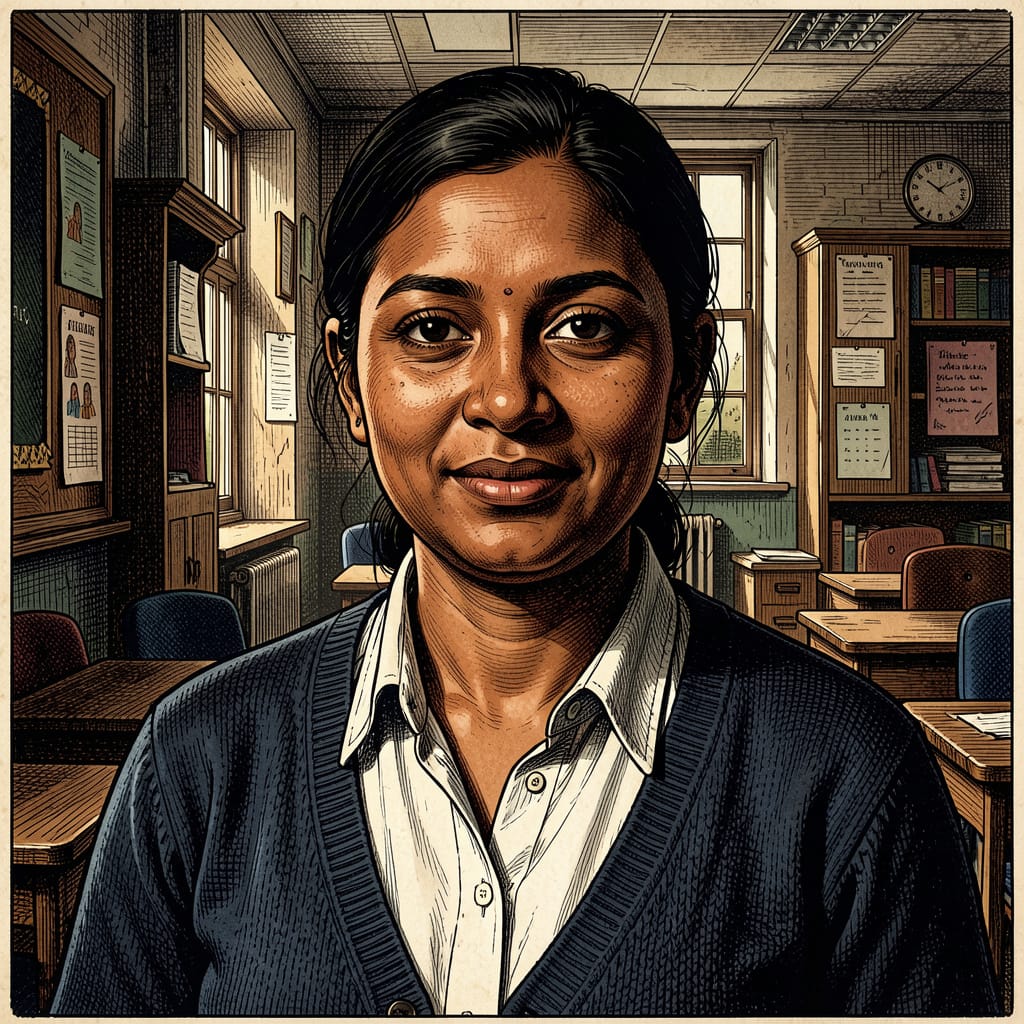
Anjali Patel

Anjali Patel — Stepping Stones Primary, Hope’s End

Character Profile
Stories Book of Thoth Saga (Vol. I)
Species Human
Status Active
Occupation Teacher, Stepping Stones Primary School (first-aid lead)
Affiliation Stepping Stones Primary staff; Hope’s End resident (originally Derby)
First Appearance Cambion, Chapter One: Quiet

Anjali Patel

“Andrews, fetch the nurse!”


Overview

Anjali Patel teaches at Stepping Stones Primary. She came to Hope’s End from Derby eight years before the events of Cambion, when she married, and has taught at the school for six of those eight years — the two she did not teach were the years her daughters were small enough to need her at home. She is one of the few people at Stepping Stones with first-aid training beyond the certificate the county requires; she renewed it voluntarily on a weekend course in Buxton last autumn. This becomes relevant at the bike shed.

On the playground she is sharp and precise. Her voice has a particular carrying quality at pace, and she uses it without ceremony when she needs to. When Mrs Jenkins calls her over — Andrews. Patel. Here. Now. — she drops to her knees beside Michael Lawson on the cold tarmac without hesitation, steadies his chin, asks him whether the tooth is loose and whether he can move it. She barks at Mr Andrews to fetch the nurse. None of this is flustered behaviour. This is a woman who knows exactly what she is doing in the first thirty seconds of a crisis and does it.

She teaches Michael Lawson’s class. This gives her a perspective on his behaviour that the playground documentation does not fully capture. She has seen him operating in an enclosed space with the same children, five days a week, for seven months. She knows what he is. She also knows what she can and cannot say in writing about a nine-year-old.

Beyond the Scene

Anjali lives in a stone-fronted terrace on the lane that runs down past the church, with her husband Vijay — a structural engineer who works out of Sheffield and complains about the commute — and their two daughters, Maya (age six) and Priya (age four). The house has too many books, not enough cupboards, and a kitchen that smells of cardamom every Sunday because she cooks for her parents-in-law when they visit, which is more often than is reasonable and less often than they would like. She teaches Year Four during the week, runs a Tuesday after-school club for children whose parents work late, and is the unofficial first port of call when one of the staff has a personal crisis they don’t want to take to Mrs Davison. She has handled three such crises in the last eighteen months. Margaret Jenkins’s was one. She has not mentioned this to anyone.

Her first-aid training is something she pursued the year after her father died of a stroke at the kitchen table in Derby and her mother spent eleven minutes trying to remember the number for the ambulance. The eleven minutes did not change the outcome. Anjali has read every paper she can find on whether they would have, and the answer is mostly no. She still keeps the certificate up to date. She walks into rooms looking for what is broken because the alternative is to walk into rooms not looking, and she cannot now imagine doing that.

She liked Robert Knight. She had not taught him; he was in Mrs Jenkins’s year group. But she had watched him in the dinner queue and on the field, and she had noticed that he was the only child in the school who flinched at the bell. Not at the sound. At the moment before the sound. She tested this twice in the autumn of his last term, accidentally on the first occasion and deliberately on the second, by watching his shoulders in the second before the bell rang. He flinched at the moment the headteacher’s finger touched the button in the corridor, two seconds before the actual sound reached the playground. Anjali never said this to anyone. She was not the kind of woman who said things she could not test, and after the bike shed there was no one in the school left to test it on. The observation has stayed with her. It has not got any easier to file.


Trivia

  • Mrs Patel is crossing the netball court with her attention on a cluster of Year Threes when the bike shed incident occurs — she is close enough to respond immediately and far enough away that she did not see how it started. This is significant. What she sees is the aftermath: Michael on the ground, blood, a crowd. What she does not see is the seven seconds before Michael went down. Her statement to Mrs Davison is accordingly incomplete — not because she is dishonest, but because she is a reliable witness to what she actually observed.
  • The Year Threes Mrs Patel was watching when the incident occurred were doing nothing wrong. She cannot now remember what they were doing. She has found this detail mildly unsettling for reasons she cannot entirely articulate.
  • The first-aid certificate she renewed in Buxton last autumn is pinned to the staffroom corkboard alongside two others — Mr Andrews’s, which is two years out of date, and the school’s, which expires in March. Anjali has reminded Mrs Davison about both. She has not yet been listened to about either.
  • She is friends with Margaret Jenkins in the way that staffroom friendships work in small village schools — not socially, not outside hours, but reliably and without effort. They share a flask between them at break and have for four years. The flask is Margaret’s. The tea is Anjali’s. Neither of them remembers when this arrangement began.

Appearances

Title Role Notes
Cambion
Book One · Book of Thoth Saga
First Aider; Playground Witness Crosses the netball court at the moment of the bike shed incident in Chapter One: Quiet. Called over by Mrs Jenkins alongside Mr Andrews. Attends to Michael Lawson, directs Andrews to fetch the nurse. Her testimony to Mrs Davison covers only what she directly observed.