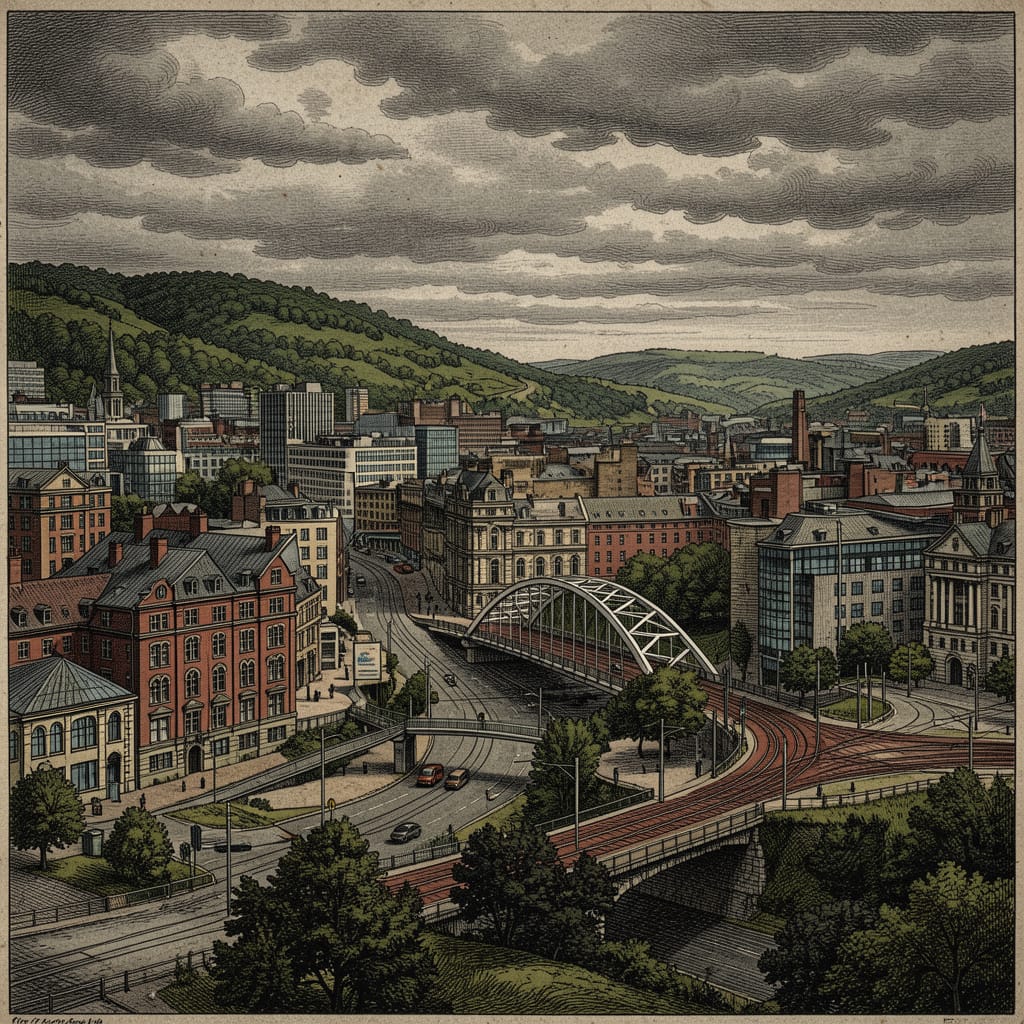
Sheffield's origins lie in two small Anglo-Saxon settlements: Sheaf-field (the open field by the River Sheaf, recorded in Domesday 1086 as Scafeld) and Hallam (the higher ground to the west). The two settlements were merged under Norman administration into the lordship of Hallamshire, with a small castle on the spur above the confluence of the Sheaf and the Don. Sheffield Castle, built around 1270, was the principal residence of the de Furnival family and subsequently of the earls of Shrewsbury; it was one of the prisons of Mary, Queen of Scots, who was held in Sheffield for fourteen years between 1570 and 1584 under the custody of the sixth Earl of Shrewsbury, husband of Bess of Hardwick. The castle was demolished in the Civil War after a Parliamentary siege in 1644.
The town's reputation for metalwork is documented from the fourteenth century. Geoffrey Chaucer, in The Canterbury Tales (c. 1387), gives the Reeve in his tale of the miller of Trumpington a Sheffeld thwitel — a Sheffield whittle, a small knife — in what is the earliest literary reference to the town's cutlery trade. The Company of Cutlers in Hallamshire, the trade guild governing the local cutlery industry, was incorporated by Act of Parliament in 1624 and remains in operation today; the Cutlers' Hall on Church Street is among the city's principal eighteenth-century buildings.
Sheffield's transformation into a major industrial centre began in the mid-eighteenth century with two key inventions. In 1740, the Doncaster-born clockmaker Benjamin Huntsman, working in Handsworth on the outskirts of Sheffield, perfected the crucible steel process — the production of a uniform, high-quality cast steel by melting and refining blister steel in fireclay crucibles. The process gave Sheffield a near-monopoly on the production of high-grade steel in the late eighteenth and early nineteenth centuries. In c. 1742, the cutler Thomas Boulsover, working on Church Street, discovered the technique of fusing a thin sheet of silver to a copper ingot — Sheffield Plate — which allowed silver-finish wares to be produced at a fraction of the cost of sterling silver and became one of the city's defining export industries through the eighteenth and nineteenth centuries.
The nineteenth century saw Sheffield's growth from a town of around 60,000 people in 1801 to a city of over 380,000 by 1901. The Don Valley, running east from the city centre toward Rotherham, was filled with the long sheds and tall chimneys of the heavy steelworks: Cammell's, Vickers, John Brown's, Firth's, Hadfield's. These works produced the armaments of the British Empire and the rolling stock and steam locomotives of the world's expanding railway networks. The city's steel industries supplied a substantial share of the world's railway track during this period, with the demand from the Indian railway system alone running to many tens of thousands of tonnes per year.
The final great Sheffield steel innovation came in 1913, when Harry Brearley, working at the Brown Firth Research Laboratories in Sheffield, accidentally discovered stainless steel — a chromium-alloyed steel that did not rust — while investigating wear-resistant alloys for gun barrels. The discovery transformed the global cutlery industry and is the basis of the modern stainless-steel sector worldwide.
The decline of Sheffield's heavy industries, which had begun gradually after the First World War, accelerated through the second half of the twentieth century and reached crisis proportions in the early 1980s. The 1984–85 miners' strike, which centred on the South Yorkshire coalfield immediately adjoining the city, was particularly bitter; the closure of large parts of the steel industry over the same period eliminated, within a generation, the economic basis on which the modern city had been built. Sheffield's population fell from a 1951 peak of approximately 580,000 to under 530,000 by the early 1990s. The Don Valley was substantially cleared and redeveloped in the late 1980s and early 1990s for the 1991 World Student Games, an act of public-investment urban regeneration which produced major sports facilities (the Don Valley Stadium, the Sheffield Arena) and which the city was still managing the financial consequences of through the early 2000s.
The post-industrial city has been rebuilt around services, the public sector, advanced manufacturing and education. The University of Sheffield (chartered 1905) and Sheffield Hallam University (granted university status 1992) are jointly the largest employers in the modern city, with a combined student population of over 60,000. The cultural quarter around Devonshire Green, the music venues of the city centre, and the substantial creative and digital sector that has grown in the surrounding inner suburbs represent the more visible elements of the city's reorientation. By the period of the Book of Thoth Saga, in the mid-1990s, this reorientation is well under way; the older steel-and-coal Sheffield is still in living memory but no longer in fact.
Sheffield's identity as the Steel City is no longer industrially accurate but remains culturally definitive. The city's cutlery and silverware trades, descended directly from medieval guild traditions, are still represented by a small number of specialist surviving manufacturers, most operating from the historic Kelham Island quarter; Henderson's Relish, the locally-loved spiced sauce produced on Leavygreave Road since 1885, remains in business as Sheffield's longest-standing consumer brand. The Kelham Island Museum, on the site of an eighteenth-century water-powered grinding wheel, preserves the city's industrial heritage in working condition, including a full-size Bessemer converter and the operating River Don Engine, a 12,000-horsepower steam engine.
Sheffield's relationship with the Peak District is geographically and culturally unusually close. The boundary between the city and the National Park runs directly through the city's western suburbs — in places, a single road marks the transition from urban housing to open National Park country. The grit edges of the eastern Peak — Stanage, Burbage, Froggatt, Curbar — are within a fifteen-minute drive of the city centre; the moorland between Sheffield and the Hope Valley below has been the open-air playground of the city's working population since the nineteenth century, and remains so today. The A57 Snake Pass, the main trans-Pennine road from Sheffield to Manchester, climbs onto the Dark Peak moorland within fifteen minutes of leaving the city centre; the road is frequently closed in winter on account of snow and ice.
The 1932 Mass Trespass on Kinder Scout was, on its eastern flank, a Sheffield action: a smaller Sheffield contingent of trespassers ascended Kinder from Edale via Jacob's Ladder to meet the larger Manchester contingent climbing from Hayfield, in coordination across the two cities' rambling movements. The Sheffield ramblers' long history of moorland access campaigning, separate from the better-publicised Manchester action, was a major contributor to the eventual 1949 National Parks Act.