Roman occupation of the site began around AD 50 with a small auxiliary fort at Strutt's Park on the west bank of the river. About twenty years later the garrison moved across the river and established the larger and more durable fort and civilian settlement of Derventio at Little Chester (Chester Green), on the line of the Roman road known as Ryknild Street, running northwards from the south Midlands toward South Yorkshire. Derventio, named after the Celtic name of the river, supported a substantial pottery industry — eighteen kilns have been excavated on the site of the modern racecourse, alongside the workshops of metalworkers and other artisans. Two of the potters even left their names stamped on their work: Septuminus and Aesticus.
After the Roman withdrawal in the early fifth century, the area was settled by Anglo-Saxons. Derby formed part of the Kingdom of Mercia. A church dedicated to All Saints was founded on the site of the present Cathedral around 943 by King Edmund I; an earlier minster church on the site went back to the late seventh century. In 874, the Danes occupied the town, renaming it Djúra-bý, ‘deer settlement’, the name from which the modern Derby derives. Under Danish administration the town became one of the Five Boroughs of the Danelaw, alongside Nottingham, Lincoln, Leicester and Stamford, governed under a separate body of law from the surrounding Anglo-Saxon kingdoms. In July 917, the Mercian queen-regent Lady Aethelflaed, daughter of Alfred the Great, recaptured the town, restoring it to English rule. The town was recorded in the Domesday Book of 1086 as a borough of more than a hundred and forty burgesses.
The medieval town developed steadily as a market and ecclesiastical centre. It was granted a royal charter in 1204 by King John, mirroring the liberties granted in the same year to Chesterfield. Derby's medieval skyline was anchored by All Saints, by the parish church of St Werburgh's, and by St Mary's Bridge over the Derwent, which carried a fourteenth-century chantry chapel — one of only six such bridge chapels surviving in England. During the Civil War of 1642–1646, the town was garrisoned by Parliamentary forces under Sir John Gell of Hopton, appointed Governor of Derby in 1643, who used it as a forward base for engagements in Nottinghamshire, Staffordshire and Cheshire.
On 4 December 1745, the Jacobite army of Prince Charles Edward Stuart, having marched as far south from Edinburgh as Derby in their attempt to overthrow the House of Hanover, halted at the city. The decision to retreat from Derby and return to Scotland was the Jacobite Rising's strategic turning point. Charles lodged at Exeter House on Exeter Street; the wall panelling from the room in which the council was held survives, on display at Derby Central Library. An equestrian statue of the Prince stands on Cathedral Green.
The transformation of Derby into an industrial centre began at the start of the eighteenth century. George Sorocold, a local engineer, laid Derby's first piped water supply — the first such municipal scheme in any provincial English town — from the Derwent in 1692. In 1717–1721, Sorocold was the engineer (with the merchant John Lombe) on the construction of Lombe's Mill, the first water-powered silk-throwing mill in Britain and one of the earliest examples anywhere in the world of the mechanised, multi-storey factory. The mill, on an island in the Derwent at the centre of Derby, was the prototype for the eighteenth- and nineteenth-century Derwent Valley mills upstream — Strutt's mills at Belper, Arkwright's Cromford Mill, and the others now collectively designated as the Derwent Valley Mills World Heritage Site. The site of Lombe's Mill is now occupied by the Museum of Making, on the same footprint.
Through the nineteenth century, Derby developed into a major centre of railway engineering: the Midland Railway established its locomotive works at Derby in 1844, making the town one of the principal hubs of the British rail network. In 1908, Henry Royce and Charles Rolls chose Derby as the site of their car company's new factory, having been offered substantial inducements by the town corporation. Rolls-Royce Limited has manufactured aero engines at Derby continuously since the First World War, and its Civil Aerospace and Defence divisions remain headquartered in the city. The Toyota plant at Burnaston, a few miles south-west of the city, opened in 1992. The combined effect is to make modern Derby one of the principal centres of advanced engineering in the United Kingdom.
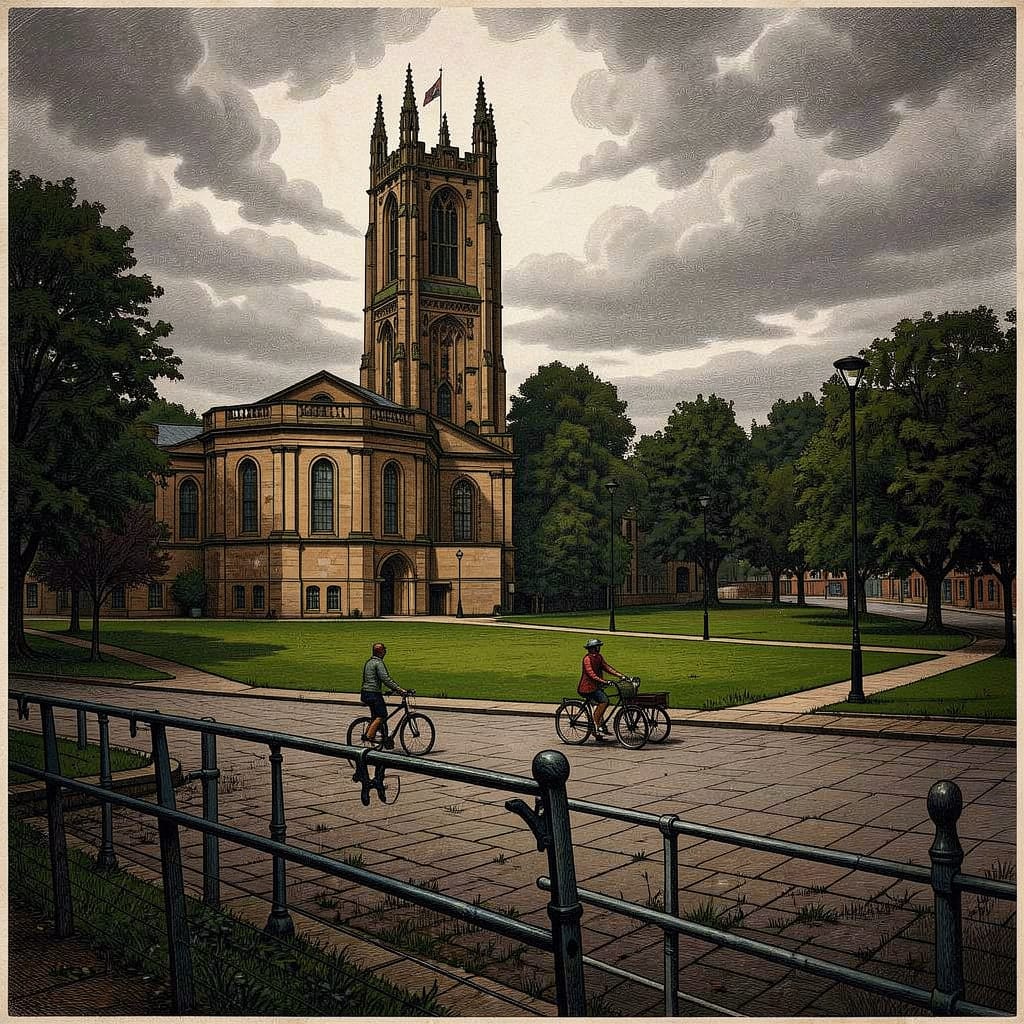
The Cathedral Church of All Saints stands on Iron Gate at the centre of the older city. Its origins go back to a royal collegiate church founded by King Edmund I of Wessex in 943, on the site of an earlier Saxon minster. The present building is essentially of two periods: the Perpendicular Gothic tower of 1510–1530, which survives from the medieval church, rises some two hundred and twelve feet above Iron Gate and is among the tallest perpendicular church towers in England; and the nave and chancel, completed by James Gibbs in 1725 in a restrained classical style after the medieval body of the church was demolished in 1723 as structurally unsafe. Gibbs's building is the surviving early-Georgian work of one of the most influential architects of the period (and the architect, in London, of St Martin-in-the-Fields). All Saints became Derby Cathedral upon the creation of the Diocese of Derby in 1927.
The interior is dominated by the great wrought-iron screen designed by the local craftsman Robert Bakewell (1719–1731), one of the finest pieces of decorative ironwork in England. To one side of the chancel stands the elaborate Renaissance-style monument to Bess of Hardwick, Countess of Shrewsbury, who in 1590 purchased a vault here for herself and her descendants. Bess died in 1608 and was buried in the vault beneath; the marble effigy above is attributed to the architect Robert Smythson. The Cavendish vault now contains over forty interments of the family, including Henry Cavendish the natural philosopher, several Earls and Dukes of Devonshire of Chatsworth, and Georgiana, the celebrated fifth Duchess of Devonshire. John Lombe, the silk-mill founder, is also buried at the Cathedral, as is the painter Joseph Wright of Derby (his headstone moved here from the Nottingham Road Cemetery in the late twentieth century).
A pair of peregrine falcons has nested on the Cathedral tower since 2006; their nest is observed by webcam from the city centre, and has produced young in most years.
Derby is one of a small number of European cities in which the foundational events of the Industrial Revolution are not interpretive overlay but documentary record. Lombe's Mill, completed on the Derwent in 1721, was, by most reckonings, the first true factory in Britain: a five-storey water-powered industrial building employing several hundred workers in continuous shift work, manufacturing a single product (Italian-grade thrown silk) by a sequence of mechanised processes operating off a single power source. The mill survived a serious fire in 1910, which destroyed everything except the bell-tower; the present building on the site is largely a 1910 reconstruction, now operating as the Museum of Making and forming the southernmost point of the Derwent Valley Mills World Heritage Site.
The mill's example was decisive. Within a generation, Derbyshire was the centre of the early British factory system: Jedediah Strutt's mills at Belper (1776 onwards), Sir Richard Arkwright's pioneering water-powered cotton-spinning mill at Cromford (1771), and the wider network of mills along the Derwent up to Matlock Bath. The whole length of the river from Derby to Matlock Bath — some fifteen miles of valley — was inscribed as a UNESCO World Heritage Site in 2001 in recognition of its standing as the cradle of the modern factory system.
The city's subsequent industrial life was dominated by railways and aero engines. The Midland Railway works (from 1844) made Derby a hub of the British rail network from the mid-nineteenth century onwards. Rolls-Royce's Derby factory, opened in 1908, has produced aero engines for almost every generation of British military and civilian aircraft since the First World War, including the Merlin engines used in the Spitfire and Hurricane and the modern Trent engines for the Boeing 787 and Airbus A350. The company remains the city's largest single employer.