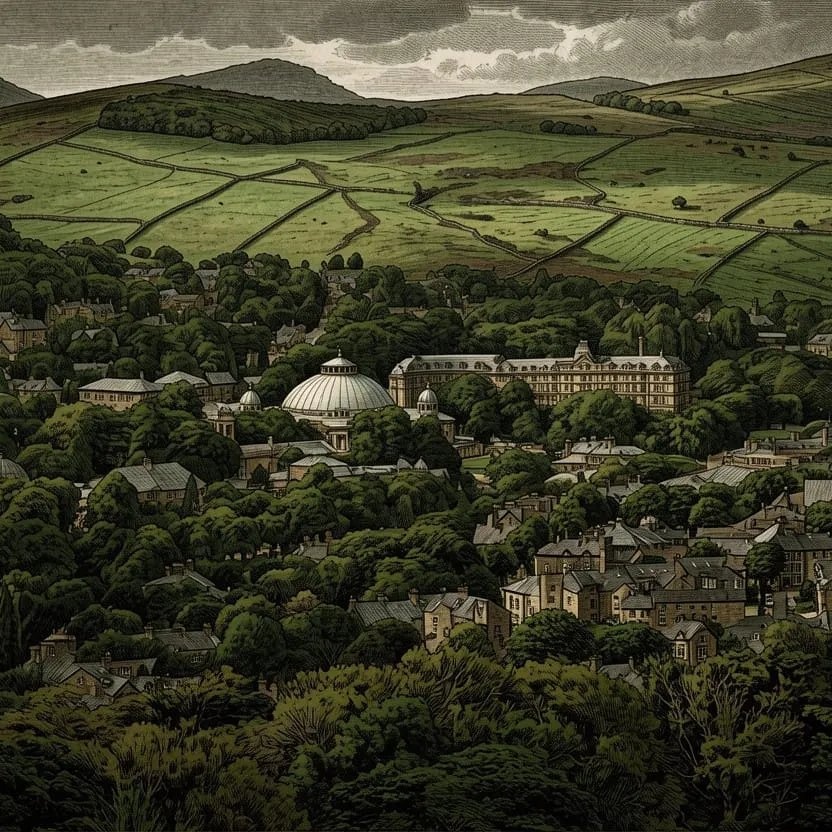
History
The springs at Buxton were almost certainly venerated long before the Roman invasion. The Romano-British goddess Arnemetia (also recorded as Arnomecta) takes her name from the Old Celtic are-nemeton, ‘by the sacred grove’, indicating a pre-existing Iron Age cult of the waters that the Romans absorbed rather than supplanted. Roman occupation of the site began around AD 75 and continued throughout the period of Roman Britain until c. AD 410. The Romans built a town and bath house, joined the place to their road network — chief among the routes the road still locally remembered as Batham Gate, the ‘road to the bath town’, running from Templebrough fort in South Yorkshire via Navio (Brough-on-Noe) to Aquae Arnemetiae — and left, in offering to the goddess, a quantity of votive coinage and bronze jewellery that has subsequently been recovered.
Some 232 Roman coins, spanning the entire period of Roman Britain (AD 41 to 400), were unearthed at the Natural Mineral Baths in 1978; they are now displayed at the Buxton Museum. The volume of votive material suggests a religious centre of more than purely local importance. The only classical reference to the town's Roman name is in the seventh-century Ravenna Cosmography, which records it as Aquis Arnemeza, between Navio and Ardotalia (Melandra) on the road north.
The town survived the end of Roman administration in some form. Its medieval history is sparse: the settlement is recorded as part of the Peverel family's estate in the twelfth century as Buckestones, came into the Duchy of Lancaster's Crown estate in 1153, and remained on the edge of the Royal Forest of the Peak through the late medieval period. By 1460 the principal warm spring had been dedicated as a holy well to St Anne, and a chapel had been built there by 1498. The waters were already acquiring a reputation for healing.
The pre-modern town that took shape around the well is most strongly associated with two figures. George Talbot, sixth Earl of Shrewsbury, built the Old Hall in 1550 over the principal spring, replacing an earlier structure on the site. The hall was used in the 1570s and 1580s by Mary, Queen of Scots, then in Talbot's custody, who was permitted to visit Buxton on several occasions to take the waters in the hope of relief from chronic rheumatism. On her final visit, in 1584, she scratched a Latin couplet onto a window pane farewelling the town; she never returned. By 1577, the relatively small settlement supported two inns and eight ale houses, an unusual concentration in a county that at that point had only eighteen inns in total.
The town we now recognise was largely the creation of William Cavendish, fifth Duke of Devonshire, in the late eighteenth century. Using profits from his copper mines at Ecton, the Duke commissioned John Carr of York to build a Crescent in the Doric style on the model of the Royal Crescent at Bath, completed between 1780 and 1789, with the explicit ambition that Buxton should challenge Bath as the leading spa resort of the country. The project did not, in the end, dethrone Bath, but it gave Buxton an architectural ensemble — the Crescent, the Pump Room, the Old Hall and (later) the Devonshire Royal Hospital — equivalent in ambition to anything outside London. The arrival of the railway in 1863 brought the resort within reach of the Manchester and Sheffield middle classes; the Pavilion Gardens were laid out in 1871; the Opera House, by Frank Matcham, opened in 1903.
The twentieth century saw the formal spa decline as the medical theory underpinning hydrotherapy fell out of fashion, then gradually return as a tourist destination. The Peak District National Park, the first National Park designated in the United Kingdom, was created around the town in 1951 with the Park boundary drawn deliberately to exclude Buxton itself. The Crescent, having stood empty for decades, was restored and reopened as a luxury hotel and thermal spa in 2020. Buxton today receives in the order of 1.3 million visitors a year and provides about 64 per cent of the bed-stock for tourism in the surrounding National Park.
The Springs & the Wells
The water that defines Buxton is not, strictly, hot. It emerges at a constant 27.5 °C; it is warm to the hand, never scalding. It rises from approximately a kilometre underground, at a rate of around a million litres per day, and tritium dating indicates a residence time underground of fifteen to twenty years before a given drop emerges at the surface. The taste is mildly mineralised — magnesium-rich, faintly sweet — and the water has been bottled commercially as Buxton Natural Mineral Water since the late twentieth century.
The principal historic well is St Ann's Well, at the top of the marketplace, dedicated to the saint by 1460 and credited through the medieval and early modern periods with the cure of rheumatism, dropsy, palsy, sciatica and a long miscellany of other complaints. The well was the focus of pilgrimage well into the Reformation and continued to draw a respectable trade in waters thereafter. The town's annual Well Dressing Festival, held in the week up to the second Saturday of July, has run in its present form since 1840; it descends, however, from a much older Peak District custom of dressing wells in thanksgiving for fresh water, traditionally believed to date to the Roman or pre-Roman period.
An octagonal stone temple to Arnemetia, identified from foundations excavated in 1787 by Major Hayman Rooke and from a gritstone altar found in 1903 in the strong room of Navio fort, once stood on the higher ground overlooking the springs — now beneath the landscaped slopes of The Slopes park. The altar inscription, addressed to Arnomecta, reads in translation: ‘To the goddess Arnomecta, Aelius Motio gladly, willingly, and deservedly fulfilled his vow.’ It is on display at the Buxton Museum.
Architecture & Landmarks
The Crescent is the architectural centre of Buxton: a Grade I listed Georgian building of 1780–1789, by John Carr of York, set in a graceful semi-circle facing The Slopes. Its Doric colonnade runs the full length of the curve. Designed to accommodate two hotels and an assembly room over the spring itself, it was modelled on John Wood the Younger's Royal Crescent at Bath but is, on close examination, a quite different building — smaller, more compact, more vertical — and the achievement is not lessened by the comparison.
The Devonshire Dome, originally built as a stable block for the fifth Duke of Devonshire in the late eighteenth century and converted to the Devonshire Royal Hospital in the mid-nineteenth, was roofed in the 1880s by a single iron-and-slate dome whose span (approximately forty-five metres) made it for many decades the largest unsupported dome in the world. It is still wider in span than the dome of St Paul's Cathedral in London. The building is now the Devonshire Campus of the University of Derby.
Buxton Opera House, designed by Frank Matcham and opened in 1903, is one of the most architecturally significant smaller theatres in England and remains in continuous theatrical use. It is the principal venue of the Buxton International Festival (operatic) and the Buxton Fringe each summer.
The Pavilion Gardens, laid out in 1871, occupy the riverside grounds between the Crescent and the upper town. The Old Hall Hotel, on the corner of the marketplace, occupies the site of George Talbot's 1550 Hall and is among the oldest hotels in England in continuous operation. The Church of St Anne, built in 1625, is the only surviving structure of the early seventeenth-century settlement.
On the southern edge of the town, Poole's Cavern — a natural limestone show-cave with over three hundred metres of chambers open to the public, containing Derbyshire's largest stalactite and a population of unique ‘poached-egg’ stalagmites — has been visited by humans since at least the Iron Age. Mary, Queen of Scots, who was a regular visitor to Buxton through the 1570s, made a tour of the cavern in 1582. The footpath from the cavern climbs to Solomon's Temple, a small Victorian folly on Grin Low which gives an extensive view over the town.
Role in the Saga — Cambion spoilers
Contains plot reveals from Book One.
Buxton functions in Cambion as a referenced rather than directly-set location: the saga's characters travel to it, talk about it and use its institutions, but no scene in the novel takes place there. Its appearances are concentrated in three operational threads.
Daniel Marsden's schooling and research. In the summer of 1998, with Daniel about to enter his final year at Stepping Stones Primary and the prospect of secondary school a year away, the question of whether Robert — in full-time home education at 13 Haversage Road since the manifestation incident of November 1995, and by then nearly three years out of mainstream schooling — might re-enter the school system at secondary level is briefly raised. Daniel mentions Buxton, the obvious secondary destination for Hope Valley children, to Robert as a clean slate — a new place where the schoolyard incident would not follow him. Robert immediately refuses, citing Ben: I heard them. Ben said it's too risky. The implication, never quite stated, is that Daniel himself proceeds to Buxton secondary the following autumn while Robert remains at home for the duration of the saga.
By the autumn term of 1999, when Daniel is conducting his own private investigation into what Robert is, Buxton Library has become his obvious first stop. He uses it twice in the term — once in the first week back, once the week before the events of Cambion's late chapters — before realising that the reference librarian, Mr Calloway, has begun to recognise his face. He stops going. He takes three buses to Marple Library instead, and conducts the rest of his research there.
The Buxton Library scene is therefore textually present chiefly as an absence: the library Daniel is not in. The reason is operational caution — the recognition pattern of an institutional librarian whose competence is, on the available reading, entirely innocent — and the response is the kind a twelve-year-old raised by Declan Marsden would have. Daniel has been taught, without quite being told he was being taught, that being noticed twice is a pattern.
Declan Marsden's pre-positioned key. Some two years before the events of Cambion's late chapters — that is, around 1997 — Declan had a key cut, in Buxton, from a local-authority maintenance depot original. He has carried it ever since. Late one night during the saga's endgame, he uses it to open a streetlight junction box on a corner of Hope's End and substitutes a previously-failed relay unit for the working one in the box, knowing that the consequent automated fault report will read as a routine component failure rather than as deliberate interference. The acquisition is unremarked in the moment; the use of it, two years later, is the point. Buxton, in this thread, is where one keeps preparation that ought not to be traceable to the place where it will be used.
The Buxton Co-op carrier bag. A discarded carrier bag from the Buxton Co-op is noted, in passing, as litter under the seat of the night bus on which Daniel is returning from Marple. The reference is incidental. It is recorded here because canon establishes that this is the bus he changes onto at New Mills (the 199), and because the saga's detail-attention to small civic objects has often turned out to be doing more work than first appears.
Trivia
- The 1978 discovery of the Buxton Coin Hoard — 232 Roman coins, spanning the period AD 41 to 400, recovered from the site of the Natural Mineral Baths — remains one of the largest and longest-spanning collections of votive offerings to a single Romano-British deity yet found in Britain. The coins are on permanent display in the ‘Wonders of the Peak’ gallery at Buxton Museum and Art Gallery.
- The Roman name for the town, Aquae Arnemetiae, is preserved on present-day Ordnance Survey maps alongside the modern name. It is one of the few Roman British place names whose Old Celtic etymology can be recovered with reasonable confidence: are-nemeton, ‘by the sacred grove’, retained in the goddess Arnemetia.
- Mary, Queen of Scots, on her final visit to Buxton in 1584, scratched a Latin couplet on a window pane farewelling the town. The window pane has not survived; the couplet has, in several variants, in the antiquarian records.
- The Devonshire Dome, roofed in the 1880s, covers a single unsupported span wider than the dome of St Paul's Cathedral in London. The building beneath it began life as a stable block for the fifth Duke of Devonshire in the late eighteenth century and was converted to a hospital in the mid-nineteenth; the present University of Derby Devonshire Campus now occupies it.
- Despite being the principal commercial centre of the surrounding region, Buxton is not within the Peak District National Park. The Park boundary, drawn in 1951, deliberately encircles but excludes the town — a small administrative anomaly created so that Buxton's commercial development would not be subject to Park planning controls.
- The well-dressing custom that flowers along Buxton's annual July festival is unique to the Peak District and immediately surrounding parts of Derbyshire and Staffordshire. It is generally held to descend from pre-Christian thanksgiving for fresh water; whether the descent runs unbroken or has been reconstructed at intervals is a question in folkloristics that has not been definitively settled.
Appearances
| Title |
Role |
Notes |
Cambion
Book One · Book of Thoth Saga |
Referenced; Operational Background |
First named in Chapter Twenty-Four: Carnaval de Paris, in Daniel Marsden's clean-slate remark to Robert Knight about secondary school. Buxton Library is referred to in Chapter Thirty-Eight: The Null Hypothesis, as the institution Daniel has just stopped using because Mr Calloway on the reference desk knows his face. The maintenance-depot key cut in Buxton some two years previously is used in Chapter Forty-Six. The town never appears as a directly-set scene. |