The Afar Triangle, Ethiopia
1996 Season
Chapter One
Passenger
“What we carry, we have always carried.”
Eliana’s room was on the third floor of the Damena, so the generator’s vibrations travelled through the soles of her feet as well as through the walls. The tremors reached her even before she put down her bag: a constant, offbeat hum that felt more like a property of the air than a sound, sometimes blending with her own internal hum.
Over recent years at field hotels, she had learned to recognise when a generator shifted from mere background noise to an obstacle that blocked her thoughts entirely, and this one hovered just below that line. It would let her sleep. What it would dampen was her sense of her own night.
Sitting on the edge of the bed, she looked at her boots. The brown leather was stiff and dark from sweat, with dust in all the seams. The toes were scuffed down to the hide. She placed them next to her duffel, with the laces doubled and the soles facing outwards.
The floor was terrazzo: poured stone, flecked grey, ochre, and a dull oxblood, cold through her socks, swept clean and waxed to a dead shine that held the bulb above it as a smear rather than a point. A single machine-made mat lay beside the bed, already travelling across the polished stone, one corner lifted where a foot had pushed it.
Thirty seconds inside the door and she could have drawn the room with her eyes shut, down to the bulb overhead. It gave a yellowish light that muted the white walls and flickered as the generator’s load fluctuated. The window was single-glazed, in a frame that did not quite close, and the cold of the highland night came in through the gap as a thin, steady draught she could feel from where she sat on the bed. The wardrobe was dark timber with its mirror gone cloudy at the edges, a piece from some better decade of the hotel, and the generator ran through it so that the glass gave off a fine, high shiver she felt in her teeth before she heard it.
She unpacked slowly. She was tired, with the flat boredom of a whole day spent in airports rather than any exhaustion of the body, and the unpacking gave her hands something to do besides the alternative.
The field notebooks were stacked on the desk, with a rubber band securing the newest one and the spine labels lined up. She unrolled the brush roll, inspected it thoroughly, and rolled it back without finding any faults. She placed the callipers parallel to the desk’s edge alongside the metric ruler, as if someone might later examine the precise geometry. Finally, she cleaned the trowel, checked the blade for nicks, found none, and set it on a folded hand towel she had taken from the bathroom.
The bedside telephone rang: a heavy, double ring unlike the generator’s hum. She hurried over before it could ring again and disturb whoever was in the room beyond the wall.
It was the front desk, a different voice from the one that had checked her in. The wake-up call, he said, speaking carefully in English. Half the lines were down due to the power cut, so she should not rely on the phone to wake her; someone would knock instead. Would 4:30 work, in case the car arrived early? She agreed, and before she could thank him, the line went dead.
She placed the receiver back and returned to the sample bags. She positioned them in the far corner of the desk, heavy, colour-coded zip locks.
When everything was in order, she stood by the window.
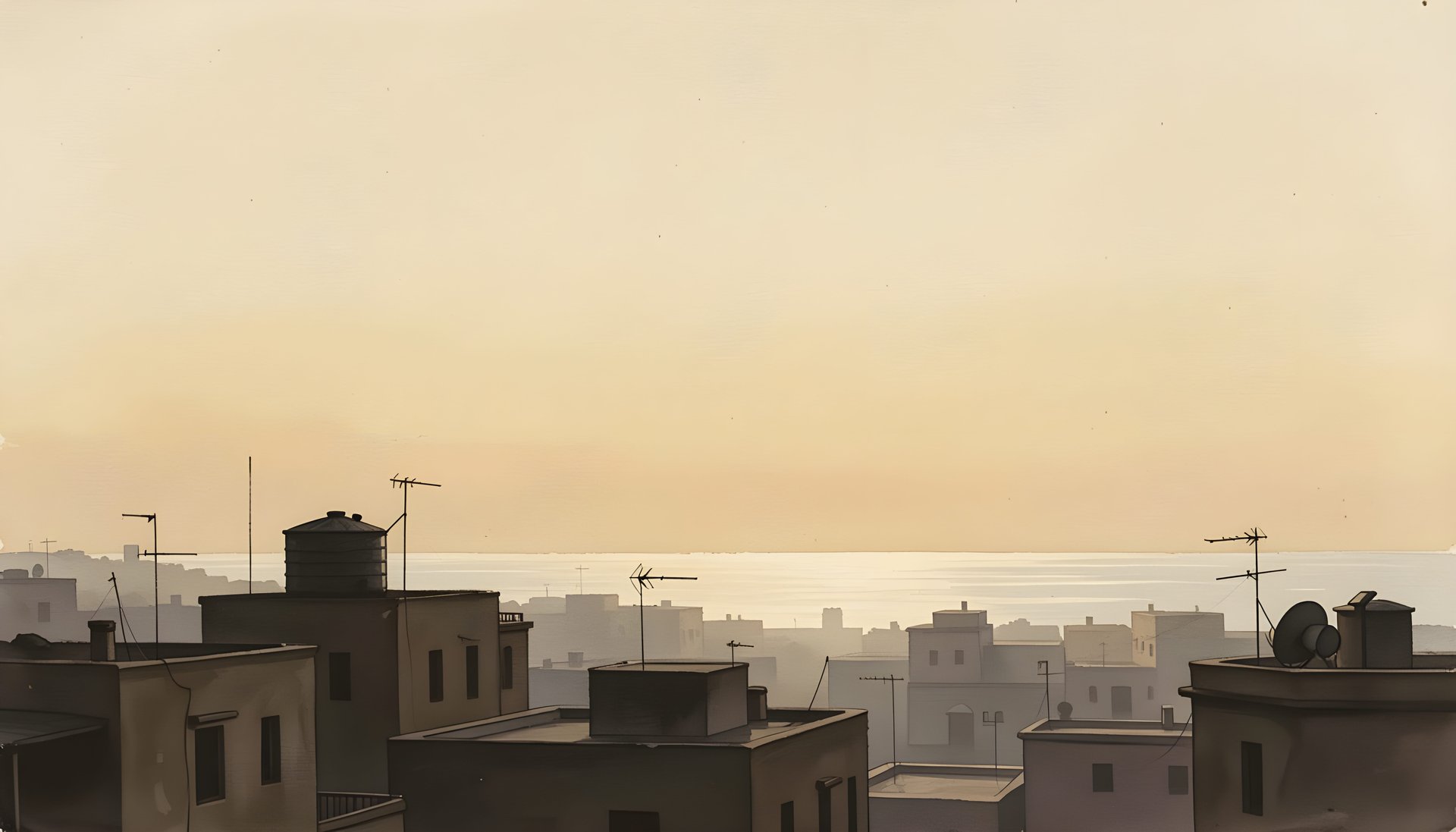
Below, the road was silent. It stretched straight towards the airport, laid without markings, its edges ragged where the asphalt had been poured and never trimmed, like every airport road she had travelled, but it was lower than she had expected and darker.
A blue minibus idled in a rut at the kerb, one rear tyre half-sunk in a construction pit that had been there long enough for the edges to have softened and the pit to have developed its own small ecology of pooled water and pale grass. The driver was smoking, gesturing at someone across the road with the loose authority of a man who had waited a long time and had stopped expecting anything to resolve.
Beyond him the street narrowed and the asphalt gave out. The city took over: a long, low spread of single-storey compounds behind walls. She had half-pictured another city from the literature and the news, one with towers and a skyline. The roofs of the compounds were corrugated iron, ridged, dented, and streaked with rust, catching what little light there was and holding it dully.
Between the roofs, eucalyptus trees rose tall with pale trunks, faintly silver even now. Smoke from cooking fires wove through the trees, flattened against the cold, and lingered in the air. The smell of woodsmoke and diesel came in at the gap in the window frame and settled in the room with her.
Occasionally, bulbs flickered on walls or in windows, scattered and unconnected, each pulsing sluggishly in time with her own hum. The grid faltered and mended itself across the entire valley as if a single nervous system were at work. Where the bulbs went out, the roofs and the trees went with them. Overhead the hills were gone, the last purple draining out of the sky above them until there was no line left where the ridge stopped and the sky began.
In the bathroom, she turned on the tap. The pipes knocked twice and ran brown for a moment before the water cleared and came cold and steady into the enamel basin, chipped at the rim where a small black star of exposed iron showed through. A plastic bucket sat beneath the basin, with a smaller jug inside it. Above the bath hung a shower head wired directly to a heating element; its casing was cracked, and two leads were taped where the insulation had worn away. This was the kind of fixture she had learned across three countries to avoid touching with wet hands and to mistrust without a proper generator.
She left the tap running and returned to sit on the bed. The duffel bag was still on the floor where she had left it, emptied of all the items she intended to remove.
In Bordeaux, on the last morning, in her flat off Rue Notre-Dame in the Chartrons, she had packed the drawstring pouch after most of the packing was completed, when only the final category of objects remained: those kept in the innermost compartment. She touched them at the start and end of each journey to ensure they were still with her.
At Mérignac she kept the pouch out of the hold, and it stayed on her lap for the short flight to Frankfurt; she held it through the second boarding as the cabin environment shifted: the announcements switching to a language she did not understand, the crew dressed in unfamiliar uniforms, and the aircraft’s vast, quiet interior marking the true start of the journey, where Europe ended and the southward descent began.
During the taxi from the airport, her hand found the pouch in her jacket’s outer pocket without her having sent it there; she moved the pouch to her lap, then back again. She never opened it at any point during these stops.
Nor did she now.
Instead, she studied a laminated site map, curled at the edges and split where she had folded it near the contour line. Aramis was marked in red, with the drainage channels highlighted in blue. She traced the Awash River with her index finger, following its bend north of the site, and reread the legend she had known by heart for three years, because the repetition served as a kind of anchor. It did not anchor her tonight.
The generator’s note fluctuated from a tremor to a drone and back again; the cold from the window penetrated her shirt into her shoulders. After a few minutes, she finally put the map down.
There was nothing else to do.
She opened the pouch and took out the brass cigarette case.
It was a small object, too tiny for a full packet, just big enough for six or eight cigarettes, although she had never seen it used for that purpose, or known it to hold anything, either before her father died or since. He had kept it on a shelf above the kitchen table in Achrafieh, beside the good coffee cups and a small framed photo of the Jounieh coast. She did not realise until she was twelve or thirteen that it was not merely decorative and that it could actually be opened.
He never explained its origin; it was just there, like certain objects in family kitchens that become part of the room’s memory, so constant they blend into the architecture. She took it the day after the funeral, from the shelf above the kitchen table, while her mother received the neighbours in the front room, and called it a “borrow” even though she knew it was not.
The case was warm because she had kept it close, tucked in her jacket pocket for most of the day. The brass had taken her warmth, and for a moment in the yellow light it looked damp, as if it had been breathed on. Her fingers closed around it before she had decided anything, her palm taking the weight and the warmth of the metal first.
Over twenty years, she had learned not to resist this particular momentum, as resistance only intensified it. Instead, she found it better to locate a floor or wall and wait.
The learning had not been straightforward. When she was four or five, she would stiffen against it, a small body frozen in place, unable to name or explain what was happening, crying out to her mother without understanding why or how. The act of going rigid often caused her more trouble than the experience itself. Later, she attempted to counter it by moving, walking through it, or keeping her hands busy, but that only made things worse.
The breakthrough came with the discovery of stillness: remaining unmoving and allowing her hands to hold what they had already closed on.
She pressed her back against the bed frame, slid down until she was seated on the cold terrazzo floor, the mat pushed aside. The chill of the stone immediately radiated through her, into the backs of her thighs and the base of her spine. With her knees drawn up, she cupped the case in both hands.
It arrived without any of the typical warning signs. There was no change in the visual field, no increase in pressure behind the eyes, and no identifiable threshold moment to brace for. The room simply disappeared.
She was in the Achrafieh kitchen, located in the north-east corner of the apartment, with a window overlooking the inner courtyard instead of the street. The afternoon light came in faint off the white-painted wall opposite, a reflected light with the sun already gone behind the building, so that nothing in the room cast a shadow. The radio on the counter was playing softly in Lebanese French, just the rhythm of the announcer’s speech, without the words. Her mother’s lime cleaner was in the air.
Her father sat at the kitchen table.
She knew it was him before she saw him, as she would have known the kitchen from the sound of the radio alone. She had come to him from behind and a little to one side, so that what she had of him was his shoulders, the curve of his back, and then his hands.
The left hand held the object still. What it was, she could not see. The right hand worked on it with a deliberate, iterative force, the patient force of someone confident in the final result, who knew that if the part were asked to seat properly, and asked enough times, it would eventually do so.
The spring of something had come loose from its housing. Quietly, he was making a sound, two notes, three, not quite a song. It was the noise he made when his hands were busy and his mind had drifted off to a place where it did not need to be.
She stood in the doorway and watched his hands. One step nearer and the edges of the room would begin to lose their line, the cups on their hooks first, then the counter, then the hands themselves.
It was always the same. The one thing she longed for was just beyond her reach. She could have his hands, the scar along his left thumb, white and slightly raised, and the sound. She had traced that scar with her thumb countless times as a child without ever asking how he got it.
But she could not have his face. There was no cruelty in that; she had never turned to the angle that would show it, because his face would have to be paid for, and the paying would be done afterwards, on a stone floor in a foreign country, once it was over.
The kitchen was just as she remembered it. There was the Formica counter edge where she had once spent an entire afternoon arranging dominoes end to end. Ceramic cups hung on hooks, all handles turned outwards at the same angle, reflecting her mother’s idea of the correct handle position. Next to the toaster, the plastic-wrapped bread sat ready. At the edge of her sight, taped to the cabinet door with two pieces of yellowing tape, was another photograph, smaller than the one of the Jounieh coast, unframed, the three of them along the Corniche. She kept her eyes on the counter.
She was not there for the photograph.
The hallway echoed with her mother’s movements between rooms, a gentle, unhurried pace. Eliana knew what time it was supposed to be. Her father was home early from the shop, for a reason she had never been told, and her mother had arranged the whole afternoon around his being there.
For a moment, nothing in the kitchen moved. The radio’s rhythm persisted unnoticed beneath everything. A fly hovered once over the plastic-wrapped bread without landing.
Eliana understood—and this was the knowledge she carried into every vision and could not set aside—that her father was already dying. He was not dying that afternoon, nor for years afterwards. But the disease that would eventually claim him had already started, quietly working within him; the man hunched over the table had no words yet for what was forming inside him; she could not give him the words, cross the room to warn him, or make him look up.
She wanted him to look up at her. If he looked up there would be the small, dry joke about her notebooks, or about the impracticality of digging up the dead for a living, the gentle and constant humour he kept for her ambitions. It had taken her years to hear the pride in it.
He did not look up. He kept his eyes on the small, loose object in his hands, something that could be fixed if only a man had enough patience with it.
His mouth parted slightly. “Eli—”
He paused. She was not home that afternoon; she was at school. He had called out of habit, or for just a breath’s length had forgotten she was gone. The sound struck her neck like a hand pressed flat against it. She waited for the second part of her name, but it never came.
In all the times she had been back here, it had never come. Yet she remained in the doorway until the afternoon light shifted slightly across the wall. Then, she found herself on the floor of the Damena room, her back against the bed frame, clutching the case so tightly that the hinge pressed a red line into her palm. Her knees were still raised, and overhead the yellow bulb was flickering with the generator’s load. The first thing that reached her was the sharp, overused scent of lime cleaner, her mother’s brand, and she turned her head towards it, only to realise it was not in this room, had never been here, and could never be.
The pressure behind her eyes was familiar, bilateral and deep, as if her eye sockets were bracing from within against something trying to escape. A vivid, unreal iron taste lingered at the back of her mouth. Her legs felt heavy, with the muscular slackness she had once described to a doctor as a child, a sensation of having run far without moving. The doctor noted the word trauma, and afterwards she stopped explaining it to anyone.
She sat still, allowing the room to re-enter her perception gradually.
Outside, headlights moved up the building’s face, briefly crossing the ceiling before fading away. Then, carried by the cold, thin air, the evening call to prayer sounded, possibly from somewhere among the dark, corrugated rooftops. Over a speaker that muddled the low frequencies into static but let the high notes through, a long, single-note chant by an Orthodox cantor rose into the night. The two devotions, one from the muezzin, one from the cantor, crossed above the city without touching, each warped by failing wires, each made beautiful by distance, cold, and hour. Neither of them belonged to her.
She had heard that song all her childhood from a different place in a different city. Now she sat against the bed frame in the flickering light, listening as it arrived here, about three thousand kilometres south, woven into a chant she did not recognise. For a moment, the feeling of disconnection was the sharpest pain in her body, sharper than the iron, the pressure, or the seam in her palm. She counted the generator’s cycles beneath her. The coldness of the stone had penetrated her to the bone. She waited until the trembling in her hands diminished from visible shaking to just a sensation, then she opened her fist.
The case rested inert in her hand, now cold, with none of her warmth left in it. She had either reclaimed it entirely, or it had taken all her warmth; she was never quite sure which. She slipped it back into the pouch and tightened the cinch carefully, keeping her fingers off the metal.
Slowly, she rose to her feet, gripping the wardrobe’s edge as her dizziness eased, then made her way to the bathroom. Standing over the basin with the cold tap still running, a detail she had forgotten, she cupped her hands and pressed cold water against her sore eyes until the pain subsided.
She changed from her travel-worn cotton into her home-made blouse: faded, with uneven seams, softened by years of washing, and worn thin in some places, patched in others where it had begun to fray. Her mother had sewn it for her before university, using fabric bought at the market beneath their apartment. Its imperfect stitching was the best part of it. She moved the duffel to the far wall and turned the pouch’s pocket away from her, so she would not see it.
She picked up the phone, knowing her mother would be awake; she had not slept well since the war. Her mother often lay in the front room reading or simply resting during the small hours, with the city quiet around her.
Eliana slowly dialled the prefix, country code, and the first four digits of the Achrafieh number, the rotary wheel turning with its small, mechanical patience. She held the open line against her shoulder for a moment, listening to the faint, suboceanic hiss of silence. Then she placed the handset back in its cradle and lay down on the bed.
What she had spent on the vision would not be recoverable before morning. She knew this completely, without consulting anything. She felt it in the quality of her attention, in a slight thinning of the present tense, as though the room and the hour were now being relayed to her from somewhere further off than they had been before.
Over the years, she had come to see it as a form of credit: a steadily replenishing reserve, rebuilt in sleep and quiet. She had not needed it tonight. She had drawn on it because the discipline of not doing so had weakened somewhere over the Mediterranean, and had gone altogether by the time her hand went into the pouch.
She had learned nothing from the vision, and she knew it. There was nothing new in it, nothing she could not have recreated from memory, or from the photos she had not brought with her. It held only the hands, the exact fall of the light on those specific tiles, the lime cleaner, the radio, the hallway footsteps, and the two notes that almost formed a song, all of which she already possessed without the case to remind her.
But without the case, carrying these memories felt different. It became an intellectual act, a voluntary effort. She could choose to engage with it or to turn away. The case made this process feel real, something that happened to her.
She lay on the bed, looking at the ceiling, and did not undress any further.
An hour later, she was at her desk with the lamp on and her notebook open to a blank page. She recorded the date, time, and city name in the upper right corner. Her handwriting had grown smaller and more precise with the fatigue, each letter closed and standing separate from the next, the loops pulled tight. She started with the gear check, a simple but essential practice: listing everything that had already been verified. The list ran: trowel, brush roll, callipers, metric ruler, hand lens, tape measure, map, notebooks, sample bags, and bands. She wrote each item in full, avoiding abbreviations, and marked off the margin column with a squared tick she had created during her first field season, and kept ever since.
She drew the locality sketch: the Awash in contours, Aramis and Hadar labelled in ballpoint, and the Rift running diagonally from south to north, with stratigraphic names aligned along its length. She boxed important dates and underlined them, carefully measuring the underlines, a habit from her Bordeaux training she had not fully abandoned. Next, she listed the project team: Aldridge, the field director; Tessema, the CRCCH representative; and the site geologist, whose name she knew only from correspondence.
She continued exploring the literature. Aramis, dating back four-point-four million years, had yielded a species now classified as Ardipithecus ramidus, previously Australopithecus until last year, with White’s correction still unfamiliar in her notes. It stood at the record’s base, the oldest named species.
Hadar, at three-point-two million years, was home to Australopithecus afarensis: Lucy and the First Family.
Kanapoi, home of Australopithecus anamensis, at four-point-one million years, she entered with a reference to Leakey’s paper, which had stirred minor controversy over its dating. She marked it in a box, questioning whether anamensis was ancestral to afarensis or simply older than it, a question that looked different depending on which way the dating fell. She added an asterisk beside the box and moved forward.
In her shorthand, she documented everything—abbreviated citations, framed dates, contested claims marked with tiny asterisks in the margin—and let the small satisfaction of it settle her. This aspect of her work still provided her with clarity, even now, even tonight. It was about naming things, arranging evidence into a sequence that could be easily understood.
At the bottom of the third page, she noted fossils dating back roughly five million years, with one disputed sample from Lukeino, and a molecular estimate ranging from five to seven million years.
She carefully recorded Sarich and Wilson’s date, just as she did with everything else on the page, and did not include the question she had been pondering since she was twenty-three, the one that the molecular clock suggested and the fossil record could not resolve because it simply ran out, ending abruptly in a silence that the field was still learning to navigate.
To her, that silence was not meaningless, though she had no proof. She had no words for it that could stand beside Sarich and Wilson on the page, and none that would keep her hard to dismiss in the rooms where she needed to be taken seriously. So she kept the question off the page, as she always had. The page was reserved for what could be recovered.
The second hour passed; pages filled steadily. The generator’s sound shifted from a tremor to a steady drone; the cold had crept from her shoulders into her chest; and her pen slowed, almost moving on its own.
She reached the bottom of a page and paused. She uncapped the pen and recapped it, twice, without writing anything. Then, in tightly compressed script resembling a stress fracture across the bottom of the column, she wrote: I am going to the deepest reachable because the field cannot go where I can.
She closed the notebook and turned off the lamp.
The darkness entered with the hum of the generator and the settled cold of a room that had never been truly warm. She lay on top of the covers, still dressed, pulling the woven cloth from the foot of the bed up over herself, allowing the fatigue of the day to settle in.
On the ceiling, the city’s residual light flickered in slow pulses, the grid faltering and then restoring itself repeatedly. For a while the ceiling dimmed by slow degrees and came back in a surge, dimmed and came back. Eventually she closed her eyes on it. Her hand stayed on the woven cloth, away from the pocket turned to the wall.
Instead, she allowed her mind to drift into the long chronology of humanity: six million years, seven, as bones gradually thinned and disappeared one by one, their molecules passing into the darkness. At the record’s foundation, a silence persisted, where everything that ever mattered had already occurred, leaving almost nothing behind and happening without witness.
She would reach the Afar region by mid-morning. The season would start regardless of her preparedness. She lay in a hotel that was not her home, in a city unfamiliar and not her destination, caught in the long transition between two lives. Eventually, in her exhaustion, she fell asleep.
[ End of Chapter One ]
© 2026 Aethereal Stories. From The Long Dawn. All rights reserved.


.png)