The incident at the bike shed in Chapter One: Quiet followed the same pattern as every incident before it, until it didn’t. Michael closed the distance. He leaned in until their foreheads almost touched. He said the thing about the mother. Daniel stepped in to block the view; Michael shoved him aside. Then he turned back to Robert. The second shove was harder. Robert punched him.
The punch was described by witnesses as like a grown-up would. Michael crumpled. The bike rack rang hollow. A tooth skittered across the frozen playground tarmac, a small white object spinning where the gravel met the painted line. Robert did not remember throwing it. Michael, on the ground, had a displaced tooth and a concussion and no language for what had happened except that it had hurt in a way that felt wrong — too hard, too sudden, not what a child’s fist should do at that range.
He did not come back to Stepping Stones Primary after the incident. Within eight weeks, the Lawsons had left Hope’s End entirely; Phillip’s deployment of his son was complete the moment Robert’s fist landed, and the household followed the data out of the village. Robert did not come back either — Toby set up lessons at the kitchen table at 13 Haversage Road, and Ben handled the physical side. The two boys never saw each other again. The playground that produced the incident is still there. The bike rack still has the dent.
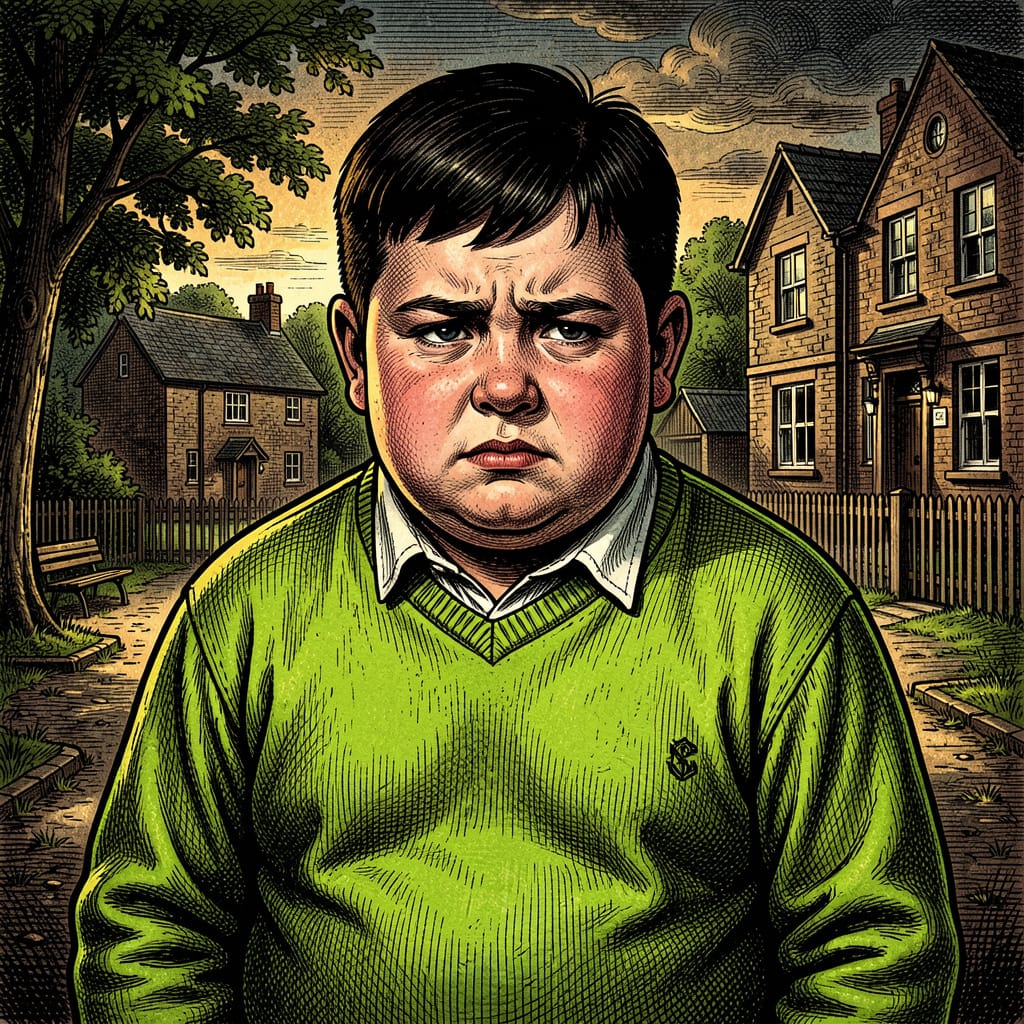
Michael lived with his mother Karen, his father Phillip, and his older brother in a pebble-dashed semi at the top of the rise on Hawthorn Lane — the house that had the view of the Knight family’s front gate from the front bedroom window. The bedroom was not Michael’s; it was his father’s study, the door of which was locked when his father was not in it and locked when he was. Michael had not asked about this and had been encouraged, in small ways, not to start.
His older brother was fifteen and home from school much of the time on suspensions Michael had not been told the details of. The brother was the source of the gelled-flat hair and the slack grin and a working philosophy of how to push other children without quite getting caught at it. Michael had been studying him for three years and was, on the available evidence, a quick study. What he had taken from those three years was less a method than a register: which children to circle, which to ignore, when to apply pressure and when to take it off. He was good at it in the way children of a certain age are good at things they cannot articulate. He thought it was instinct.
What it actually was was his father’s operational priorities, internalised without explanation by a boy who had never been told he was operating on anyone’s behalf. Robert, in the year below, was sanctioned for sustained attention. The instinct that kept Michael from picking targets above a certain weight class — nothing that would draw social services in, nothing that would generate a press cutting, nothing that would make any child’s injuries the subject of a formal investigation — was the household’s tolerance ceiling, not Michael’s. Phillip sat in Mrs Davison’s office on three occasions over those two years to discuss Michael’s conduct. None of those meetings produced anything actionable. He had the connections to absorb them. He did not have the connections to absorb the kind of meeting Michael could have caused if he had ever pushed past the line. Michael, who had never been told the line existed, kept to it because keeping to it was the condition under which his father remained pleased with him. He did not understand it as a rule because he did not know rules were what it was.
What he loves, when nobody is watching him, is football and a particular Game Boy game his older brother gave him last birthday and that he has not let his mother know he plays under the duvet at half-eleven. He is good at it. He has finished it twice and started it a third time. He is also frightened of the dark in a way he would die rather than admit, and frightened of his father in a way he has not yet realised is fear. He used to think his father was the most impressive man in Hope’s End. He used to think the things his father said when his father thought the children were not listening were the truest things in the world. He used to repeat them on the playground because saying his father’s words out loud felt, for as long as the saying took, like being him. He still thinks all of that, in the new place.
Eight weeks after the bike shed, the family leaves Hope’s End. The pebble-dashed semi at the top of Hawthorn Lane goes up for sale and is gone by the new year. Michael, who had assumed the move was about him — a punishment, a withdrawal, a thing his mother had pushed for — comes slowly to understand, in the way of a child who is told nothing and pieces things together from the wrong angle, that it was none of those things. The family was in the village to do a job. The job was him — sitting in the right classroom, in the right playground, in the right boy’s peripheral vision — until the day a fist came out of nowhere and a tooth landed on the tarmac and his father had what he had been waiting two years to record. After that day the house was for sale within a fortnight. Michael had not been kept; he had been deployed. The deployment ended on the eighth of November and the relocation followed because the operation no longer required a Lawson at Stepping Stones.
He doesn’t put it in those words, of course. He’s nine. What he notices, weeks into the new place, is that his father’s late-night phone calls have stopped, the locked study at the new house faces the back garden, his mother has been quieter in a way that is not exactly relief, and his older brother, on the rare occasions he speaks at all, has begun to look at him differently — as if Michael was the reason for something, and the something is over now, and Michael is, in some new way, no longer needed. Michael does not have language for any of this either. He has the sensation of it. It does not go away.