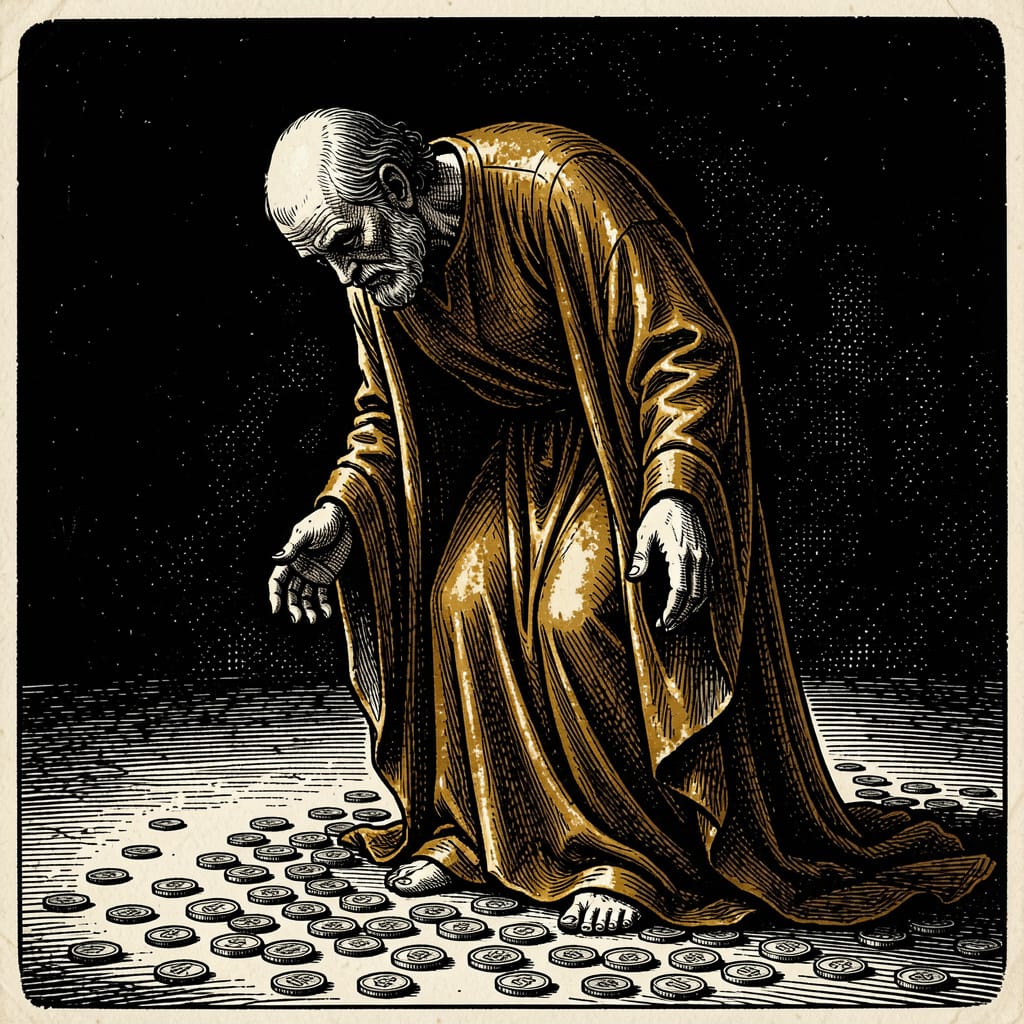
Within the Book of Thoth Saga, Mammon holds the office of Greed among the Seven, and rules the kingdom of The Hoard within the Seven Thrones.
Nature & Method
Mammon does not possess in the classical sense. It takes no ground and announces nothing. It operates, in Declan Marsden's formulation, by inducement rather than extraction — it takes nothing, and instead sharpens a want until the person acts on it as though the impulse were entirely their own. For those inside its field the effect is undetectable: what is felt is not intrusion but appetite, clarified and insistent, indistinguishable from ordinary desire.
Its characteristic calling card is a coin. Wherever they surface, the coins share the same mint mark; they weigh roughly three times what sterling of their apparent denomination should; and they retain a faint warmth that persists even in December, with no heat source to account for it. Wherever these coins circulate, patterns follow: thefts with no profit motive, embezzlements by employees with impeccable records, violence in pursuit of trivial objects. The coins pass hand to hand as ordinary change, and the damage spreads with them.
Known Activity: Derbyshire 1995
In the six weeks following Robert Knight's first major manifestation in November 1995, five confirmed anomalous incidents tied to Mammon's coin-signature occur within a forty-mile radius of Hope's End: Derby, Matlock, Bakewell, Chesterfield, and Sheffield. Each presents the same profile — a circulating coin of the distinctive weight and warmth, a cluster of decisions made under unusual appetite, then a local anomalous event.
The geographic pattern is tightening: each successive incident sits closer to Hope's End than the last. Mammon's movement is not random; the village is being approached. By the time Declan Marsden names the pattern, the implication is already operational — something older than the agencies has become interested, and its interest has a direction.
The Old Trafford Encounter
The saga's only depicted face-to-face meeting between Mammon and Robert Knight takes place at a Germany–Russia match at Old Trafford, to which his uncle Ben has taken him. At half-time a woman in an old black dress moves through the stand — "calm in the specific way of someone who has already decided what they came for" — and lets a coin fall against Robert's foot. He picks it up: it is dense, wrong for its size, and its date is not a year he recognises. She is watching not his face but his hands. When he returns the coin she tells him, "Careful. Money's a bad thing to lose," and is gone into the crowd.
Robert does not recognise what he has met. To him it is only a strange moment at a football match. But the scene carries every signature the archive attributes to Mammon — the anomalous coin, the fixation on the hands that will do the reaching, the inducement dressed as a warning — and it places Mammon in direct physical proximity to the pureborn cambion years before the wider pattern comes into focus.
Significance
What makes this a threshold event is its place in a much longer silence. The Seven have not moved openly in the world for generations — their last documented activity, in 1918 at the close of the Great War, was followed by seventy years of quiet. That quiet broke in the 1987–1989 window, immediately after Robert's birth, though only in scattered signs; the 1995 circulation is the first time the renewal hardened into something that could be tracked and named. And it points beyond itself: a coin trail is evidence of arrival, not of a single visitor.