Bakewell's site has been settled since well before the Anglo-Saxon period. The valley contains a cluster of warm, iron-bearing (chalybeate) springs and wells — a dozen or so were once recorded — which appear to have drawn Iron Age and, later, Roman attention; the town's very name (the well of Badeca; earlier still, the place of bath-springs) preserves that origin. There is no surviving evidence of a major Roman settlement in the centre, but Roman finds in the surrounding limestone dales are common, and the springs are likely to have been used.
The first secure historical reference is in the Anglo-Saxon Chronicle for the year 924, in which King Edward the Elder is recorded as marching with his army from Nottingham to Badecanwellan, where he commanded a fortification to be built and garrisoned. By the time of the Domesday survey of 1086 the place is recorded as Badequella, with a church and a mill and lands held by the Crown. The settlement lay within the Anglian kingdom of Mercia, on a contested frontier between English and Danish jurisdictions in the ninth and tenth centuries; the parish church preserves Anglo-Saxon stonework, including a ninth-century cross shaft, that pre-dates the Norman building it now sits within.
In 1330, John Gernon claimed by writ of quo warranto the right to hold a Monday market and two annual fairs at Bakewell. The Monday market has run, in some form, ever since. The medieval town developed in the limestone wedge between the river and the church hill; the main road between Buxton and Chesterfield ran through it, and continues to. By the seventeenth century the town had a stone-built town hall (1602, in King Street) and a bath-house, completed in 1697 at the expense of the Manners family of Haddon, then Earls (and later Dukes) of Rutland, to enclose the principal warm well in the town centre.
The eighteenth and nineteenth centuries brought lead mining, limestone quarrying and fluorspar extraction in the surrounding hills, and a degree of light industrial prosperity that culminated in the opening of Bakewell railway station in 1862, on the Midland Railway main line from London to Manchester via the Peak. John Ruskin, characteristically, objected; he complained that the railway would now allow “every fool in Buxton” to reach Bakewell, and vice versa, in half an hour. The line closed in 1968; its trackbed survives as the Monsal Trail. The Peak District National Park, the first such park designated in the United Kingdom, was created around the town in 1951; in 1968 the Park Authority took up residence at Aldern House. Bakewell has since become, by some distance, the most visited town inside the National Park's boundaries.
It has not always been so quiet. In 1797, around a thousand farm labourers and small farmers from Bakewell and the surrounding villages gathered in the town to protest the Militia Act's compulsory ballot for service in the Napoleonic Wars; the protest spread to Ashbourne and Wirksworth before being suppressed by the magistracy. The Bakewell Riots are now a footnote in most histories, but they remain the largest civil disturbance the town has produced.
Bakewell Bridge, the gritstone five-arched road bridge over the Wye at the centre of the town, is the oldest substantial structure in Bakewell still in continuous everyday use. It is variously dated from the late thirteenth to the early fourteenth century; it is Grade I listed and a Scheduled Monument, and is one of the oldest bridges of its kind in regular vehicular service in England. The bridge is also the site — in recent decades, and to the visible irritation of Derbyshire County Council, who periodically have to take them off — of the largest collection of ‘love-locks’ on any structure in the county.
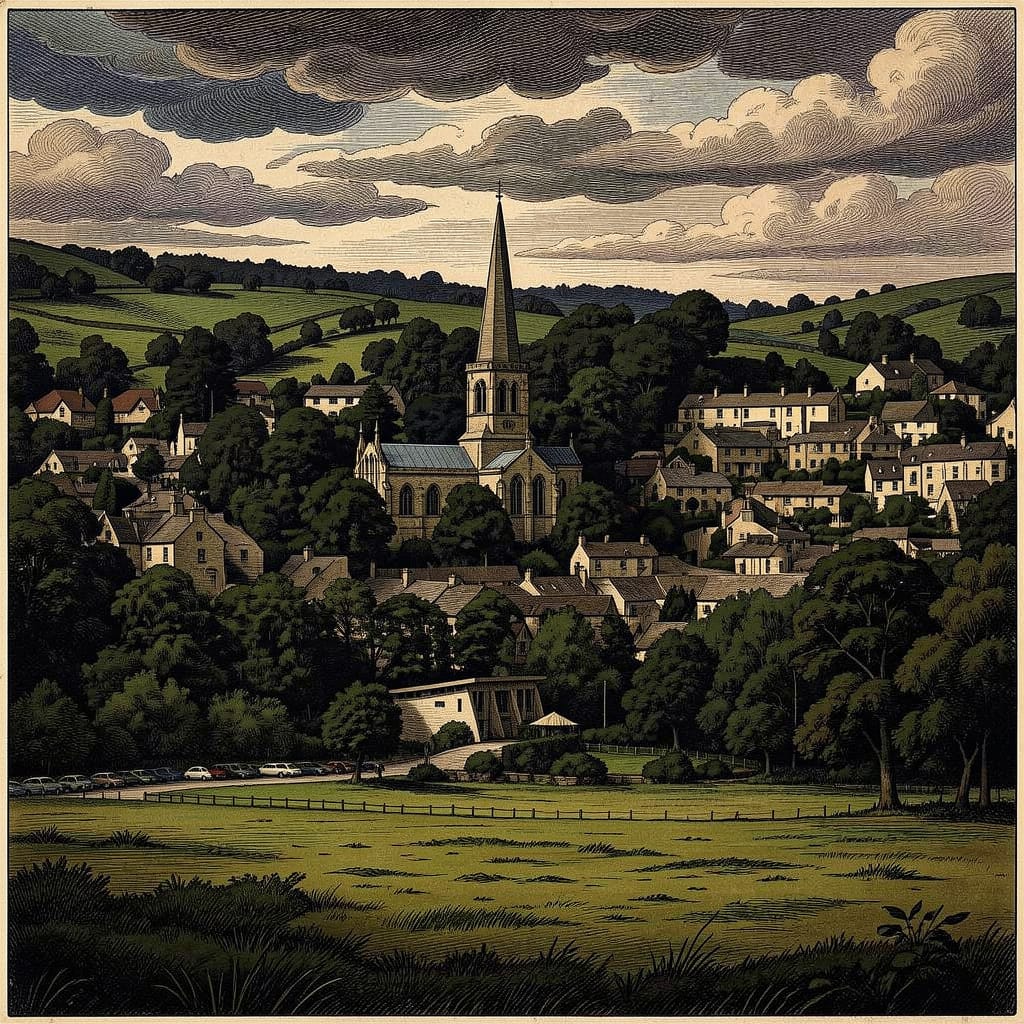
All Saints Church, the parish church, stands on the hill above the town. The present building is largely thirteenth- and fourteenth-century, with a spire and unusual octagonal tower added in the same period; a sympathetic Victorian restoration left the medieval fabric mostly intact. The church preserves a remarkable collection of Anglo-Saxon and Norman carved stones, including a ninth-century cross shaft and a number of grave covers, suggesting that the present church was preceded by an earlier minster of some importance during the late Saxon period.
The Old House Museum, in Cunningham Place just below the church, occupies a Tudor parsonage of 1534 — one of the oldest domestic buildings in Bakewell — and is now run as a small local history museum. Aldern House, on the southern approach to the town, is a nineteenth-century gentleman's residence converted in 1968 to serve as the headquarters of the Peak District National Park Authority. The town has, in total, a hundred and eighty-three listed buildings.
The Bakewell Show, an agricultural and country show inaugurated in 1819 and held over two days each August on the showground across the river, is one of the larger surviving regional shows in England, attracting attendances of around fifty thousand in a good year.
Bakewell's best-known cultural export is the Bakewell Pudding, a regional pastry consisting of a flaky pastry shell spread with a layer of strawberry or raspberry jam and topped with an egg-and-almond filling. It is, the town will tell you with feeling, not a Bakewell Tart — the tart is a quite separate confection, descended from the pudding, with a sponge filling and an icing on top. The tart is made commercially across England; the pudding is, by tradition, made and sold only here.
The pudding's origin is a matter of cheerful local dispute. The most widely repeated story places its accidental invention at the White Horse Inn (later the Rutland Arms) in or around the 1860s, when a cook misunderstood the landlady's instructions for a strawberry tart and spread the egg-and-almond mixture over the jam rather than mixing it into the pastry; the resulting dish proved popular enough that the landlady began to sell it deliberately. Two principal pudding shops in the town — the Old Original Bakewell Pudding Shop and the Bakewell Pudding Parlour — each maintain, with considerable dignity, that their respective recipe is the authentic original. The dispute is unlikely to be settled in either direction.