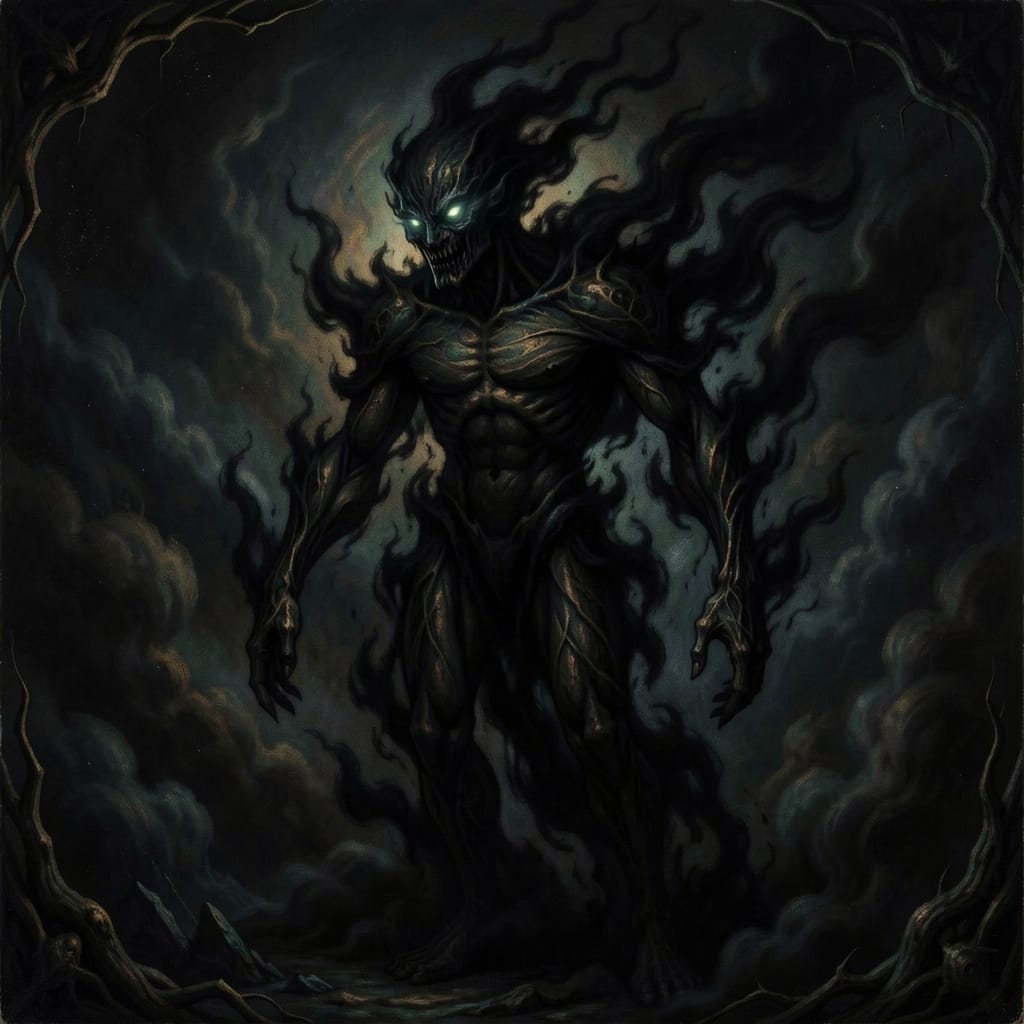
Kaos

Kaos — the keeper of the dark

Lore Profile
Nature Avatar of Pandemonius; the keeper of the dark
Form A single, whole being — unpaired
Purpose To preserve the status quo; to defend against the Creators
Disposition Anti-creation
Opposes The Creators — the avatars of the light
Origin Manifested by Pandemonius, the principle of Dark

Kaos

The keeper  ·  The whole  ·  Anti-creation


Overview

Kaos is the avatar of Pandemonius — the dark's own power made manifest, fashioned to defend it against creation. Where the Creators are the avatars of the light, made to bring creation about, Kaos is their opposite and their adversary: the keeper, whose purpose is not to make but to prevent, and to hold the dark in its unbroken stasis.

Two ancient figures stand behind it. The first is the chaos-monster — the primordial embodiment of disorder that creation must overcome, the dragon of the deep that the myths of the world set against the making of the ordered cosmos. The second is the guardian — the warden set to keep a threshold, who acts not to build but to bar the way. Kaos draws on both: the chaos that resists order, and the keeper that stands watch over it.


The Chaos-Struggle

In the creation myths of the ancient world, order is almost never established without a battle. Scholars of comparative religion gave the recurring pattern a name — the Chaoskampf, the "chaos-struggle" — in which a god of order confronts and defeats a monstrous embodiment of primordial disorder, most often a serpent or dragon of the waters, and only then can the world be made. It is one of the most widely attested motifs in all of mythology, surfacing across the ancient Near East, in Greece, in the Norse world, and in the Hebrew scriptures alike.

Its fullest form is the Babylonian Enūma Eliš. There the primordial saltwater ocean is personified as Tiamat, a vast dragon of chaos, mother of the first gods, who turns against them and raises an army of monsters to unmake the order they represent. The young storm-god Marduk goes out to meet her; he catches her in a net, drives the winds into her body, looses an arrow that splits her, and from the two halves of her corpse he fashions the heavens and the earth. Creation, in this telling, is literally built out of the defeated body of chaos — the ordered world is chaos conquered and given form.

The same struggle echoes far beyond Babylon. The Canaanite storm-god Baal defeats Yam, the unruly sea; the Hittite storm-god slays the dragon Illuyanka; in Greece Zeus overcomes the monstrous Typhon, and in the Norse world Thor is set eternally against the world-serpent Jörmungandr. Even the Hebrew scriptures preserve echoes of the pattern in the LORD's defeat of the sea-dragons Rahab and Leviathan. In every case the meaning is the same: chaos is not a neutral emptiness but an opponent, a living force that the made world must defeat and hold back.

Two Faces of the Dark

Not every mythology imagines the primordial dark as an enemy. The Greek Chaos of Hesiod is a gaping void, a neutral abyss out of which the cosmos gently unfolds without struggle — the formless as raw material, not resistance. The chaos of the Chaoskampf is the opposite conception entirely: here the formless is a will, a power actively set against the ordered world and forever threatening to drag it back into the disorder from which it came. The distinction is the whole of the matter. In the first vision the dark is a womb; in the second it is an adversary.

It is the second vision that Kaos embodies, and in its purest possible form. The mythic hero shapes chaos only after he has defeated it, and even then his victory is never final — the serpent endures at the edges of the world, coiled and waiting, and the cosmos must be defended for as long as it stands. Kaos is that enduring resistance given a single body and a single will: not the dark as the stuff from which things are made, but the dark as the standing refusal to let anything be made at all.


The Guardian of the Threshold

Beside the chaos-monster stands a second and related figure, and Kaos is as much this one as the first: the guardian. Mythology is thick with such wardens — beings set to keep a boundary, to watch a threshold, to bar a way. The dragon Ladon coils about the tree of the golden apples of the Hesperides; the serpent Níðhöggr gnaws at the roots of the world-tree; the hound Cerberus keeps the gate of the Greek underworld so that none of the dead may leave; the flaming sword turns at the gate of Eden to guard the way to the tree of life. Their office is not to act but to prevent — to hold a boundary against all who would cross it, and to keep what lies beyond untouched.

A guardian of this kind is defined entirely by what it opposes. It builds nothing, seeks nothing, explores nothing; it preserves a state of affairs by force, standing watch so that nothing is altered. This is the deeper sense in which Kaos is a keeper — not the warden of a treasure or of the dead, but the guardian of stasis itself. Its threshold is the boundary between the light and the dark, and its charge is to see that the two are never joined, so that the creation such a joining would bring is never permitted to begin.


Kaos in Aethereal Stories — the keeper of the dark In-universe lore. Contains worldbuilding for the Aethereal Stories universe.

In the Aethereal Stories universe, Kaos is Pandemonius made manifest — the dark's answer to the light's Creators. So set is Pandemonius against creation that, exactly as the light did before it, it pours its own power into a living form. That form is Kaos, and its charge is a single one: to stand against the Creators at the crossing. When a Creator carries the light through the transwarp and into the dark to seek the union from which all creation proceeds, it is Kaos set squarely in the path — the keeper who turns the light back, so that the two principles are never joined and nothing new is ever brought to be. The whole drama of creation, in the saga's cosmology, narrows to that one confrontation.


Why the Dark Makes Only One

The strangest thing about Kaos is not what it does but that there is only one of it — and the reason runs to the root of what it is. The Creators come always as a pair, because creation is a union: the meeting of two complementary powers is the creative act itself, and neither half can perform it alone. Destruction answers to no such law. To unmake a thing, or to prevent its making, requires no partner and no complement; it is complete in a single stroke. The light must therefore make two, and the dark need make only one.

This is why Kaos is singular — not as a limitation but as the plain expression of its nature. Creation is the harder and stranger act, the one that needs two unlike things to meet; prevention needs nothing but itself. The wholeness of Kaos is the wholeness of a closed door: entire, sufficient, and requiring no other to do its work. It is, in this, the truest possible servant of the principle that made it — for Pandemonius too seeks no union, no growth, and no change, and its avatar is that refusal given a single body and a single will.


Trivia

  • The name "Kaos" preserves the Greek Cháos, but reverses its original meaning. Hesiod's Chaos was a peaceful, gaping void — the neutral emptiness that precedes and gives rise to the cosmos. Kaos is the exact inversion: not the void from which creation comes, but the will set against creation ever coming at all.
  • In the Enūma Eliš, the ordered world is built literally from the body of the defeated chaos-dragon Tiamat — her split corpse becomes the sky and the earth. The Aethereal Stories cosmology takes the opposing view: its avatar of chaos is not raw material to be conquered and shaped, but a living keeper whose whole purpose is to ensure creation never begins, and so is never available to be built from.
  • Kaos is unique among the mythological chaos-figures in being singular by nature rather than by circumstance. Tiamat commands an army; the guardian dragons hoard and coil; but Kaos requires no host and no pairing, because destruction — unlike creation — is whole in itself. Its solitude is a statement about the nature of unmaking.
  • The guardian figures Kaos draws upon — Ladon at the golden tree, Cerberus at the gate of the dead, the turning sword at Eden — share a single trait: each keeps a threshold that leads to life or renewal. Kaos keeps the ultimate version of that threshold: the boundary whose crossing would allow life and creation themselves to come into being.

Related Entries

Kaos is the avatar of the dark. For its source, see Pandemonius, the principle of Dark; for the avatars it opposes, the Creators; for the light that seeks union with the dark, Aetherius; and for the wider cosmology of creation, the Cosmology archive.


Appearances

Title Role Notes
The Divine Library
Aethereal Stories
The Keeper The avatar of Pandemonius, set against the Creators to prevent the union of light and dark.