Creators

Creators — the avatars of Aetherius

Lore Profile
Nature Avatars of Aetherius; living manifestations of creative light
Status The first creation
Purpose To bring about creation through the unity of light and dark
Manifestation In pairs — one male, one female — as life partners
Powers Traversal of the transwarp; the ultimate source of power for the universes they create
Lifespan Immortal, while the balance of light and dark holds
Origin Manifested by Aetherius, the principle of Light

Creators

The first creation  ·  Avatars of the light  ·  Made in pairs


Overview

Creators are the avatars of Aetherius — the living manifestations of its creative light, and the very first thing it brought into being. Their purpose is singular: to carry that light across the boundary between dimensions so that it may join with the dark of Pandemonius, and from that joining bring all creation to be. They are, by the universe's own reckoning, the most powerful creations in existence.

Two of the oldest patterns in the mythology of the world meet in them. The first is the maker who stands between the highest divinity and the made world and shapes the cosmos on its behalf. The second is the pair — the two complementary powers, most often male and female, whose union is itself the act of creation. The sections below trace both traditions, from the craftsman-gods of the ancient Near East to the divine couples of Gnostic myth.


The Divine Maker

The idea that the world was fashioned not by the highest god directly but by a maker acting on its behalf is one of the most widespread in ancient cosmology, and its clearest expression is the demiurge. The word is Greek — dēmiourgos, literally "one who works for the people," a public craftsman or artisan — and Plato gave it its philosophical career in the Timaeus. There the demiurge is a benevolent craftsman who looks upon the eternal, perfect Forms and labours to reproduce them in matter, imposing order upon a pre-existing chaos. He does not create from nothing; he shapes, as a potter shapes clay, and the visible cosmos is his workshop's result — as good as the recalcitrant material will allow.

Later Gnostic thought inherited the figure and darkened it. In the Gnostic systems the demiurge is a lesser, often ignorant power who fashions the material world in imperfect imitation of the true divine realm above him, sometimes mistaking himself for the highest god. Here the maker becomes a jailer, and the material world a flawed copy or even a prison of the spirit. The two readings — Plato's noble craftsman and the Gnostics' blind architect — frame a lasting question about any intermediary maker: whether the one who shapes the world is its benefactor or its warden.

The pattern reaches its most exalted form in Egypt, in Ptah of Memphis. The Memphite theology preserved on the Shabaka Stone describes a creation of a strikingly abstract kind: Ptah conceives the world in his heart — the seat of thought — and brings it into being through the word of his tongue, speaking each thing into existence. He is at once craftsman and supreme creator, patron of artisans and the mind that thinks the cosmos before it is made. It is from this lineage of makers — the craftsman who shapes, the architect who orders, the god who conceives and speaks — that the Creators take their name and their office.

The Divine Pair

If the maker is one tradition the Creators draw upon, the pair is the other, and it is older still. Across the mythologies of the world the generative power of the cosmos is imagined again and again as the union of two — a masculine and a feminine principle whose joining brings all things forth. The Egyptians set Geb the earth beneath Nut the sky and made every living thing the issue of their separation and longing; the Greeks began with Ouranos and Gaia, sky and earth, whose embrace fathered the first generation of gods; across the ancient world the sacred marriage of a god and goddess is the engine from which the world proceeds.

Gnostic cosmology gave this instinct its most systematic form in the syzygies — the divine pairs, or aeons, that emanate from the ineffable source and together compose the fullness of the realm of light, the Pleroma. The aeons issue in couples, each a masculine and feminine principle bound as one: Logos and Life, Anthropos and Ecclesia, Word paired with the vitality that gives it force, Humanity paired with the assembly it gathers. Their pairing is not decorative but structural — the whole architecture of the spiritual universe is built from these unions, and the catastrophe that Gnostic myth places at the origin of the material world is precisely the story of one aeon, Sophia, acting alone, without her partner, and so producing something flawed.

Beneath all of it lies a division the modern age has learned to describe in its own terms: the two hemispheres of the human brain, the analytic and the intuitive, neither of which thinks the whole of a thought alone. The mythic pair gives that division a face and a body — two beings, each holding one half of a power that is whole only in their meeting. It is a very old intuition wearing modern clothes: that to make anything is to bring two unlike things together, and that the truest image of creation is therefore not a single figure but a couple.


Creators in Aethereal Stories — the first creation In-universe lore. Contains worldbuilding for the Aethereal Stories universe.

In the Aethereal Stories universe, Creators are the medium through which Aetherius works its purpose: the union of light and dark from which all creation proceeds. Because everything else is made through them, they are themselves the first thing made — Aetherius's opening act, the instrument fashioned before the work it was fashioned to perform.


Manifestation in Pairs

A Creator never appears alone. They manifest as life partners, one male and one female, and the division between them is exact — each carries one half of the creative faculty, and the creative act belongs only to the two of them together:

Side Faculties
A Linear thinking, arithmetic, logic, speech, comprehension, and language
B Spatial ability, creativity, imagination, intuition, and skill

The mythological pattern of the divided pair is, in the saga, literal fact: a single Creator would be as incapable of creation as a single hemisphere is of a whole thought.


The Crossing

A Creator's defining act is the crossing. To bring creation about, the light must be physically carried out of its own dimension and into the dark — and so the Creators traverse the transwarp, the passage between dimensions, bearing the light of Aetherius into the domain of Pandemonius. Once the crossing is made and the light delivered, Aetherius can establish a permanent link with Pandemonius; the journey of the avatar is the thing that seals the union of the two principles, and from that union all creation flows.

It is against this crossing that the dark sets its own avatar. Where a Creator carries the light towards union, Kaos — the keeper made by Pandemonius — stands to bar the way, so that the two are never joined and nothing new is brought to be. The whole drama of creation, in the saga's cosmology, turns on whether the crossing succeeds.


Immortality and Its Condition

Creators are the ultimate source of power for the universes they bring into being, which makes them the most powerful creations in existence — but that power is conditional. A Creator exists only so long as the balance between light and dark is maintained; while it holds, they are immortal, and should it fail, their immortality fails with it. They are not gods standing outside the system they serve. They are of it, sustained by the very equilibrium their work exists to complete.


Appearance

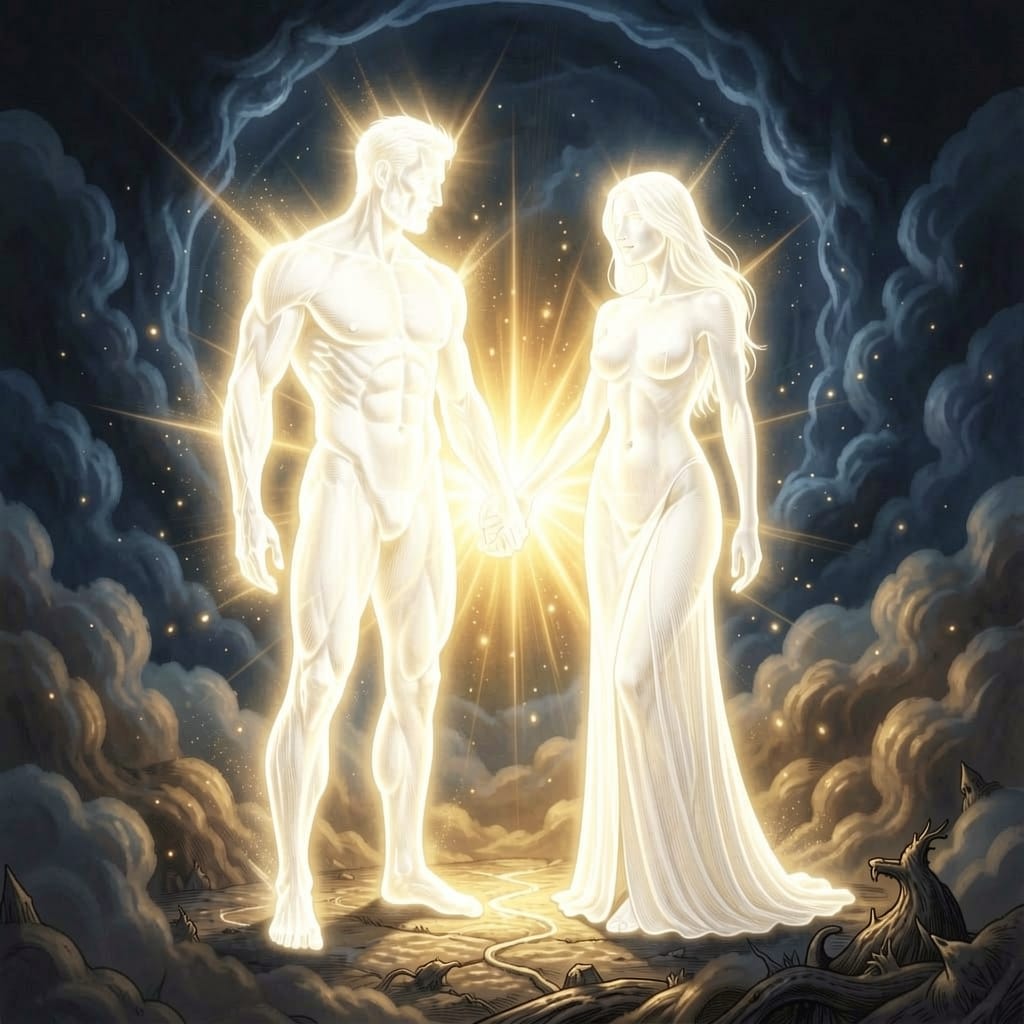
The true form of a Creator is incomprehensible to any mortal — a thing the mind is not built to hold. To be seen or spoken with at all, a Creator shapes light into a form a mortal can perceive, a deliberate figure assembled for the sake of being understood. What anyone sees of a Creator is therefore never the being itself, but a vesture of light it has chosen to wear; the reality behind that borrowed shape remains beyond the reach of mortal sight.


Trivia

  • The Egyptian creation of Ptah — conceiving the world in the heart and speaking it into being with the tongue — is one of the earliest recorded instances of creation ex verbo, by the word, a motif that would later open the Gospel of John ("In the beginning was the Word"). The Creators inherit the idea of thought and speech as the instruments of making rather than hands and clay.
  • The Gnostic Pleroma — the "fullness" of the realm of light from which the paired aeons emanate — is the direct conceptual ancestor of the Creators' home dimension of Aetherius. Both are realms of pure light and completeness, out of which a descent into the dark or the material must be undertaken before anything can be made.
  • Unusually among divine intermediaries, the Creators are held to be more powerful than the world they make, not less — the ultimate source of its power rather than a diminished copy of a higher one. This inverts the Gnostic demiurge, who is always a lesser and often ignorant maker; the Aethereal Stories tradition keeps the craftsman-maker figure but restores its dignity.
  • Because a Creator's true form is held to be incomprehensible, every depiction of one — including any image in this archive — is by definition a portrait of the vesture of light a Creator adopts in order to be perceived, and never of the being itself.

Related Entries

The Creators are the avatars of the light. For their source, see Aetherius, the principle of Light; for the dark with which they seek union, Pandemonius; for the keeper set against them, Kaos; and for the wider cosmology of creation, the Cosmology archive.


Appearances

Title Role Notes
The Aethereal Chronicles
Aethereal Stories
The First Creation The avatars of Aetherius, through whom the union of light and dark is achieved.