Method
Phillip’s background is in pattern analysis — the slow accumulation of thermal signatures, communication intercepts, and behavioural anomalies into something that will hold up to scrutiny. He is not a field operative in the kinetic sense. He is a man with a camera and equipment, who sits in a front bedroom and watches, and walks the village and times his runs to the BP petrol station to brush past the school gate, and reads the patterns of curtains and televisions and post-arrival times in the houses opposite. He is good at it. He has been doing it long enough that the distinction between professional observation and private fixation has become, over the years, difficult to maintain.
The thermal signatures he has recorded are described as brief-duration events — not sustained, not proof, but anomalous enough that a signals analyst with his background would not dismiss them. He has photographed the old bike shed. He has watched the school. He has, on the available evidence, built a case dossier whose existence Orion’s leadership has not acknowledged and whose contents Orion’s leadership has not yet seen. He is building it for the day he can hand it over and force the formal operation. The bike shed accelerates that timeline considerably.
His son’s deployment in Robert Knight’s school was part of the apparatus. Michael was placed at Stepping Stones Primary not because the school was good but because the school had Robert in it. The bullying was both Michael’s own performance and the operational pressure-test Phillip needed to confirm what he had been theorising. The bike shed was the manifestation, witnessed and recorded. The deployment ended at the moment Robert’s fist landed. The household relocated within eight weeks, because the operation no longer required a Lawson at Stepping Stones.
Beyond the Scene
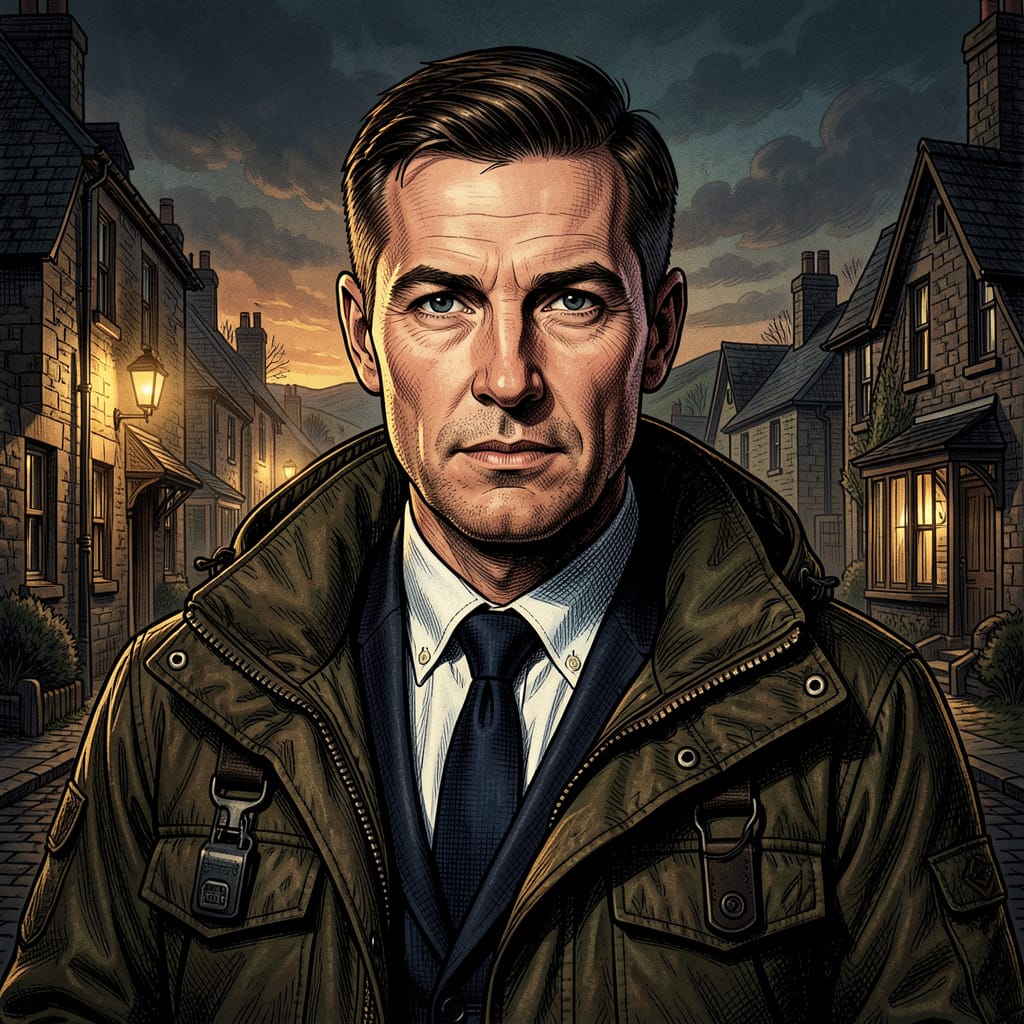
Phillip Lawson is, to anyone who meets him in the village or at school, a quiet, professional, well-dressed man with a wife and two boys. The neat haircut and the suit under the parka are the working uniform of someone who has decided early in his career that being underestimated is operationally useful. He is polite to neighbours, has not invited any of them to the house, and is not, on the evidence Hope’s End has of him, a man who feels strongly about anything in particular. The village, on the whole, has not formed a view of him. This is the view he was going for.
Inside the house, he is not the same man. The locked bedroom is his working environment. Karen has not found the equipment because Phillip has been concealing things in domestic spaces for twenty years and is competent at it. His older son knows there is something behind the locked door and has been encouraged to know not to ask. Michael, on the available evidence, has assumed his father is doing something important and has not had the language to ask further. The household runs on three people not asking the question their lives are organised around.
What is not in his Orion file, and what would not be readable from his cover or from his neat haircut, is the part of him that has stopped being an investigator at some point in the last several years and become something else. Investigation requires distance. He has lost it. The Knight family is no longer a case to him in the way the cases he made his name on were cases. He moved his wife and two children to a village he otherwise had no reason to live in to maintain a sightline. He has used his younger son as an instrument. He stayed in the operation when his organisation pulled the rest of his colleagues out, and when his family relocated, he kept driving back. He does not, on his own assessment, register any of this as compromise. The compromise is the entire shape of his life now. He has stopped being able to see the edges of it.
His marriage is held together by the agreement Karen has long since made not to ask, and by the threat of him that he has allowed his wife to use, for years, to keep their boys in line. He has never raised his voice in the kitchen. He has not, in the available record, struck his wife or his children. He has not needed to. The threat does the work. He has worked out, over a long period, that being feared without acting on it is the most operationally efficient form of household control. He applies the principle. It works.
After the Relocation
When Orion withdrew its overt surveillance from Hope’s End in late 1995 — the thermal van, the silver saloon, the operational footprint — Phillip’s family relocated alongside, the deployment of his son complete and the household’s purpose in the village fulfilled. Phillip himself, however, continued. In May 1997, on a foggy night, Declan spots a Cavalier near the streetlamp by the bakery, a silhouette sitting motionless in the driver’s seat. He counts to fifty at the junction. The car is still there. Still here then, Lawson, Declan murmurs to the fog. Thought Orion pulled you off.
The Cavalier is the visible edge of Phillip’s post-sanction continuation. His official status was inactive when the family lived in Hope’s End. After the family relocated and his colleagues were withdrawn, his unsanctioned operation stayed unsanctioned and continued in his own time. He drives back, sometimes, on his own initiative, to maintain a watch he was never authorised to begin and is no longer authorised to continue. Orion’s leadership does not know. Karen does not know. The dossier is being built in the new house, on weekends and in stolen evening hours, against a family whose operational interest to Orion has been formally downgraded. The compromise is now total. He cannot put it down.
Trivia
- Phillip’s credit card was spotted at the BP petrol station in Hope’s End on a Wednesday morning, the card catching the light, by Mick Hargreaves’s informant. It is the first piece of hard confirmation of Declan’s suspicions: name, place, time, organisational affiliation. Phillip did not know the moment was being observed. He had bought petrol countless times. This one Wednesday, an unknown man saw the card. The whole institutional architecture of Beowulf’s response to him resolves around that single retail transaction.
- The distinction between Orion Surveillance and Orion Investigation is the operational point Mick Hargreaves draws for Declan: surveillance watches, investigation builds. Phillip is in the second category. The implication is that Orion’s interest in the Knight family is not passive observation but the slow construction of a case that intends to act. Phillip is the man building the case. Orion may not be aware he is doing it.
- The line attributed to Phillip on this page — He’s been watching the family home. He doesn’t have proof, but he’s building a pattern — is delivered in the manuscript by Declan’s Beowulf contact, briefing Declan by encrypted phone. It is the cleanest summary of Phillip’s operational situation as observed by people who are themselves watching him. He himself does not, in Cambion, speak a single line out loud.
- Phillip is not seen on the page. He has no scenes. He has no dialogue. He is the figure behind the locked bedroom door, the silhouette in the Cavalier, the credit card on the petrol station counter, the name on the Orion file. The way the manuscript handles him — named, located, identified, but never directly observed — is the way operational figures get handled when they are functions before they are people. Phillip has built his own life that way. The manuscript is honouring it.
Appearances
| Title |
Role |
Notes |
Cambion
Book One · Book of Thoth Saga |
Orion Investigation Operative; Long-term Surveillance Asset |
Identified to Declan Marsden by Mick Hargreaves in Chapter Ten: Beautiful Lie. Confirmed in the same chapter by Declan’s Beowulf contact via encrypted call. Filed an unsanctioned residential observation report on the Knight family on 10 November 1995. Spotted parked in a Cavalier near the bakery in Hope’s End in May 1997 in Chapter Forty-One, eighteen months after his family’s relocation, continuing his unsanctioned watch. Has no spoken lines in Cambion. |