13 Haversage Road

13 Haversage Road, Hope's End

Location Profile
Type Residential; stone terrace
Village Hope's End
Region Derbyshire, Peak District
Country England
Residents Ben Knight, Toby Knight, Robert Knight
Status Inhabited; private residence
First Appearance Cambion, Chapter Four: Complications

13 Haversage Road

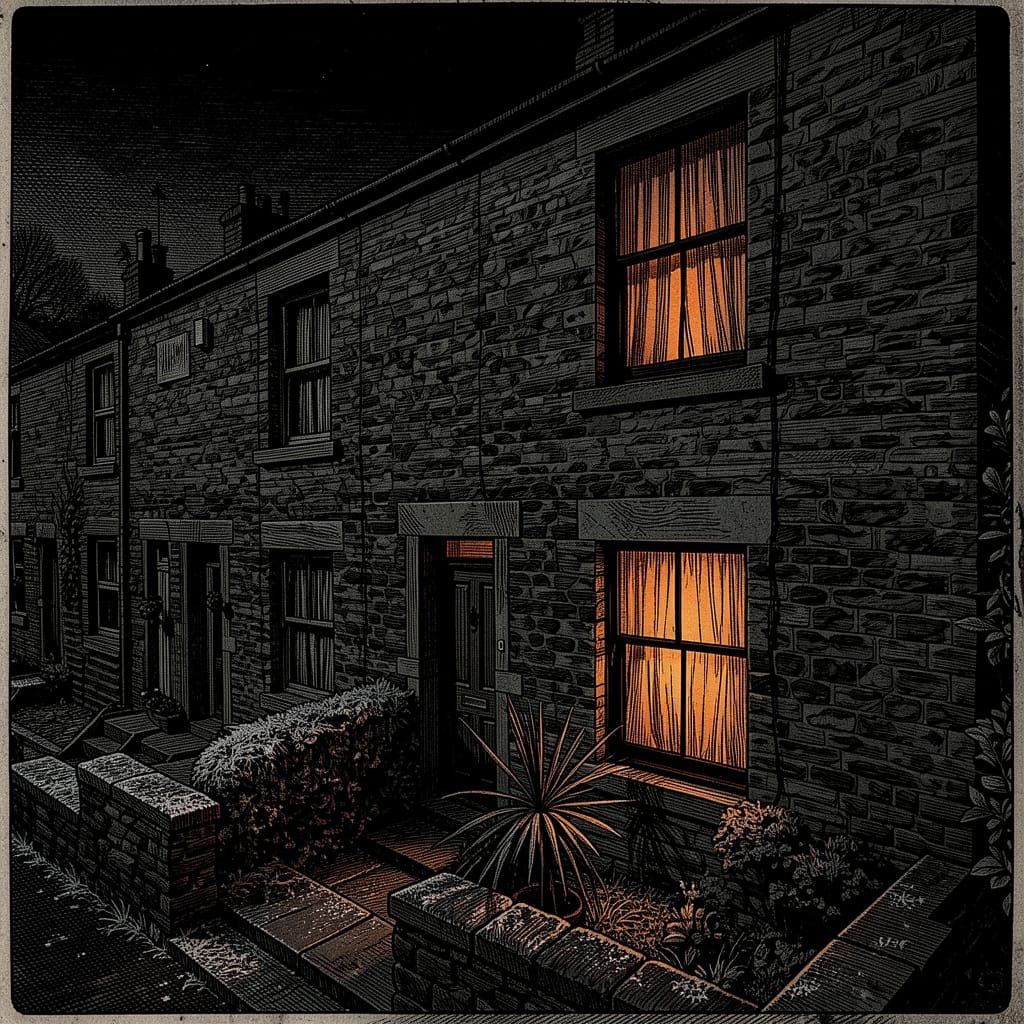
Stone terraced house, Haversage Road, Hope's End, Derbyshire.


Overview

13 Haversage Road is a stone terraced house on a quiet road in Hope's End, the small Derbyshire village in which much of the Book of Thoth Saga is set. It is the home of the brothers Ben Knight and Toby Knight, and of their nephew Robert Knight, whom they have raised at the address since infancy.

The house is the principal domestic setting of Cambion. A great deal of the novel takes place inside its kitchen, on its narrow stairwell, and in its three small bedrooms. Outside the family it is unremarkable; inside it, very little is.


Geography & Atmosphere

Number 13 sits part-way along Haversage Road, one of the older residential streets of Hope's End. The terrace is built of the rough gritstone characteristic of Peak District villages: weather-darkened, narrow-fronted, two storeys above ground, with a slate roof, single-glazed downstairs windows, and a small porch lantern beside the front door. A garden gate opens onto the pavement at the front; the back of the property gives onto a small yard.

The kitchen is the centre of the house. Its walls are ceramic-tiled; its floor is brown-and-orange patterned linoleum, worn through to a black underlayer in the patch by the sink. The chairs are 1970s brown vinyl, cracked along the seat backs. The wooden table carries the gouges, mug rings and old pen marks of years of family use, including, near one corner, the dent left by a toolbox of Ben's. There is a gas hob with an old whistling kettle whose spout has blackened with use, a fridge that hums perpetually, and, above it, a cheap plastic novelty wall clock cut in the shape of a fried egg, with two bacon-rashers for hands. The kitchen window looks onto the rear garden.

The hallway runs from the front door past the foot of the stairs to the kitchen. The stairs themselves have, over eight years, taught the family their habits — the third stair groans only if trodden on its edge; the pipes in the wall judder three times before the hot tap surrenders any water; the back door, swollen with successive winters of rain, refuses to latch unless slammed twice. The living room sits to one side of the hall: a sofa, a television, a sideboard with a record player, heavy curtains kept drawn against the afternoons. Its walls are lined with books, stacked, shelved and wedged sideways across most of the available surfaces. Since November 1995 it has, by quiet domestic arrangement, doubled as Robert's schoolroom, with a low coffee table acting as a desk.

Three bedrooms open off the upstairs landing — one for each Knight. Robert's contains an Alan Shearer poster from his Blackburn years, a peeling poster for Batman Forever, faint glow-stars affixed to the ceiling, and a single framed photograph of his mother on the nightstand. The atmosphere of the house, on a quiet evening with the radio on and the kettle going, is the atmosphere of any number of small Derbyshire homes of its age and class: warm, spare, slightly draughty. Visitors find it ordinary. The Knights, who live in it, have come to feel otherwise.

Construction & Setting

13 Haversage Road belongs to the vernacular tradition of small Peak District terraced housing: rough-coursed gritstone walls, slate roofs, stone surrounds to door and windows, modest internal volumes, party walls shared with the neighbours on either side. Houses of this type were built in considerable numbers across Derbyshire villages from the late eighteenth century through the Victorian period, often as quarry workers' or millworkers' cottages, and many remain occupied as ordinary family homes today. The address is, in that sense, architecturally indistinguishable from a great many surviving Peak District terraces. The road name — Haversage — carries a faint echo of the real Derbyshire village of Hathersage, a few miles north of the area in which Hope's End is sited; whether the resemblance is deliberate is not addressed in the text.


Role in the Saga — Cambion spoilers Contains plot reveals from Book One.

The Knight brothers did not choose the address themselves. It was given to them, in a single instruction, by their mother — Dorothy Knight — in the final letter she wrote to her sons in the hours surrounding the 1987 Hospital Incident at Shoreham Haven Hospital. Their sister Christine Knight had died in childbirth on 16 October 1987; her son had been recorded stillborn at 00:47 GMT and would be revived, unaided, seven years later. Dorothy's letter named the address as the destination for a child she would never meet, and instructed her sons to keep him hidden there. The instruction was a single line, unexplained.

You have to run—13 Haversage Road, Hope's End, Derbyshire—keep the child hidden. Remember your promise. There is no supernatural. Dorothy Knight, final letter, October 1987.

The choice of address was, on the available reading, deliberate. Hope's End sits more than two hundred miles from Shoreham, on the edge of the Peak District, in a valley whose principal civic quality is that nothing happens in it. The terrace at number 13 was, evidently, selected for exactly that ordinariness — a place a child of no recorded existence could grow up in silence, well below the threshold at which the agencies that had tried to ensure he was never born would notice he had survived.

By Cambion's late chapters, that protective ordinariness has begun to fail. The house is now a centre of activity rather than a hiding place; the village is being watched; and the long quiet of eight years at the address is, in operational terms, ending.

Anomalous Activity — Cambion spoilers Contains plot reveals from Book One.

From the autumn of 1995, the address exhibits a sustained and recognisable pattern of domestic anomaly, intensifying around Robert Knight and during periods of emotional pressure within the household. The most consistent of these is the recurring time 00:07, which appears on every timekeeping surface in the house under particular conditions: the kitchen wall clock, the oven display, the microwave, the bedside clock in Robert's room, the living-room clock, the counter on the video recorder. The kitchen clock above the fridge has, since one Tuesday whose date is never quite established, continued to read 00:07 whenever Robert is in the room.

Other recurring phenomena include the fridge's hum deepening in sympathy with raised voices, the television activating without contact, radio channels drifting between stations, and a pooling cold that accumulates in the house on certain mornings without meteorological cause. The pattern is consistent enough that Robert, by November, has stopped looking at clocks at all and learned to navigate the day by the quality of the light through the curtains and the movement of Toby's radio between programmes.

By November 1995, the house has come under formal surveillance from at least one Orion source. Phillip Lawson, a local resident with a long-dormant Orion background and an investigative role re-activated after his son's injury at school, files a residential observation report on 10 November 1995 logging a domestic spike at the address. A separate handwritten complaint — from the village post office, concerning ‘strange electrical interference’ whenever Robert stood near the scales — is intercepted before it can reach its addressee and shredded in the offices of Declan Marsden, who has spent eight years curating the public record of Robert's ordinariness on the family's behalf. The shredder, on this occasion, briefly stutters.

Trivia — Cambion spoilers Contains minor reveals from Book One.
  • The recurring clock time at the house is 00:07. The recorded time of Robert Knight's stillbirth, in Beowulf's 1987 records, is 00:47 GMT. The two times are not the same, and the discrepancy is not addressed within Cambion.
  • The address — 13 Haversage Road, Hope's End, Derbyshire — is named in full only once in the text, in the body of Dorothy Knight's 1987 letter as it is read by her surviving sons. The house has been the setting of the saga for forty chapters by the time the reader is told what its address actually is.
  • Although the house is, by November 1995, plainly anomalous to everyone who lives in it, the closing instruction of Dorothy Knight's final letter — there is no supernatural — remains the operating fiction maintained inside the household in Robert's presence. The brothers themselves discuss the subject when he is not there; in his hearing, number 13's wrongnesses are addressed in any vocabulary other than the obvious one.

Appearances

Title Role Notes
Cambion
Book One · Book of Thoth Saga
Primary Setting The saga's domestic centre. First appears as a setting in Chapter Four: Complications; named in full at the address level in Chapter Forty-Two.
Beauty and the Beast Within
Book Two · Book of Thoth Saga
Primary Setting Details forthcoming.
Hope's End
Book Four · Book of Thoth Saga
Primary Setting Details forthcoming.