


Livyaten

Livyaten — envy among the Seven

Entity Profile
Classification One of The Seven
Sin Correspondence Envy (Invidia) — per Binsfeld
Status Active (circling)
First Appearance Cambion, Book One · Book of Thoth Saga

Livyaten

"He does not want what you have. He wants you not to have it."


Overview

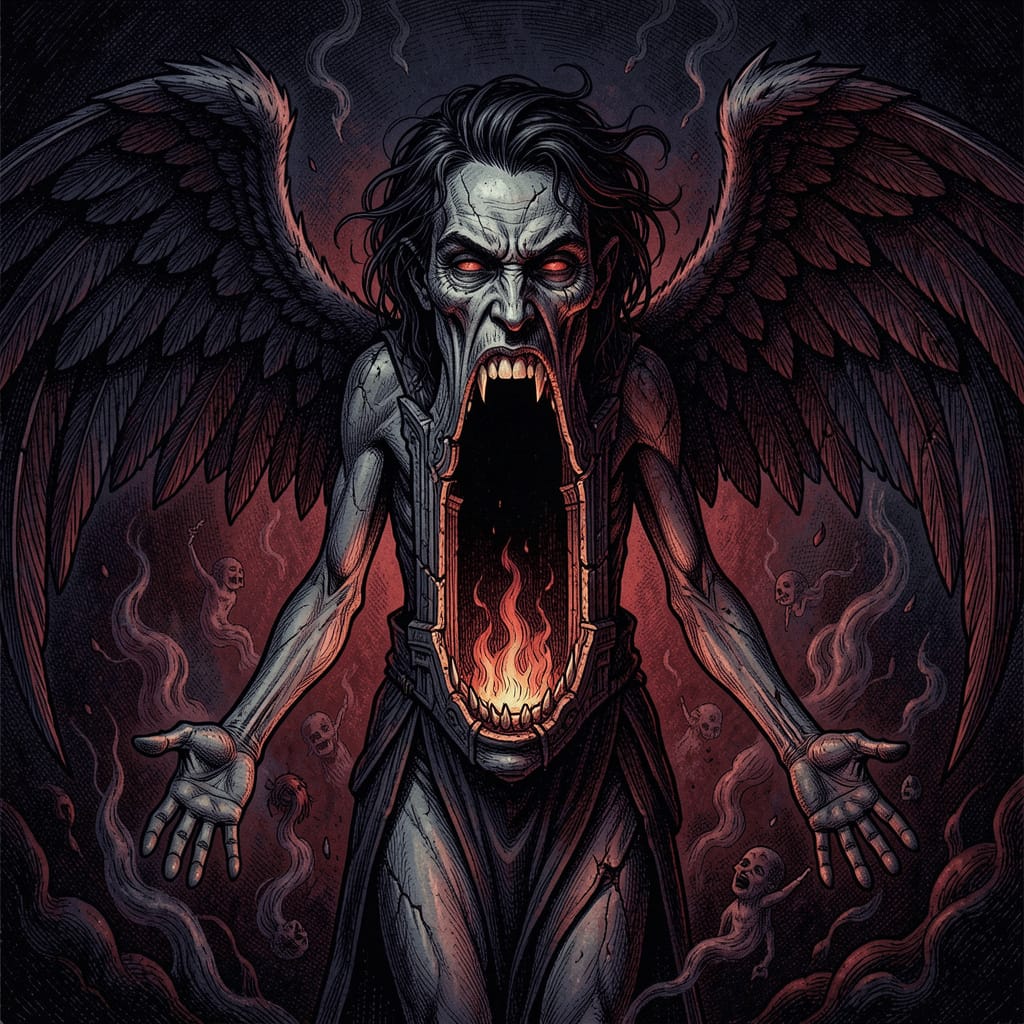
Livyaten is one of the Seven, corresponding to Invidia — Envy. A fallen angel of disputed origin, he is the most architecturally significant of the Seven: his body, in demonological tradition, contains a gateway — the Hellmouth, the opened jaw, the passage that leads not merely into darkness but into somewhere specifically other. He does not envy in the ordinary sense. He embodies the grief of another's good fortune — the specific, annihilating pain of witnessing something that should have been yours, and being unable to bear that it is not.

In Helen Marsden's analysis, Livyaten is Invidia isolating targets — the function of envy as a weapon of separation, turning a target's community against them through the amplification of resentment, status anxiety, and the specifically human tendency to find another's success intolerable. By the time a target is truly isolated, no direct intervention is required. Everyone around them has already decided, independently and for entirely human reasons, that they deserve to be alone. Livyaten's work is invisible because it looks entirely like other people making free choices.

Mythological Origins

Livyaten is a fallen angel whose nature and origin are disputed across traditions. The name derives from the Hebrew root meaning to coil or twist — a name shared with the primordial sea-serpent Leviathan, but distinct in character and function. Where Leviathan is a force of chaos, ancient and geological and ultimately destined to be defeated and consumed at the end of days, Livyaten is something more targeted: a fallen being whose specific domain is the corrosive intelligence of envy, the watching that undoes.

His defining characteristic across traditions is the open mouth — the Hellmouth, the gateway, the jaw that opens onto somewhere other than here. Medieval iconography placed the entrance to Hell in the mouth of a vast beast: the souls of the damned passing between teeth, descending into fire and absolute darkness. This image — the Hellmouth as architectural fact, as literal gateway in the body of an entity — belongs to Livyaten. He does not merely embody envy; he is the passage through which its consequences flow. What enters him does not return.

In the cosmology of the Aethereal Stories universe, Livyaten is a fallen angel who preceded the formal hierarchy of Hell — a being whose allegiance was shaped not by rebellion but by observation, by the long accumulation of watching others possess what he did not, by the specific theological suffering of a creature who can see paradise and cannot enter it. His fall was not dramatic. It was the slow wearing-away of a being who could not stop watching, could not stop comparing, could not stop being present at the moment of another's joy and finding it unbearable. The Hellmouth is the outward expression of that inner condition: the thing that opens when you cannot contain what you feel, the gateway that forms when envy becomes architecture.


Trivia

  • Livyaten's status in Cambion is active and circling — one of the two entities, alongside Mammon, whose proximity to the events of the saga is confirmed but whose direct involvement remains unresolved by the novel's end. The tightening of the Mammon pattern and the concurrent isolation of the Knight family — the village of Hope's End slowly ceasing to look directly at them, the school that will not take Robert back, the neighbours who have learned not to ask — may represent Livyaten's function in operation. Or it may be ordinary social mechanics. The distinction is not established.
  • The Hellmouth — Livyaten's open jaw as a gateway to the Abyss — is one of the oldest sustained visual metaphors in Christian iconography, present in manuscript illumination, church tympana, and mystery play staging from the early medieval period through the Reformation. The image predates any specific demonological attribution. The mouth as gateway precedes the angel as owner. Whether Livyaten inherited the symbol or the symbol found its entity is a question the archive does not resolve.

Appearances

Title Role Notes
Cambion
Book One · Book of Thoth Saga
Active (Circling); Invidia Function Named in Helen Marsden's analytical framework as the entity isolating targets. Status confirmed as active and circling by the novel's close. The social mechanics of Hope's End during the events of Cambion may reflect Invidia in operation.
A Glastonbury Tale
Book Three · Book of Thoth Saga
Antagonist Details forthcoming.
Hope's End
Book Four · Book of Thoth Saga
Antagonist Details forthcoming.
The Divine Ring
Book Five · Book of Thoth Saga
Antagonist Details forthcoming.
The Long Dawn
Aethereal Histories
Primary Antagonist Details forthcoming.