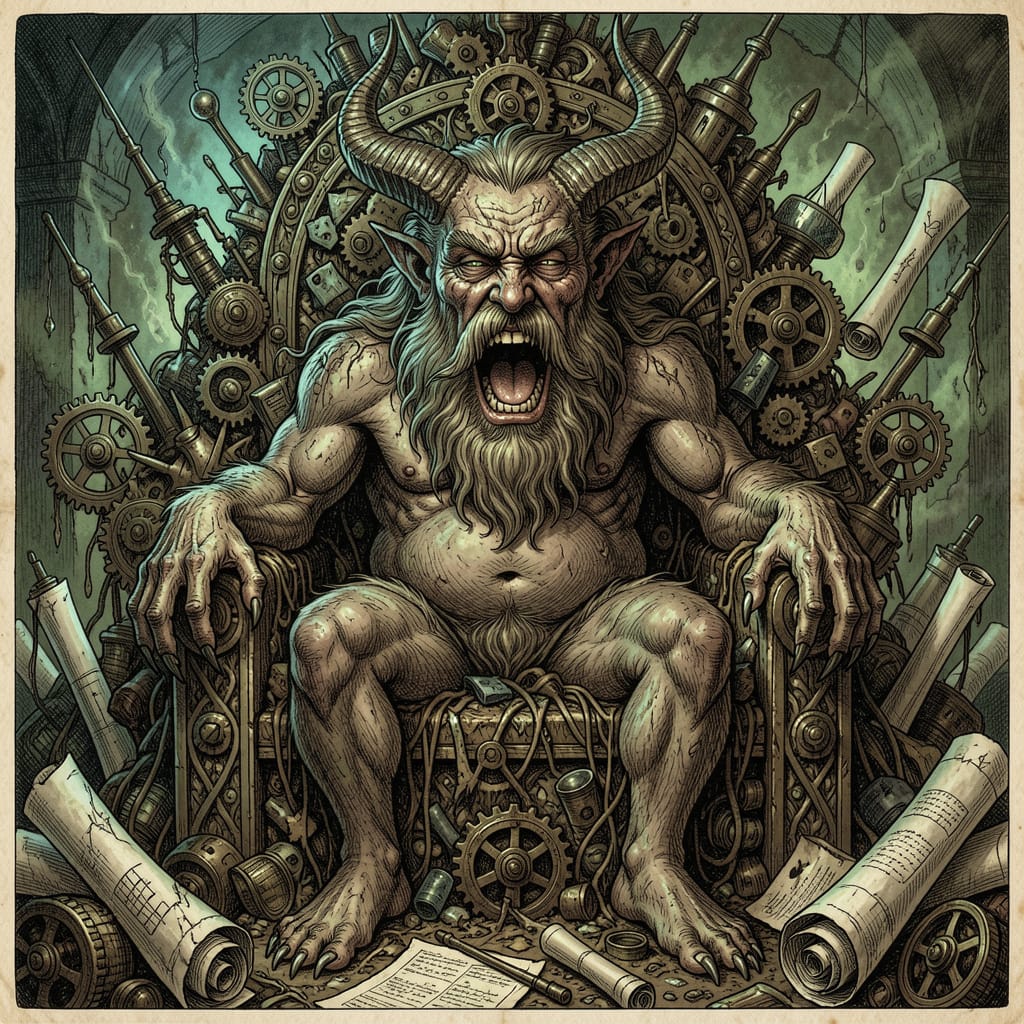
Belphegor

Belphegor — sloth among the Seven

Lore Profile
ClassificationOne of the Seven
Sin CorrespondenceSloth (Acedia)
OriginHebrew Ba‘al-Pĕ‘or — "Lord of the Gap"; the Moabite Baal-Peor
KingdomThe Fen — see the Seven Thrones
StatusActive
First AppearanceCambion, Book One · Book of Thoth Saga

Belphegor

"He does not make you lazy. He makes you certain that starting is not worth the effort."


Overview

Belphegor is one of the Seven, corresponding to Acedia — Sloth. He began as Baal-Peor, a Moabite deity worshipped at Mount Peor, and became, by the long process that recast the old gods of Israel's neighbours as devils, a prince of Hell: the demon of discoveries and ingenious inventions, and, in Binsfeld's reckoning, the demon of sloth.

His method is not torpor but seduction. He approaches through brilliant, irresistible ideas — inventions that will make one rich, discoveries that will change everything — and then watches as the idea proves unfinishable, the inventor grows apathetic, and the work collapses under the weight of its own promise. He does not oppose effort. He makes effort seem unnecessary, because the idea is already perfect in the imagination, and any execution can only diminish it.


Etymology & Name

The name Belphegor is a corruption of the Hebrew Ba‘al-Pĕ‘or — the "Lord of Peor," combining ba‘al (lord) with pĕ‘or, a word meaning "gap," "opening," or "cleft," at once the geographical feature of Mount Peor and a symbolic aperture. He is thus the "Lord of the Gap" or "Lord of the Opening." The Septuagint and Vulgate render the biblical name as Belphegor, the form that passed into demonology. In the Kabbalah he is named the "disputer," an adversary of the sixth sephirah, which is Beauty. His characteristic open mouth was later tied etymologically to Phegor — fissure, split — binding his very body to the openings through which he was once worshipped.

Mythological Origins

Baal-Peor appears in Numbers 25, in the episode at Shittim: the Israelites, encamped on the plains of Moab, attach themselves to the Moabite god, joining in his sacrifices and rites, which the text associates with licentiousness. The apostasy provokes a divine plague; the priest Phinehas intervenes with a violent act that ends it, and the worshippers are put to death. The local god of Moab becomes, in the Hebrew tradition, a byword for transgression and idolatrous seduction — the foreign cult that draws the faithful away through appetite.

The transition from Moabite deity to demon of Hell followed the familiar path by which the god of a rival people becomes the evil spirit of later theology. By the medieval period Belphegor had acquired his full demonological character: the demon who tempts through ingenious inventions, promising fame and wealth through discovery, and drawing his victims into greed, procrastination, and ruin through their own ambition. In Binsfeld's 1589 classification he is the chief demon of Sloth, the office he holds among the Seven.

His appearance in the literature is notably doubled. He can manifest as a beautiful naked woman — the seductive promise of the idea, the perfect vision before execution — or as a monstrous bearded demon with horns, sharp claws, and a gaping, permanently open mouth, enthroned on a seat of filth. The open mouth is characteristic and much remarked. His fullest literary treatment is comic: Niccolò Machiavelli's novella Belfagor arcidiavolo (published 1549), in which the demon is sent up from Hell to discover whether marriage is truly the misery the damned claim it to be, takes a wife, is ruined by her, and flees back to Hell convinced that human life is unendurable.


The Seduction of the Unfinished

Belphegor's domain is the subtlest of the seven, because it does not look like a vice at all. Sloth, in its theological sense — acedia — is not simple laziness but a spiritual listlessness, a failure to care, a refusal to take joy in the good and to make the effort it asks. Belphegor's genius is that he arrives disguised as its opposite: as inspiration, as brilliant possibility, as the idea so perfect it hardly seems to need the doing.

The trap is the gap between conception and execution — the opening that is his very name. The idea stands whole and shining in the mind; the work of making it real can only be laborious and diminishing; and so the work is never begun, or never finished, and the brilliance curdles into apathy. What looked like ambition becomes paralysis. The peculiar cruelty of sloth as Belphegor wields it is that it feels, from the inside, not like failure but like peace — the calm of a man who has decided, without quite noticing, that nothing is worth the trouble of starting.



Belphegor in Aethereal Stories — Acedia among the Seven In-universe lore. Contains worldbuilding and spoilers for the Book of Thoth Saga.

Within the Book of Thoth Saga, Belphegor holds the office of Sloth among the Seven and rules the kingdom of The Fen within the Seven Thrones. Of the Seven his function is the last to act and the hardest to see — the long institutional indifference that settles after the others have done their work.


Method

In Helen Marsden's analysis of the Seven's coordinated function, Belphegor is the entity ensuring no one cares enough to stop them. This is the tail of the operation — not the corruption, the seduction, or the violence, but the long indifference that settles afterward and makes certain no inquiry follows, no record survives, no one picks up the thread. By the time his influence is fully active, the other six have already done their work; he is the administrative closure of the campaign, the inquiry that never opened and the file that was never pulled.


The Genius of Sloth

The peculiar danger of Belphegor's function is that it produces no event to investigate. The other members of the Seven leave traces — a coin, a possession, an isolation, a death. Belphegor leaves an absence: of attention, of follow-up, of anyone caring enough to ask the next question. It is the perfect concealment, because there is nothing there to find. What looks like the matter having quietly resolved itself, like the world simply moving on, is the sin in full operation — and it is why, in the saga's reckoning, no campaign of the Seven is complete until Belphegor has closed it.


Trivia

  • Belphegor's function in Helen Marsden's Seven analysis — Acedia ensuring no one cares enough to stop them — positions him as the final stage of the operation rather than its initiating force. By the time Belphegor's influence is fully active, the other six have already done their work. He is the administrative closure of the campaign: the institutional forgetting, the inquiry that never opened, the file that was never pulled.
  • The legend of Belphegor's mission to Earth — sent by Lucifer to investigate whether married happiness was real, returning convinced it was a myth — is one of the earliest fully developed demonic comedy narratives in Western literature, told in various forms through the Renaissance and given its fullest treatment by Machiavelli in 1549. The entity's conclusion — that human relationships are irredeemably miserable — is the conclusion of a creature for whom effort at connection is already incomprehensible.
  • Belphegor's association with invention and discovery gave him, in the later occult tradition, an unexpectedly modern reputation: he was named the demon who inspires ingenious contrivances and technological breakthroughs, tempting through the promise of the great idea. The Kabbalistic tradition names him the "disputer," an adversary set specifically against the sixth sephirah — Tiferet, which is Beauty — a placement that casts his sloth as the enemy not of labour but of the harmony and completion that labour serves.

Appearances

TitleRoleNotes
Cambion
Book One · Book of Thoth Saga
Referenced — Acedia FunctionNamed in Helen Marsden's framework as the entity ensuring no one cares enough to stop the Seven's operation.
Hope's End
Book Four · Book of Thoth Saga
MentionedDetails forthcoming.
The Divine Ring
Book Five · Book of Thoth Saga
MentionedDetails forthcoming.