The Underworld in Tradition
Almost every culture that has left a record placed the dead somewhere — and that somewhere was, overwhelmingly, below. The instinct is older than any scripture: a realm beneath the living world, entered through cave, grave, or the setting sun, to which all the dead descend. What divided the traditions was not whether such a place existed, but what happened there. Two broad conceptions run through the ancient world. In the first, the underworld is morally neutral — a shadowed waiting-place where every soul goes alike, neither rewarded nor punished, simply gathered out of the light. In the second, later and more elaborate, it becomes a place of judgment, where the dead are sorted and the wicked suffer.
The Hebrew Sheol belongs firmly to the first kind: a comfortless place beneath the earth where slave and king, righteous and wicked, slept alike in silence and dust. The Greek Hades was much the same — a dim, shadowy expanse ruled by the god whose name it bore, holding the great mass of the dead as bloodless shades. So too the Mesopotamian Irkalla, or Kur, an egalitarian house of dust without moral division, and the Norse Helheim, a cold underground realm that received those who died of sickness and age while the battle-slain were taken to Valhalla — a division by manner of death, not by virtue. The fiery, judging underworld of popular imagination was a later development, and it is to that strand that the word “Hell” most properly belongs.
Underworlds of the World
The conception is near-universal, but its furnishings differ enormously from culture to culture. Some underworlds are journeys, some prisons, some courts; some are final, others a stage on the way to rebirth. The table below sets out the principal realms of the dead across the major traditions.
| Realm |
Tradition |
Ruler |
Character |
| Sheol |
Hebrew |
— |
The silent grave; the abode of all the dead alike, without reward or torment |
| Gehenna |
Jewish |
— |
A place of fire and judgment for the wicked; punishment everlasting, temporary, or ending in destruction |
| Hades / Tartarus |
Greek |
Hades |
A shadowed realm of all the dead, with the deep pit of Tartarus below for the wicked and the rebel Titans |
| Helheim |
Norse |
Hel |
A cold underground realm for those dead of sickness and age, set against the warriors' Valhalla |
| Jahannam |
Islamic |
— |
A fiery, multilayered realm of judgment crossed by a bridge finer than a hair; punishment measured to the sin |
| Duat |
Egyptian |
Osiris |
A nocturnal journey-space of trials, where the heart is weighed against the feather of truth |
| Irkalla |
Mesopotamian |
Ereshkigal |
The house of dust; a grey, egalitarian expanse without moral division |
| Naraka |
Hindu / Buddhist |
Yama |
Many-layered hells of hot and cold torment, suffered until karma is spent and the soul reborn |
| Diyu |
Chinese |
Yanluo Wang |
A bureaucratic maze of courts that punish and purify the soul before reincarnation |
| Mictlan |
Aztec |
Mictlāntēcutli |
Nine layers of trial, emphasising endurance of the journey over judgment of the soul |
Two patterns recur across this variety. Where the underworld punishes, it tends either towards the eternal — as in the Christian and Islamic hells, where the damned are fixed in their fate — or towards the purgatorial, as in the Hindu, Buddhist, and Chinese systems, where torment is a refining stage that ends in rebirth. And where it is governed, it is governed by a sovereign of the dead: Hades, Osiris, Ereshkigal, Yama, Yanluo Wang — a king or queen presiding over the realm below.
The Geography of Hell
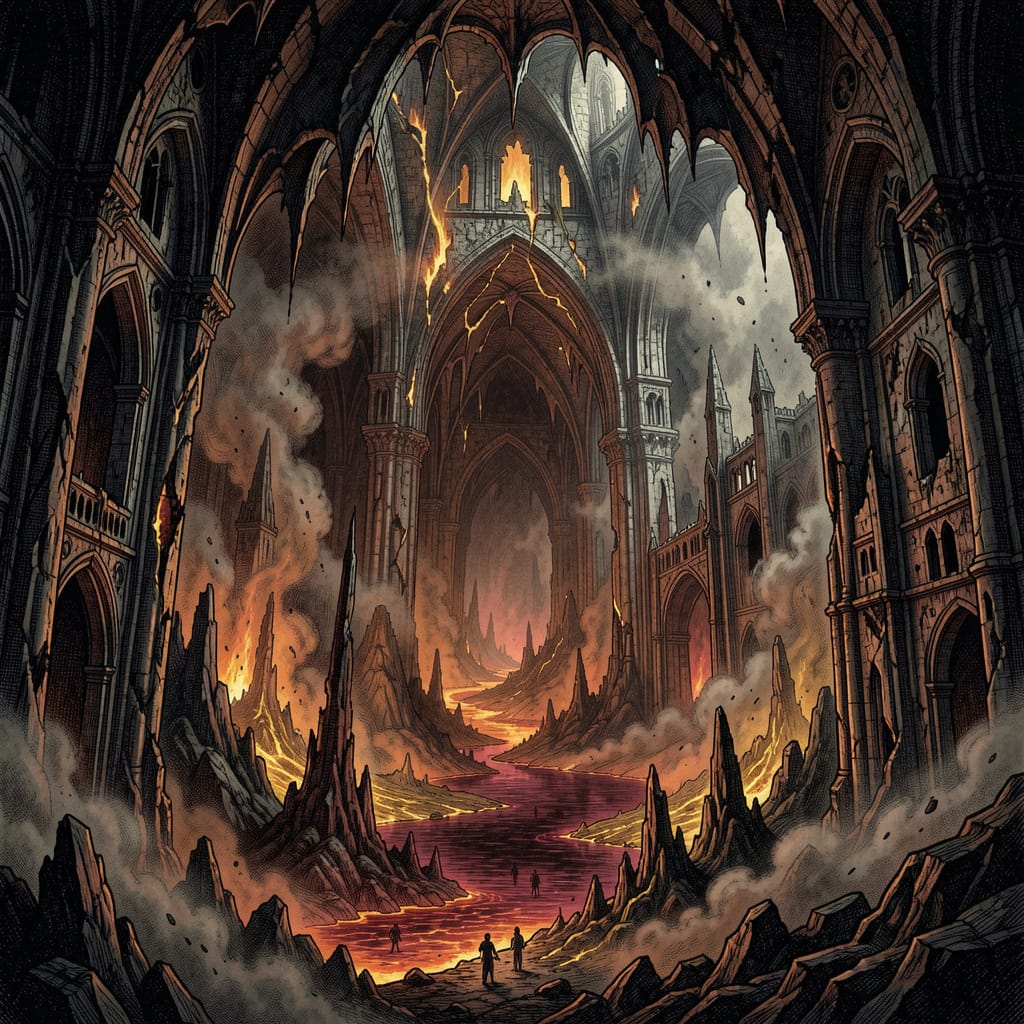
If the theology of Hell was assembled slowly, its geography — the Hell of nine circles and burning cities that the modern imagination pictures — was largely the work of poets. The most influential map was drawn by Dante Alighieri in the Inferno (c. 1308–21), the first part of the Divine Comedy. Dante imagined Hell as nine concentric circles descending into the earth, each holding a category of sinner and a punishment fitted to the sin, narrowing to the frozen centre where Lucifer himself is held in bondage. Halfway down, the iron-walled city of Dis — towered, gated, and guarded by fallen angels — divides the upper Hell of weakness and appetite from the lower Hell of deliberate malice. It is chiefly from Dante that the popular image of Hell as an ordered, descending, meticulously classified place of graded torment derives.
The other great architect was John Milton, whose Paradise Lost (1667) gave Hell not a torture-map but a capital. In Milton's telling the fallen angels, newly cast down from Heaven, raise a great city in a single day — Pandæmonium, literally the “place of all demons” — and there convene a council to debate their next move against Heaven. Milton's Hell is a polity: the defeated host organising itself, building, deliberating, governing its own affairs. This conception — Hell not as a pit for the human dead but as a kingdom raised and ruled by the fallen themselves — is the one the Aethereal Stories universe takes up and makes literal.
Punishment and the Damned
The idea that the punishments of Hell fit the sins that earned them is one of its most persistent features, and it reaches its fullest expression in Dante. There the principle is called contrapasso — the counter-suffering, in which the penalty mirrors or inverts the crime. The lustful, who let passion drive them, are driven forever on an endless wind; the gluttonous lie in cold and filthy slush; the wrathful tear at one another in the mire of the Styx; the violent are sunk in a river of boiling blood to the measure of their violence; flatterers are steeped in filth, and traitors frozen in ice at the bottom of the world, furthest from the warmth of divine love.
Beneath the imagery lies a moral architecture that long predates Dante: the conviction that the deepest places are reserved not for the weak but for the deliberately, knowingly wicked — that malice and betrayal are graver than mere appetite. It is the same logic that orders the deadly sins themselves, and the same logic the Seven embody in the cosmology of this universe, where each sin is not a failing to be punished but a domain to be ruled.
Hell in Aethereal Stories — the kingdom of the fallen
In-universe lore. Contains worldbuilding for the Aethereal Stories universe.
In the cosmology of the Aethereal Stories universe, Hell is a literal kingdom — the dominion built by the host that fell with Lucifer in the Fall. When the rebellion failed, a third of Heaven's host was cast down: exiled into the semi-physical realm that lies between Heaven and the physical universe, their divinity stripped from them and their power to take physical form denied. They did not vanish. In the realm of their exile they built a kingdom of their own — Hell — and made themselves its rulers.
Hell is therefore not a punishment imposed on the fallen from above. It is their own work, raised in defiance: a sovereign realm carved out of the middle realm by the defeated, and held by them ever since. Its rulers are the Seven — the apex of its hierarchy, each bound to one of the seven deadly sins.
The Seven Thrones
Hell is not a single undivided territory. It is partitioned into seven kingdoms, known together as the Seven Thrones — each an independent realm bound to one of the deadly sins, and each governed by the entity who holds that sin's office. The binding is to the sin, not to the demon: a sin is an eternal office, and the one who holds its throne may change across the ages, but the kingdom itself remains the kingdom of that sin whoever currently rules it. Each Throne takes its character from the vice that defines it.
Government
Though each of the Seven Thrones is independently governed within its own borders, Hell as a whole is not a tyranny under a single infernal monarch. It is a democracy. The seven sovereigns rule the kingdom collectively, sitting together as Council-7 — the ruling government of Hell, in which each Throne holds an equal voice and the affairs of the whole realm are decided in common.
No one of the Seven stands above the others; Lucifer's failed bid to set himself over Heaven is not repeated in the order the fallen built below. Power in Hell is held in balance between its seven rulers, and exercised through their council. The full constitution, membership, and workings of that council are recorded in the entry for Council-7.
Related Entries
Hell sits within the wider cosmology of the convergence. For the structure of the realms, see Heaven; for the event that brought the fallen there, the Fall; for its rulers, the Seven; and for its government, Council-7.
Appearances
| Title |
Role |
Notes |
Cambion
Book One · Book of Thoth Saga |
Cosmological Background |
The origin and nature of the Seven, and the realm from which they operate, established through Declan's research and Beowulf documentation. |
A Glastonbury Tale
Book Three · Book of Thoth Saga |
Cosmological Background |
Details forthcoming. |