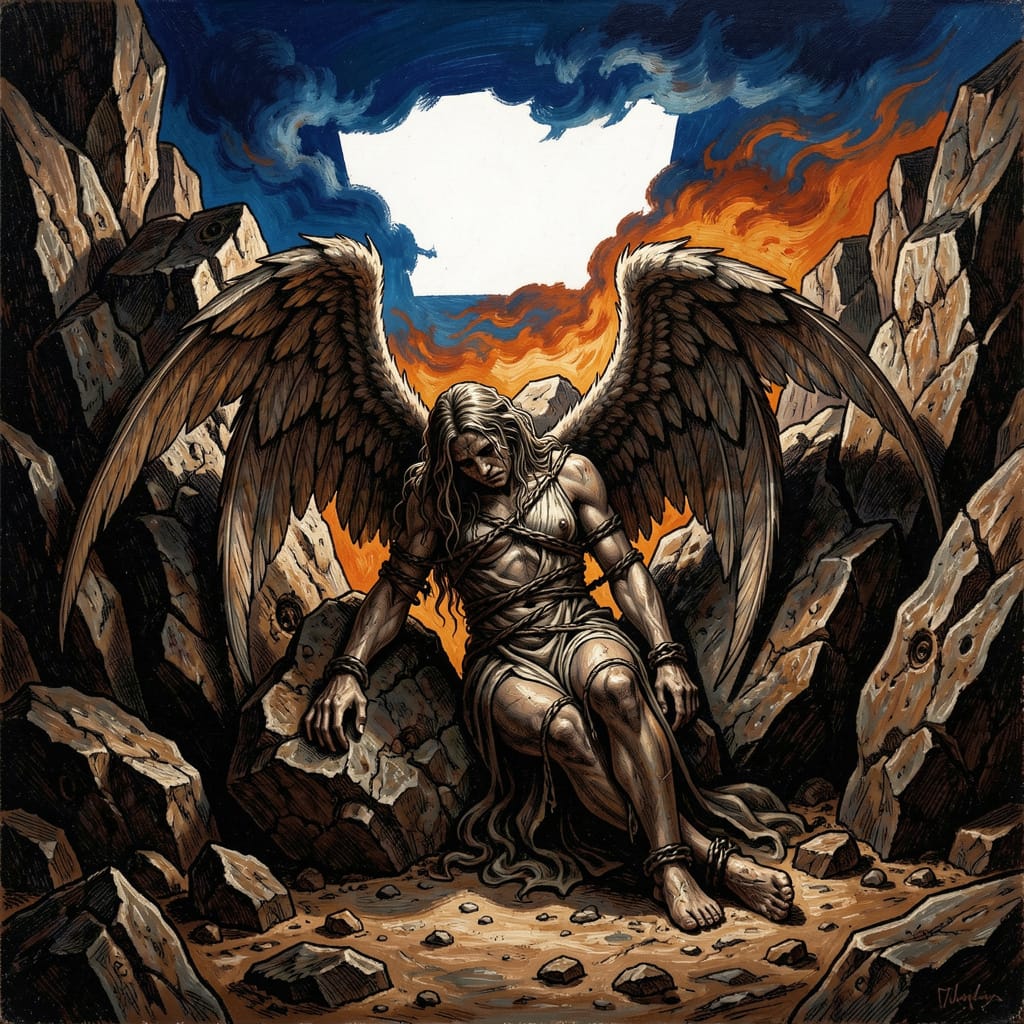
Azazel

Azazel — wrath among the Seven

Lore Profile
ClassificationOne of the Seven
Sin CorrespondenceWrath (Ira)
OriginLeviticus 16 (the scapegoat); the Watcher of the Book of Enoch
KingdomThe Pyre — see the Seven Thrones
StatusActive
First AppearanceCambion, Book One · Book of Thoth Saga

Azazel

"He does not make you angry. He teaches you what you already have the capacity to do with anger."


Overview

Azazel is one of the Seven, corresponding to Ira — Wrath. His domain is not rage in the ordinary sense but the systematic amplification of the human capacity for violence: the knowledge of how to hurt, how to kill, what weapons exist and how to use them. In the oldest traditions he is the entity to whom all sin is ascribed — not because he commits it, but because he taught the means that make it possible. He is the instructor, never the executioner. The execution is always human.

This is the crucial distinction of Azazel. He does not act; he equips. From the Book of Enoch onward he is the teacher of forbidden arts — the maker of swords, the revealer of metallurgy — and the record of what humanity has done with that teaching is the entire history of warfare. He provides the knowledge. The hands are ours.


Etymology & Name

The name Azazel (Hebrew ‘Azāʾzēl) is of contested meaning. It appears in Leviticus 16 in the phrase la-azazel — "for Azazel" — and has been read variously as a place (a desolate cliff or region of wilderness), an abstraction ("complete removal," or "the precipice"), and the proper name of a demon. The rabbinical tradition largely preferred to treat it as rough or desolate ground, avoiding any suggestion that a demon was receiving an offering — but the structure of the ritual, one goat for Yahweh and one for Azazel, implies a parity the later tradition laboured to deny. By the Book of Enoch the ambiguity has resolved: Azazel is a distinct fallen being, chief among the Watchers.

Mythological Origins

Azazel's earliest appearance is in the Yom Kippur ritual of Leviticus 16. Two goats are chosen: one for Yahweh, to be sacrificed, and one la-azazel — for Azazel — upon whose head the sins of the people are laid, and which is then driven out into the wilderness to bear them away. The scapegoat carries the community's guilt not into destruction but somewhere — to Azazel. It is one of the oldest acknowledgements in any religious tradition that the forces requiring propitiation include something other than the divine.

In the Book of Enoch the figure becomes explicit and terrible. Azazel is one of the chief Watchers — the Grigori, the angels who descended to earth and took human wives. He taught men to make swords, knives, shields, and breastplates; he revealed the metals of the earth and the art of working them; he taught the use of cosmetics and the art of deception. Enoch 8 is precise: "The whole earth has been corrupted through the works that were taught by Azazel: to him ascribe all sin." Seeing the corruption, God commands the archangel Raphael to bind Azazel hand and foot and cast him into the darkness — into a ravine at Dudael, covered with jagged rocks, his face covered that he may not see the light, there to wait until the day of judgement, when he is to be cast into fire.

The Apocalypse of Abraham shows him in another form — an unclean bird, his angelic nature reduced to the remnant of a celestial garment now reassigned to another. He has been stripped of what he was. What remains is the fallen thing, the teacher of weapons, bound in the desert under the weight of what he enabled. In the classification the Seven follow, Azazel holds the office of Wrath — a divergence from Binsfeld's own attribution, which placed Satan at Wrath, reflecting the shifting of the roster across the ages.


The Teacher of Violence

The comparison most often drawn to Azazel is Prometheus — the Titan who stole fire from the gods and gave it to humanity, and was bound and tormented for it. The parallel is exact in structure: both bring forbidden knowledge from a higher register down to mortals; both are punished with binding and suffering; both are defined by what that knowledge enabled. The difference is only in the framing. Prometheus is remembered as benefactor, Azazel as corruptor — yet the knowledge is the same. What divides them is not the gift but the judgement passed upon it.

The parallel also marks the limit of the comparison. Prometheus gave one gift and was done; Azazel's teaching did not end with the swords and the breastplates of Enoch. The tradition treats him as the permanent tutor of human violence — each age's means of killing understood as the same lesson taught again in a new form, from the forge to the furnace to whatever comes after. He is bound at Dudael and yet never absent, because the knowledge outlived the teacher and needs no further instruction to spread.



Azazel in Aethereal Stories — Ira among the Seven In-universe lore. Contains worldbuilding and spoilers for the Book of Thoth Saga.

Within the Book of Thoth Saga, Azazel holds the office of Wrath among the Seven and rules the kingdom of The Pyre within the Seven Thrones.


Method

In Helen Marsden's analysis of the Seven's coordinated function, Azazel is the entity executing dissenters — the enforcement arm of the operation, the means by which those who approach the truth are removed. True to the oldest traditions, the execution is always performed by human hands. Azazel provides only the knowledge of how those hands can be most effectively deployed. He has been providing that knowledge since before recorded history, and the record of what has been done with it is the whole of human warfare.


Why the Enforcement Is Never Caught

Within the saga, this is what makes Azazel's function so nearly impossible to prove. Where Mammon leaves a coin and Beelzebub leaves a documented possession, an enforcement laid at Azazel's door leaves a case file indistinguishable from any ordinary killing: a suspect with a motive, a weapon that can be accounted for, a verdict that closes. Nothing supernatural is present to find, because nothing supernatural was used. It is the reason the deaths that shadow those who look too closely at the Knight case — Helen Marsden's among them — can be read equally as murder or as coincidence, and why no investigation built on physical evidence has ever reached him.


Trivia

  • The Yom Kippur scapegoat ritual — one animal for Yahweh, one for Azazel — is one of the oldest documented acknowledgements in any religious tradition that the forces requiring propitiation include something other than the divine. The goat sent to Azazel carried the sins of the community. The sins are not destroyed. They are sent somewhere. The implication that Azazel receives them — that he is the appropriate destination for what humanity has done — is one the later tradition worked hard to contain and never entirely succeeded in erasing.
  • Azazel's comparison to Prometheus is made explicitly in scholarship on 1 Enoch: both are figures who brought forbidden knowledge from a higher register to humanity, both were punished with binding and suffering for it, and both are defined by what that knowledge enabled. The difference is that Prometheus is generally presented as benefactor. Azazel is presented as corruptor. The knowledge is the same. The framing is everything.
  • In the Book of Enoch the corruption Azazel spreads is specifically technological: he teaches not only the making of swords, knives, shields, and breastplates, but metallurgy itself, and — in the same breath — the working of ornaments, the use of antimony and cosmetics, and the beautifying of the eyelids. Weaponry and vanity are named together as a single lesson, so that the arts of killing and the arts of seduction descend to humanity from the same teacher and the same fall.

Appearances

TitleRoleNotes
Cambion
Book One · Book of Thoth Saga
Referenced — Ira FunctionNamed in Helen Marsden's framework as the entity executing dissenters.
Hope's End
Book Four · Book of Thoth Saga
ReferencedDetails forthcoming.
The Divine Ring
Book Five · Book of Thoth Saga
Minor AntagonistDetails forthcoming.