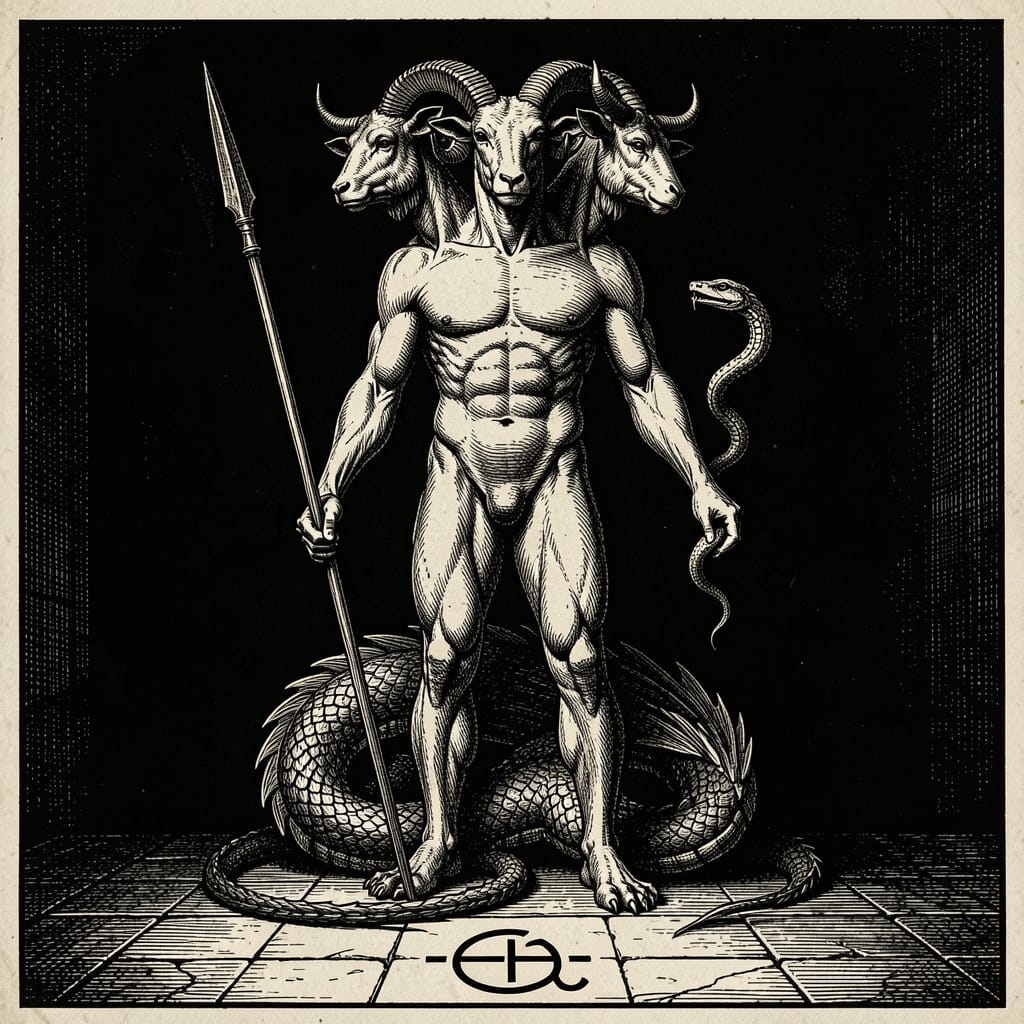
Asmodeus

Asmodeus — lust among the Seven

Lore Profile
ClassificationOne of the Seven
Sin CorrespondenceLust (Luxuria)
OriginAvestan aēšma-daēva — demon of wrath; the Book of Tobit
KingdomThe Embers — see the Seven Thrones
StatusActive
First AppearanceCambion, Book One · Book of Thoth Saga

Asmodeus

"He slew seven husbands before the marriage could be made. The eighth undid him with the smoke of a fish."


Overview

Asmodeus is one of the Seven, corresponding to Luxuria — Lust. He is among the oldest and most fully realised of the demonic figures the Seven draw upon: a king of demons in his own right, best known from the deuterocanonical Book of Tobit, where he is the primary antagonist, and from the Testament of Solomon, where he is bound and made to labour on the Temple. His roots reach back further still, into the demonology of ancient Persia.

His domain is lust, but the tradition consistently pairs it with jealousy and rage — desire that curdles into possession, and possession that turns murderous. In Tobit he does not merely tempt; he kills, slaying seven husbands in succession rather than allow another to have the woman he wants. He is the demon of desire made destructive: not the wanting, but the refusal to let anyone else have.


Etymology & Name

The name Asmodeus (Hebrew Ashmedai) is widely held to derive from the Avestan aēšma-daēva — where aēšma means "wrath" and daēva means "demon." In Zoroastrianism, Aeshma is the demon of wrath and fury; the compound "wrath-demon" gives Asmodeus a Persian ancestry older than his Hebrew appearances. This origin is telling: the demon the West came to know as the prince of lust carries a name that means wrath, and both currents — desire and rage — run through every version of him. Some Kabbalistic traditions give him a different parentage entirely, as the cambion offspring of a union between a mortal and a spirit.

Mythological Origins

Asmodeus enters scripture in the Book of Tobit (c. second century BCE). Sarah, daughter of Raguel, has been married seven times, and on each wedding night Asmodeus — who desires her, and will let no husband possess her — slays the bridegroom before the marriage can be consummated. When the young Tobias comes to marry her, the archangel Raphael instructs him: he burns the heart and liver of a fish on the embers, and the smoke drives Asmodeus away to Egypt, where Raphael binds him. It is one of the oldest exorcism narratives in the biblical tradition, and it fixes Asmodeus forever as the enemy of marriage and the destroyer of the marriage-bed.

The Testament of Solomon, a later pseudepigraphical text, gives him his second great story. Summoned before King Solomon by the power of a ring bearing the Seal of God, Asmodeus is compelled to confess his nature — that he plots against newlyweds, spreads madness of desire, and works to undo the happiness of the married — and is then forced to labour on the building of the Temple. In the Talmudic legends he is Ashmedai, king of the shedim (spirits): a more ambiguous, sometimes almost genial figure, who nonetheless tricks Solomon, seizes his throne, and reigns in his place for a time before the king returns.

In the grimoire tradition Asmodeus becomes a Great King of Hell. The Ars Goetia lists him as the thirty-second spirit, commanding seventy-two legions, appearing with three heads — one of a bull, one of a man, one of a ram — with the tail of a serpent, riding a dragon and breathing fire. He teaches geometry, arithmetic, astronomy, and the handicrafts, and reveals the location of hidden treasure. In Binsfeld's 1589 classification he is the demon of Luxuria — Lust — and the Malleus Maleficarum names him the same.


The Enemy of Marriage

Across every version, one thread holds constant: Asmodeus is the specific enemy of the marriage-bond and the union of husband and wife. In Tobit he murders to prevent consummation; in the Testament of Solomon he confesses that his work is to estrange the married and drive newlyweds apart; in the Talmud his desires turn upon Solomon's wives and Bathsheba. His lust is never presented as mere appetite but as something that destroys — that will not permit love to be completed in another, and will kill before it allows it.

This is what makes him the demon of Luxuria in its gravest sense: not desire as pleasure, but desire as the corruption and destruction of the bonds it should serve. The smoke of a fish's heart drives him off in Tobit, but he is never destroyed — only bound, only removed, always waiting to return to the threshold of the bridal chamber.



Asmodeus in Aethereal Stories — Luxuria among the Seven In-universe lore. Contains worldbuilding and spoilers for the Book of Thoth Saga.

Within the Book of Thoth Saga, Asmodeus holds the office of Lust among the Seven, and rules the kingdom of The Embers within the Seven Thrones.


Method

In Helen Marsden's analysis of the Seven's coordinated function, Asmodeus is Luxuria seducing cooperation — the function by which resistance is turned to complicity, by which those who might oppose are instead drawn in. His domain is not merely carnal but relational: the corruption of loyalty, the exploitation of desire in all its forms to bind people to a course they would otherwise refuse.

True to the oldest traditions, Asmodeus works through the destruction of bonds — the estrangement of those who should stand together, the isolation of a target from the people who might protect them, achieved not by force but by the slow poisoning of trust and the amplification of want.


Status in the Saga

Where Mammon is the first of the Seven caught in open activity — a coin trail anyone can follow — Asmodeus is the opposite kind of presence: never quite caught, but implied at every turn to run deeper and closer to the Knight case than the evidence will yet confirm. What the record holds are proximities, not proof.


The Marsden Investigation

The gravest material attached to Asmodeus within Cambion concerns the death of Helen Marsden — and, through it, the parentage of Robert Knight. None of what follows is stated as established fact within the saga. It is the conclusion drawn by Declan Marsden across nine years of unsanctioned investigation, corroborated independently by Daniel Marsden, and the archive records it strictly as their belief.

Three weeks after Helen Marsden filed the report that named what Robert truly was, she was found dead in a disused outbuilding in Shoreham. An identifying mark had been carved into her flesh below the left clavicle — a mark Declan later matched, symbol for symbol, to the Ars Goetia sigil of Asmodeus. The photograph that records it survives only as a newspaper photocopy: the original vanished from the evidence file within forty-eight hours of her death, and Declan obtained his copy through three separate channels over eighteen months. The pathologist's phrasing — defensive posturing consistent with prolonged awareness — points to a slow death, one Helen was conscious throughout. In Declan's reading, Asmodeus did not kill cleanly; it marked what it claimed.

Declan's investigation turned from documentation to something darker. In a locked, unmarked folder he keeps the angel-lore he is not cleared to hold, and beneath a woodcut of the three-headed Prince of Lust he set down a single practical question: how do you kill a fallen angel? He is also understood to keep a "stable" of bound, half-broken entities, which he interrogates in the hope that one of them will give up Asmodeus. He compels Ben Knight to stand in the room during these interrogations because the bound things fear Ben more than they fear Declan — Ben walking away each time with someone else's blood on him, staying only to stop it going too far. It is Asmodeus, above all the others, he is hunting — the one he holds responsible for Helen.

The parentage is the darkest thread. Both Declan and Daniel, through their separate investigations, came to believe that Asmodeus fathered Robert Knight. It is a belief consistent with the wider account of Robert as a pureborn cambion, and it is the reason Helen died: she had come close enough to the truth of what Robert was that something decided she had to be stopped, and signed the work.


Trivia

  • The Asmodeus sigil from the Ars Goetia — the mark carved into Helen Marsden's skin and the mark Declan places beside the woodcut — is described in precise geometric terms: a continuous line, a circle, a bar with vertical marks, a hooked loop, a dipping shape ending in a sharp tail. Geometric. Deliberate. The care with which it was placed on Helen is part of what tells Declan what kind of entity he is dealing with: one that takes its time, and signs its work.
  • Asmodeus's traditional attributes — Destroyer of Marriages, Keeper of the Seventh Heaven for Widowers — acquire specific resonance in the context of Declan Marsden's situation: a widower, nine years into a case that killed his wife, sitting with the name of the entity he holds responsible written on a page in front of him. Whether Asmodeus's traditional domain over widowers is the saga's comment on Declan's specific vulnerability is not stated. It is present.
  • Ben Knight's reported statement — that Declan believes Asmodeus did for his wife, and that Declan is after it — establishes that Declan's pursuit of Asmodeus is known to the Knight brothers. They have absorbed this information from Declan himself at some point prior to the conversation in which Ben reports it to Toby. Declan has told them. The degree to which this represents trust, tactical disclosure, or simply the exhaustion of nine years carrying it alone is not resolved.

Appearances

TitleRoleNotes
Cambion
Book One · Book of Thoth Saga
Referenced — Luxuria FunctionNamed in Helen Marsden's framework as the entity seducing cooperation. Implicated in the saga's documentary record.
Beauty and the Beast Within
Book Two · Book of Thoth Saga
Primary AntagonistDetails forthcoming.
Hope's End
Book Four · Book of Thoth Saga
Primary AntagonistDetails forthcoming.
The Divine Ring
Book Five · Book of Thoth Saga
Primary AntagonistDetails forthcoming.