


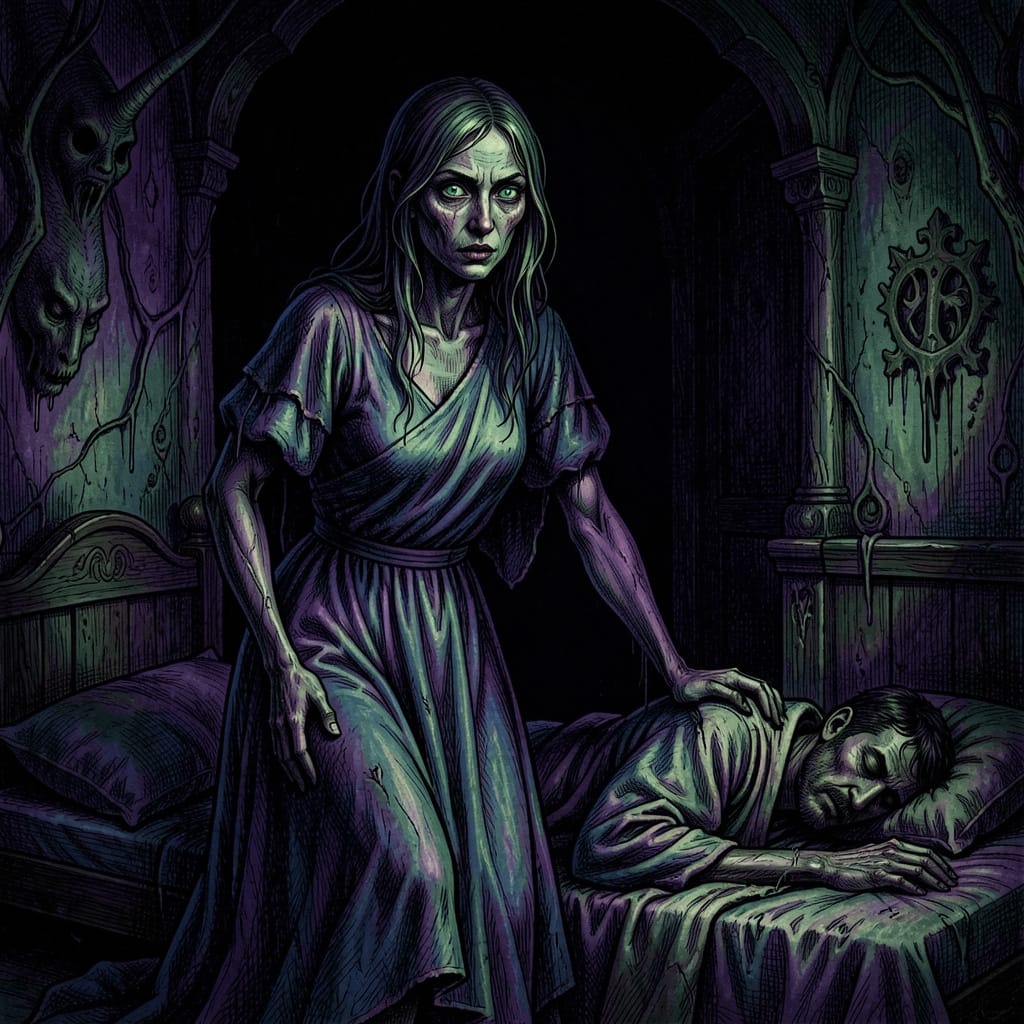
Succubus

Succubus — demonic entity; female aspect

Lore Profile
Classification Demonic Entity
Counterpart Incubus
Related Entities Agrat bat Mahlat
First Appearance Cambion, Book One · Book of Thoth Saga

Succubus


Overview

The word succubus appears in Declan Marsden's research files alongside incubus, in the demonological context of cambion origins. Both terms bleed from the page half-Latin, half-menace, carved into margins alongside symbols and hand-drawn figures. In the traditional framework the terms describe, a succubus is a demonic entity that assumes female form — a counterpart to the incubus, the two forming the dual mechanism by which, in scholastic demonology, demonic entities could mediate human reproduction for their own ends.

In the saga's specific mechanics, the figure who functions closest to the classical succubus framework is Agrat bat Mahlat — not because she seduced in the classical sense, but because she acted as broker and intermediary, preparing the vessel and opening the crossing. She is the key, not the occupant. The succubus tradition names the general category; Agrat bat Mahlat is the specific instrument deployed within it.

Mythological Origins

The succubus — from the Late Latin succuba, meaning to lie under — appears in medieval Christian demonology as a female demon that visits men during sleep to engage in sexual intercourse, drawing vitality and seed for demonic purposes. The earliest sustained theological treatment appears in the writings of church fathers grappling with the problem of demonic reproduction: Augustine of Hippo acknowledged persistent reports of such entities without committing to their mechanism; Thomas Aquinas in the Summa Theologica proposed the intermediary theory — that a demon might collect seed in succubus form and deploy it in incubus form, acting as a carrier between encounters rather than a biological participant.

In Jewish tradition, the succubus finds its most specific expression in the figure of Lilith — Adam's first wife in certain midrashic texts, who refused subordination and became a demon of the night, copulating with men in their sleep and producing demonic offspring. Her attendants in later tradition include Agrat bat Mahlat, Naamah, and Eisheth Zenunim — the four queens of the demonic realm in Kabbalistic demonology, each presiding over a different aspect of demonic seduction and night visitation. These are not allegories. In the tradition that produces them, they are operational entities.

Peter Binsfeld's 1589 taxonomy does not list the succubus as one of the Seven, but his classification of Asmodeus to Lust acknowledges the same domain. The succubus tradition and the Binsfeld taxonomy are two frameworks for the same cosmological fact: that demonic entities operate through sexual desire as a mechanism of entry into the human bloodline.


Trivia

  • The four queens of the demonic realm in Kabbalistic tradition — Lilith, Agrat bat Mahlat, Naamah, and Eisheth Zenunim — are each associated with a different night of the week and a different mode of demonic seduction. Agrat bat Mahlat is specifically associated with Wednesday nights and with the roads — she moves, rather than waits. This is consistent with her function in the saga as broker and intermediary rather than vessel.
  • The theological problem the succubus poses — how a non-corporeal entity produces physical offspring — was never satisfactorily resolved in medieval scholasticism. The Aquinas intermediary theory satisfied the mechanics but not the theology. The saga sidesteps the problem entirely by introducing Asmodeus as the biological father operating through a specific brokerage, which is a different mechanism and a more disturbing one: not a demon mimicking biological function, but a primordial entity crossing into the physical world through a prepared vessel.
  • The word succubus appears in Declan's files beside a hand-drawn figure: a woman whose hair falls like smoke. Daniel reads it by hallway light and does not yet have the framework to understand what he is reading. The image stays with him.

Appearances

Title Role Notes
Cambion
Book One · Book of Thoth Saga
Referenced in Research Documentation Appears in Declan Marsden's cambion research files alongside incubus, providing the classical demonological framework within which the saga's characters understand cambion begetting. Agrat bat Mahlat operates within this tradition as its specific instrument in the Knight case.