

Incubus

Incubus — demonic entity; male aspect

Lore Profile
Classification Demonic Entity
Counterpart Succubus
Role in Cambion Origins Traditionally the demonic parent in cambion begetting; see Cambion
Related Entities Asmodeus; Agrat bat Mahlat
First Appearance Cambion, Book One · Book of Thoth Saga

Incubus


Overview

The word incubus appears in Declan Marsden's research files on cambion origins, half-Latin, described as bleeding up from the page with menace. It appears alongside succubus in the margins of documents about Robert Knight's nature, beside hand-drawn figures with watching eyes. Both terms frame the theoretical underpinning for how a cambion is made — and therefore how Robert came to be.

In the demonological tradition drawn on by the saga's research documents, an incubus is a demonic entity that assumes male form to father children on human women. The theological problem this poses — how a being without a body produces biological offspring — was addressed in medieval scholastic writing through the theory of demonic intermediary: that the demon could act as a carrier between a human man and a human woman, or in later developments of the tradition, that entities capable of crossing into the physical world through specific conditions could father children directly.

The saga's mechanics are more specific. Asmodeus — Prince of Lust, the third of the Seven — fathered Robert not through classical incubus mechanics but through Agrat bat Mahlat's brokerage. The incubus framework is the tradition the characters are working within when they reach for language to describe what happened. The actual mechanism exceeded it.


In the Research Files

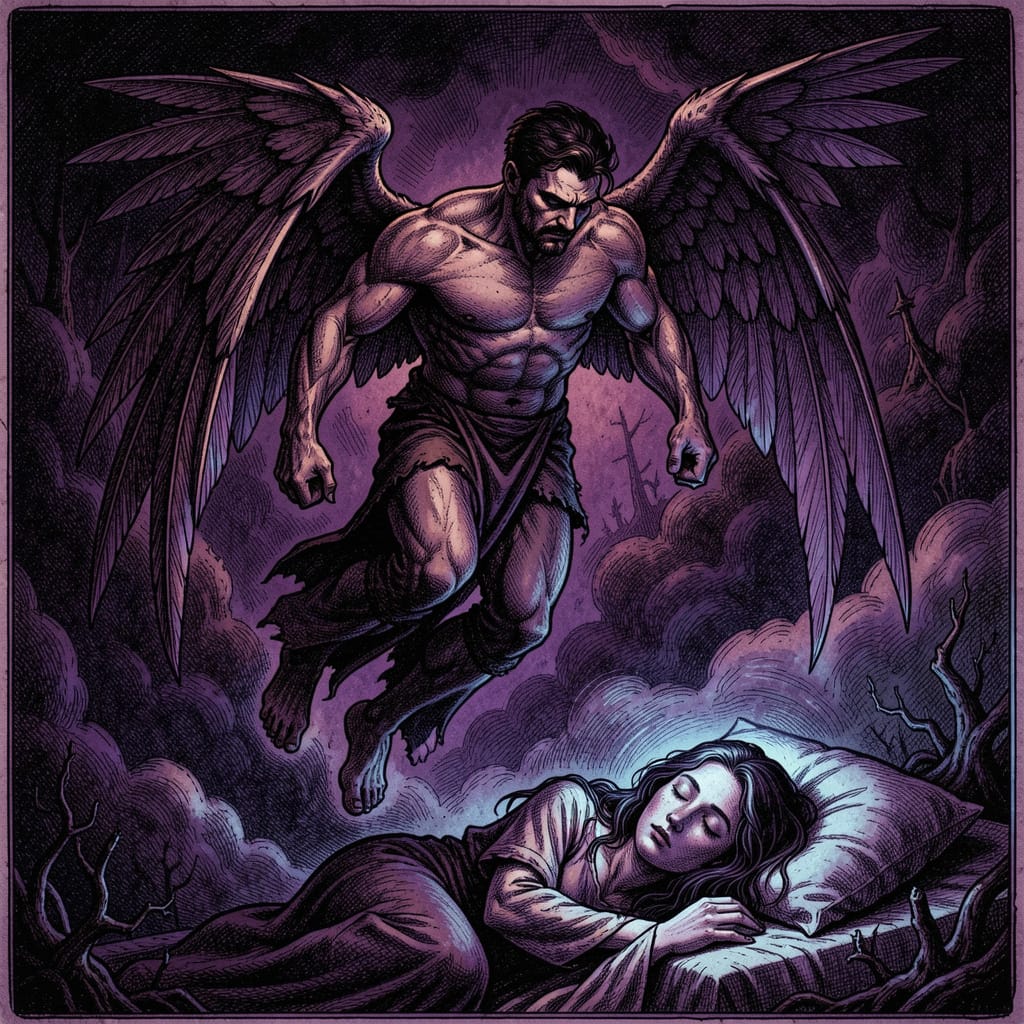
Daniel Marsden, reading his father's files by hallway light, finds the word among the documents on cambion origins: Incubus. Succubus. The words are half-Latin and half-menace. The margins are carved with furious ink — notes, symbols, hand-drawn figures with watching eyes. One image shows a figure caught halfway between beauty and hunger: a woman whose hair falls like smoke, a man whose wings are shadow pretending to be bone, and between them a child half-born, half-stolen.

The image is the traditional iconography of cambion begetting in medieval demonology. The notes beside it are not medieval. They are Declan's own — methodical, specific, working toward a conclusion about a specific child born on 16 October 1987. The tradition and the present case sit on the same page, and Daniel reads both without yet having the framework to separate them.

Mythological Origins

The incubus — from the Latin incubare, to lie upon — is the male aspect of the demonic sexual entity in medieval Christian demonology, the counterpart to the succubus. Where the succubus visits men, the incubus visits women. The distinction matters in the context of cambion begetting: the incubus is the father-figure in the taxonomy, the entity whose seed — however mediated — produces the half-demonic child.

The theological mechanics were debated with considerable seriousness by medieval scholastics. Thomas Aquinas, in the Summa Theologica, proposed that a demon could collect human seed in succubus form and deposit it in incubus form, acting as a carrier — preserving vitality through demonic means — rather than generating seed of its own. This preserved the theological principle that demons, as non-corporeal beings, lacked biological capacity, while accounting for the persistent folk tradition of demonic paternity. Martin Luther accepted the reality of incubi without endorsing the Aquinas mechanism. Peter Binsfeld classified them within the broader demonological system he used to organise the Seven.

In Kabbalistic tradition, the equivalent figure is found among the male demonic consorts of Lilith and her court — entities who father shedim on human women, producing offspring that are neither fully human nor fully demonic. The cambion tradition in the saga draws on both the Latin scholastic framework and the Kabbalistic one, the two traditions sitting on the same research page with equal weight.


Trivia

  • The medieval Church's insistence on debating incubus mechanics at length — Aquinas, Bonaventure, Martin of Arles, Heinrich Kramer in the Malleus Maleficarum — reflects a genuine theological anxiety: if demons could father children, the implications for the doctrine of human soul and biological lineage were significant. The cambion as a category is the direct consequence of taking that anxiety seriously as a cosmological fact rather than a superstition to be dismissed.
  • In the Malleus Maleficarum (1487), Heinrich Kramer devotes considerable attention to the incubus as a vector of witchcraft, arguing that witches frequently had sexual relations with demons and that the demon in such cases was real, present, and physically effective. The book was among the most widely distributed texts in Europe after the Bible. Declan Marsden's research files draw on this tradition without endorsing its prosecutorial conclusions.
  • The image beside the word incubus in Declan's files shows a man whose wings are shadow pretending to be bone, and between him and a woman a child half-born, half-stolen. Daniel reads it and does not yet know that the image is a description of his best friend's origins. The files do not explain themselves. They simply document.

Appearances

Title Role Notes
Cambion
Book One · Book of Thoth Saga
Referenced in Research Documentation Appears in Declan Marsden's cambion research files, read by Daniel by hallway light. The word appears alongside succubus in the demonological context of cambion begetting. The actual mechanism of Robert's conception exceeded the classical framework the term describes.