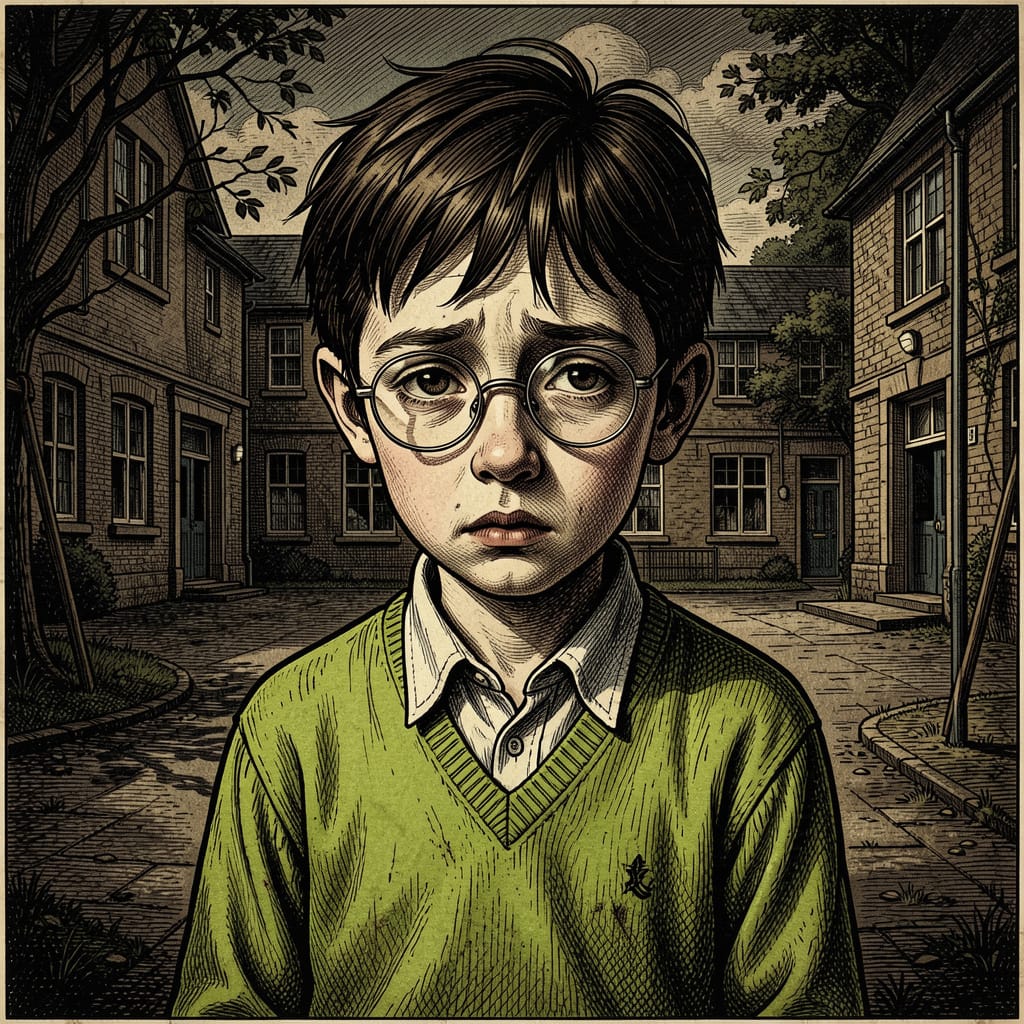
When Robert’s punch dropped Michael, Adam backed against the wall, one hand pressed flat to the brick, breathing fast and shallow as if trying to disappear into the limestone. His glasses sat crooked. He was not looking at Michael’s blood or Robert’s hands. He was looking at his own feet.
When Mrs Jenkins arrived and Kevin told her He punched him. Out of nowhere, Adam muttered, eyes still on the ground: He was just standing there. It was the closest thing to a defence Robert got from anyone in that group. Adam did not know he had said something that mattered. He was just saying what he had seen.
Daniel later told Declan that Kevin and Adam had been behind Robert when the punch landed and had only seen Michael fall. Robert himself, much later, remembered it the same way: Kevin and Adam backed off. I don’t remember the moment. It was like I slipped and something else stepped in. Adam backed off before he understood why. That instinct — the body knowing before the mind did — is, arguably, the most accurate response anyone in the cycle shelter had to what they witnessed.
Adam grew up above a shop on Hope’s End high street. His parents ran it, or worked in it, or rented above it; the specifics are the kind that settle into the background of a village without needing to be stated. His home life was ordinary in the way that ordinary is a thing unto itself: two parents, regular meals, the particular unremarkableness of a household where nothing dramatic happens and the main tensions are homework and bedtime. He was not neglected. He was not unhappy. He was, by most measures, fine.
The problem with being fine, in Hope’s End, was that fine was not the same as belonging. Adam was the kind of child who existed at the edge of every group without quite being in any of them — too cautious for the rough boys, too eager-to-please for the children who didn’t need anyone’s approval. His wire-rimmed glasses and his tendency to ask questions at the wrong moment marked him as the kind of kid other kids decided about without telling him. By Year Four he had understood, without being able to articulate it, that belonging required purchase, and that purchase required proximity to whoever had the most of it.
Michael Lawson had the most of it. Not because anyone particularly liked him, but because the social architecture of Stepping Stones Primary ran on fear and adjacency, and Michael had positioned himself at the centre of both. Adam attached himself to the orbit not out of cruelty or loyalty but out of the quiet, animal logic of a child who had worked out that the alternative was being the boy in the cycle shelter with his console held out of reach. He had, at various points, been that boy anyway. The arrangement was imperfect. He took it.
What he did not have, by Year Six, was Michael’s gravitational pull to attach himself to. The Lawsons had moved away. Kevin Sharpe, his other point of orbit, had gone quiet in a way that other children noticed without quite understanding. The boys Adam had spent two years adjacent to as a survival strategy had effectively dispersed without him. He was on his own with his glasses and his Game Boy and the small unremarkable life his parents had given him, and that turned out, to his own quiet surprise, to be enough. He read a lot. He stopped asking questions at the wrong moment. He became, in the way of children who have spent too long trying to be other people, somewhat himself.
The bike shed has not entirely left him. He thinks about it less often than Kevin does, and remembers it less specifically. What stays is the moment after the punch, when he was looking at his own feet, and the sense — not formed enough to be a thought — that something had happened in the cycle shelter that the adults were not going to ask the right questions about. He muttered the truest sentence he knew that morning. He was just standing there. Nobody seemed to hear him. He has wondered, on and off, whether it would have mattered if they had.