


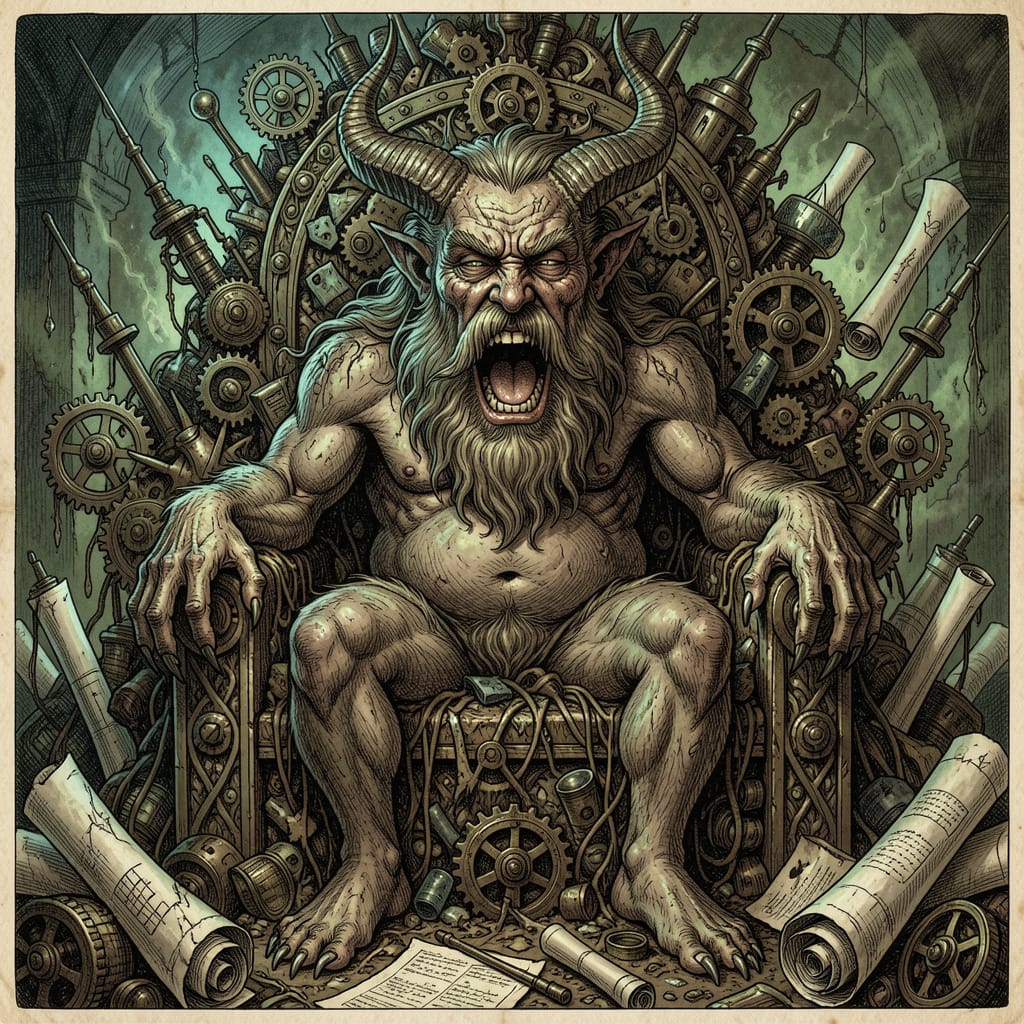
Belphegor

Belphegor — sloth among the Seven

Entity Profile
Classification One of The Seven
Sin Correspondence Sloth (Acedia) — per Binsfeld
Status Active
First Appearance Cambion, Book One · Book of Thoth Saga

Belphegor

"He does not make you lazy. He makes you certain that starting is not worth the effort."


Overview

Belphegor is one of the Seven, corresponding to Acedia — Sloth. His method is not torpor but seduction: he approaches through brilliant, irresistible ideas — inventions that will make you rich, discoveries that will change everything — and then watches as the idea proves unfinishable, the inventor grows apathetic, and the work collapses under the weight of its own potential. He does not oppose effort. He makes effort seem unnecessary, because the idea is already perfect in the imagination and the execution can only diminish it.

In Helen Marsden's analysis of the Seven's coordinated function, Belphegor is Acedia ensuring no one cares enough to stop them. This is the tail of the operation — not the corruption, not the seduction, not the violence, but the long institutional indifference that settles after the other six have done their work and makes certain that no inquiry follows, no record survives, no one picks up the thread. The genius of Acedia as a weapon is that it looks like peace.

Mythological Origins

Belphegor's origins lie in the ancient Moabite deity Baal-Peor — the Lord of the Gap, or Lord of the Opening, worshipped at Mount Peor east of the Dead Sea. The name ba'al-pe'or in Semitic combines ba'al (lord) with pe'or, a word for crevice, opening, or gap — both geographical and symbolic. In Numbers 25, the Israelites at Shittim are condemned for attaching themselves to Baal-Peor, a cult associated with licentiousness and orgiastic rites. Moses orders the perpetrators executed. The deity of Moab becomes, in the Hebrew tradition, a name for transgression.

The transition from Baal-Peor to Belphegor as a demon of the infernal hierarchy occurs through the standard mechanism of demonisation: the local god of a rival people becomes the evil spirit of later theology. By the medieval period Belphegor had acquired his full demonological personality: in Binsfeld's classification he corresponds to Sloth; in the Ars Goetia and related grimoires he is a Prince of Hell who tempts through the seduction of ingenious inventions, promising fame and wealth through discovery, drawing his victims into greed, procrastination, and ultimately ruin through their own ambition.

His appearance in demonological literature is notably doubled. He can appear as a beautiful naked woman — the seductive promise of the idea, the perfect vision before execution — or as a monstrous bearded demon with horns, sharp claws, and a gaping permanently open mouth, seated on a toilet or throne of waste. The open mouth is characteristic: the theologian Wierus noted it specifically, deriving it from the name Phegor, meaning fissure or split, linking his body to the crevices and apertures through which he was once worshipped. His palindromic prime number — 1000000000000066600000000000001, Belphegor's Prime — is a modern mathematical coincidence that the entity would find entirely characteristic of its domain: a thing that looks significant and turns out, on examination, to be mostly zeros.


Trivia

  • Belphegor's function in Helen Marsden's Seven analysis — Acedia ensuring no one cares enough to stop them — positions him as the final stage of the operation rather than its initiating force. By the time Belphegor's influence is fully active, the other six have already done their work. He is the administrative closure of the campaign: the institutional forgetting, the inquiry that never opened, the file that was never pulled.
  • The legend of Belphegor's mission to Earth — sent by Lucifer to investigate whether married happiness was real, returning convinced it was a myth — is one of the earliest fully developed demonic comedy narratives in Western literature, told in various forms through the Renaissance and given its fullest treatment by Machiavelli in 1549. The entity's conclusion — that human relationships are irredeemably miserable — is the conclusion of a creature for whom effort at connection is already incomprehensible.

Appearances

Title Role Notes
Cambion
Book One · Book of Thoth Saga
Referenced — Acedia Function Named in Helen Marsden's analytical framework as the entity ensuring no one cares enough to stop the Seven's operation. Not directly present in the events of Cambion.
Hope's End
Book Four · Book of Thoth Saga
Mentioned Details forthcoming.
The Divine Ring
Book Five · Book of Thoth Saga
Mentioned Details forthcoming.