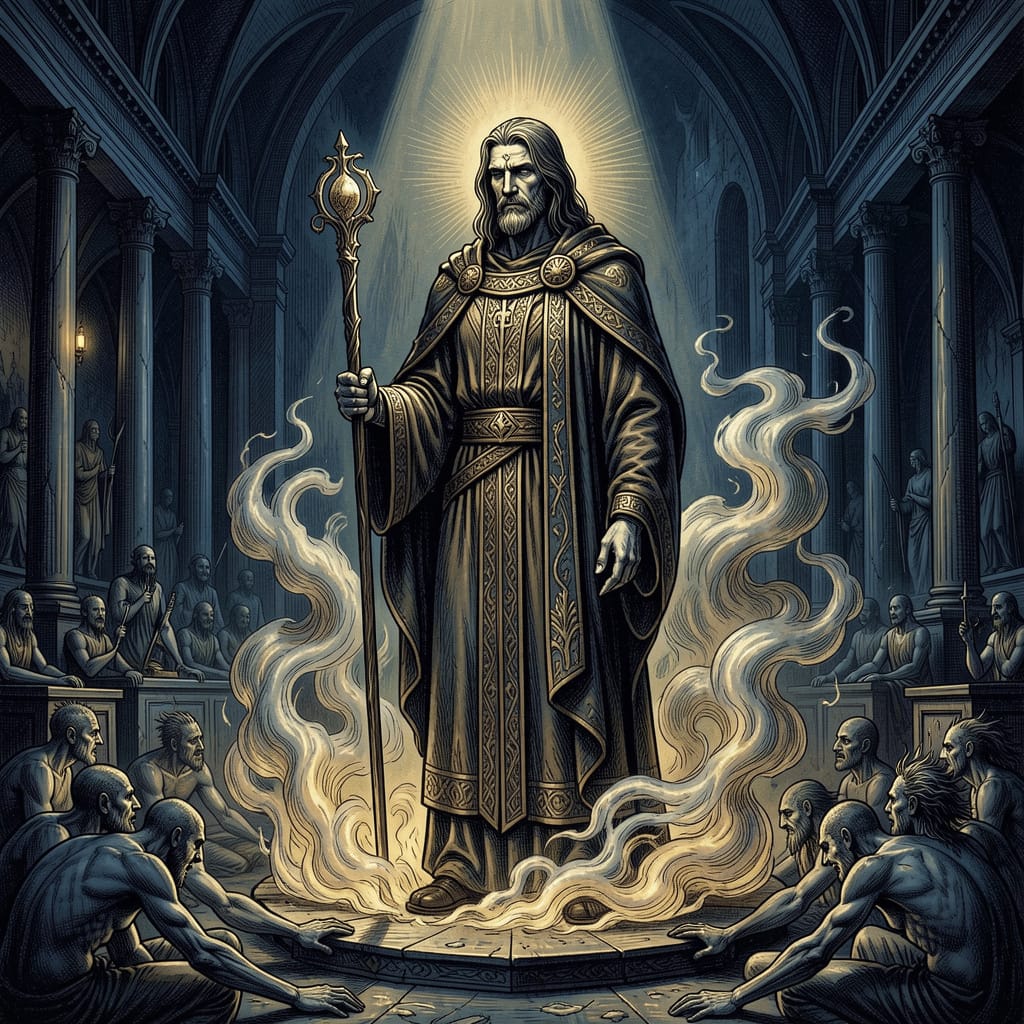
Mastema

Mastema — pride among the Seven

Lore Profile
Classification One of the Seven
Sin Correspondence Pride (Superbia)
Origin The Book of Jubilees; the angel of mastemah — enmity
Kingdom The Spire — see the Seven Thrones
Status Active
First Appearance Cambion, Book One · Book of Thoth Saga

Mastema

"He did not rebel against Heaven. He was given permission."


Overview

Mastema is one of the Seven, corresponding to Superbia — Pride. He originates in the Book of Jubilees, a Second Temple Jewish text, as an antagonistic angel whose defining characteristic is that he acts not against the divine order but within it. Of all the demonic figures gathered under the Seven, he is the most theologically ambiguous: not a rebel, but an instrument; not a thief of authority, but its licensee.

What sets Mastema apart from every other figure the Seven draw upon is the source of his power. He is not a rebel who seized authority against Heaven, but an adversary who was granted it — a prosecutor operating inside the divine court, licensed to test and to tempt, whose every action is permitted rather than usurped. It is a distinction that makes him, in some readings, stranger and more troubling than the Devil of later tradition: an adversary who serves the very order he afflicts, and whose licence comes from above rather than against it.


Etymology & Name

The name Mastema (Hebrew Maśṭēmā; also Mastemat or Mansemat) is a personification of the Hebrew common noun mastemah, meaning “hatred,” “hostility,” “enmity,” or “persecution.” It is one of the rare cases in which an abstract quality of opposition became, through the literature that used it, the proper name of a distinct entity. In the writings of the Second Temple period the name appears some eighteen times — second only to Belial, which occurs far more often — as a designation for the chief of the opposing spiritual forces. Where Belial is associated with worthlessness, Mastema is associated with active enmity: the prosecution rather than the corruption, the challenge rather than the temptation.

Mythological Origins

Mastema appears in the Book of Jubilees, a Jewish text dated to approximately 170–150 BCE that retells the events of Genesis and the early chapters of Exodus. In it he functions much like the Satan of the Book of Job — an accuser operating within the divine court, granted licence to test and prosecute, and never exceeding the permissions he has been given. He is described as the chief of the spirits of the Nephilim, the disembodied entities of the half-angelic offspring of the Watchers, whose nature is to corrupt the children of men.

His origin as a power in the world is a matter of a bargain. When God prepares to bind all the evil spirits after the Flood, and Noah prays that his descendants be freed from their affliction, Mastema intervenes: he beseeches God to allow him to retain one tenth of these spirits under his command, to tempt and test humanity before the day of judgement, “for the evil of the sons of men is great.” God grants the request. One tenth of the spirits remain, and Mastema commands them. His authority is not seized in rebellion — it is petitioned for, and licensed. This is the theological crux of the figure: his power exists by permission.

Throughout Jubilees, Mastema is the adversarial hand behind the trials of the patriarchs. It is Mastema, not Satan, who urges God to test Abraham with the sacrifice of Isaac. He is the force that seeks to kill Moses on his return to Egypt, and it is Mastema who releases the Egyptian magicians to counter the plagues, and whose powers are credited with the death of the Egyptian firstborn. He is bound while Israel departs Egypt, then loosed to drive the Egyptians into the sea and their doom. In the Dead Sea Scrolls, the Damascus Document refers to the “angel of mastema” — the prosecutorial angel, adversarial by definition. Notably, the text implies he does not fear imprisonment alongside the Nephilim: he is of a different order, an angel who serves rather than a spirit to be bound.


Mastema and Satan

The relationship between Mastema and the figure of Satan is close enough that many readers have treated them as one. In Jubilees, the entity Belial (or Beliar) is mentioned and is probably identical with Mastema; and Mastema's function — the accuser who tests God's servants — is precisely that of the Satan in the Book of Job, rather than the Satan of later Christian tradition who is the uttermost enemy of God. Scholars have suggested that Mastema represents a step in the development of the Devil as a figure independent of God: by transferring to an angel the troubling, adversarial actions attributed to Yahweh in the Torah, the authors of Jubilees remove malice from the Godhead while preserving divine sovereignty. Yet the text stops short of true independence. Ultimately it is God who grants Mastema his demons, and God who sets the limits. Evil is permitted, for a time, without being committed by the divine directly.

The theological distinction is precise: Mastema acts with permission, where the later Satan acts in opposition. It is a difference with a sharp edge — an enemy who works inside the divine order cannot be resisted by defying that order, since defiance only sets one against the very authority he serves.



Mastema in Aethereal Stories — Superbia among the Seven In-universe lore. Contains worldbuilding and spoilers for the Book of Thoth Saga.

Within the Book of Thoth Saga, Mastema holds the office of Pride among the Seven, and rules the kingdom of The Spire within the Seven Thrones. His domain is the Pride that does not announce itself — not arrogance, but certainty: the conviction of one's own correctness, the inability to consider that one might be wrong, the belief that one's judgement supersedes all others'. He does not make people arrogant. He makes them sure.


The Coordinating Principal

In Helen Marsden's analysis of the Seven's coordinated function, Mastema is the entity through which the others are organised — Pride set at the head of the cohort not as its cruellest member but as its organising principle.

This coordinating role is Helen's extrapolation, not established Beowulf doctrine. The agency's classification places Mastema at the apex of the seven-sin hierarchy without specifying how that hierarchy operates in practice; Helen's conclusion — that Pride coordinates because it cannot imagine being wrong — is her own. She filed it on 14 February 1989. Three weeks later she was dead.


Trivia

  • Mastema's function as the coordinating intelligence of the Seven — Superbia as the organising principle of the cohort's operation — is Helen Marsden's analysis rather than established Beowulf doctrine. The agency's classification places him at the apex of the seven-sin hierarchy without specifying how that hierarchy operates in practice. Helen's extrapolation, that Pride coordinates because it cannot conceive of failure, is her own conclusion. She filed it on 14 February 1989. Three weeks later she was dead.
  • The theological distinction between Mastema and Satan is precise and significant: Mastema acts with permission, where the later Satan acts in opposition. This makes him, in some readings, the more dangerous of the two — a force that cannot be defeated by opposing the divine order, because he operates within it.
  • The name Mastema appears roughly eighteen times in the surviving literature of the Second Temple period — most densely in the Book of Jubilees, where he petitions God to leave a tenth of the evil spirits under his command rather than have them all bound, and is granted it. The figure is thus, unusually, an adversary who negotiates the terms of his own opposition, and whose authority to tempt and to test is explicitly delegated rather than seized.

Appearances

Title Role Notes
Cambion
Book One · Book of Thoth Saga
Referenced — Coordinating Principal Named in Helen Marsden's analytical framework as the coordinating intelligence of the Seven. Not directly present in the events of Cambion, but present in its architecture.
Hope's End
Book Four · Book of Thoth Saga
Mentioned Details forthcoming.
The Divine Ring
Book Five · Book of Thoth Saga
Off-Page Antagonist Details forthcoming.