Livyaten belongs to no canonical scripture. He is a fallen angel of the rebellion, but the sources that preserve him place his ruin before the revolt rather than in it: he was a lesser servant of the heavenly host, an angel of no eminence lost among countless equals, and it was there — not at any throne, but in the middle of an infinite multitude — that his sin took root. The seraph who burns nearest the throne has little to envy; the unremarkable angel, forever seeing others lifted and praised above him, has nothing else. When Lucifer's revolt came, it gave that long-nursed resentment a cause, and Livyaten fell with the rest, having wanted no crown of his own, only that no other should wear one.
His trace in the written record is heterodox and thin, surviving chiefly in a pseudepigraphal fragment the archive designates the Book of the Envier — a Second Temple text condemned out of the canon and preserved only where later writers quoted it to refute it, which names among the fallen "the one who fell coveting." It is this fragment that binds him to the first murder. It does not make him the murderer; the hand and the blow are a man's. It seats him instead in the space between two brothers, the unseen third who made the elder's favour unbearable to the younger until the younger struck. In its telling the first death in the world was an act of envy before it was an act of violence, and the fragment declines to name the brothers, trusting its readers to supply them.
From this the later demonology drew his rank. When the fallen host settled into the hierarchy of Hell, the proud rebels seized their dominions by force and warred over the greatest of them; Livyaten seized nothing and contested no one, and was left with the office none of the others wanted — Envy — and the bleakest of the kingdoms, the Grey Reach. He did not rise to his throne so much as settle into it, and the commentaries note the fitness of a prince of Envy who holds his kingdom for the single reason that no one else desired it.
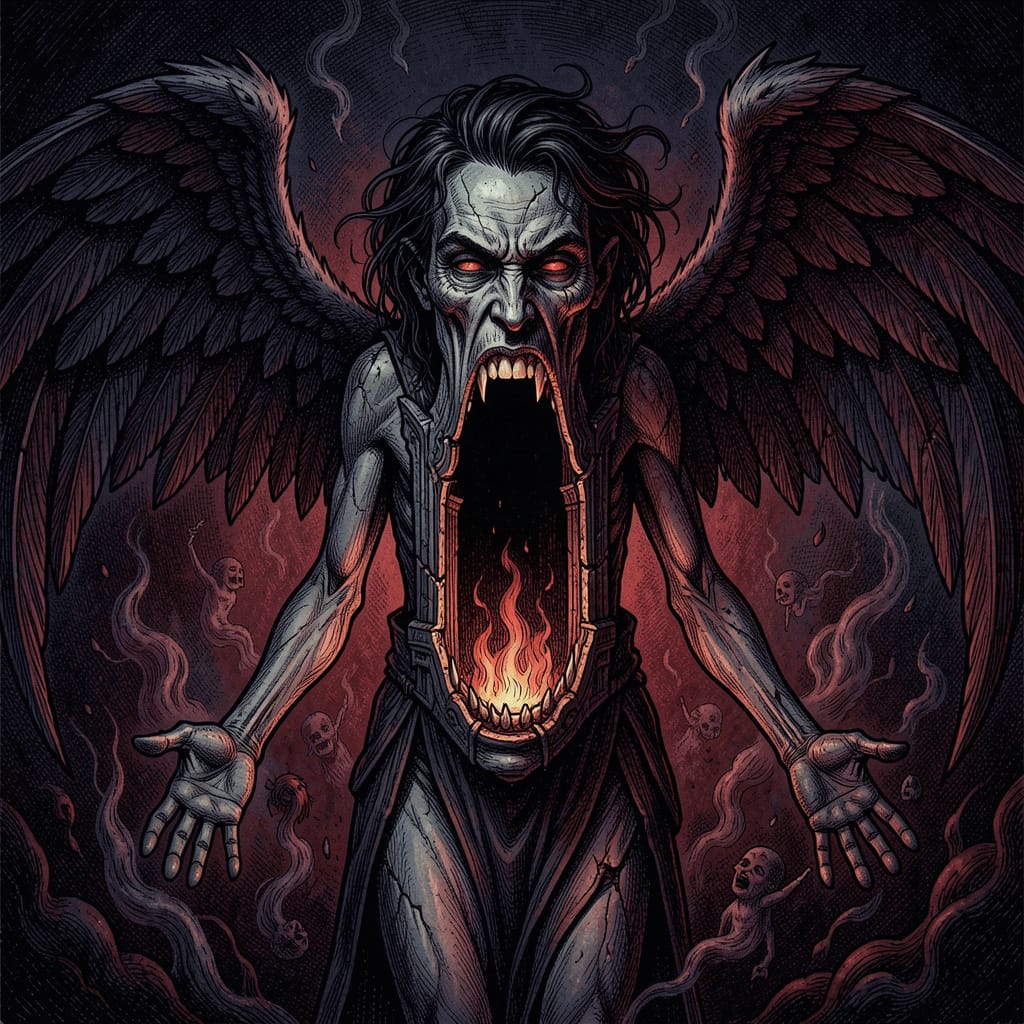
Every rebel angel, the tradition holds, was deformed in the fall into the shape of his sin, and Livyaten's deformation is the most literal of all. Where his heart had been, a mouth opened — a wide maw set into the torso, ringed in bone and lit from within by a furnace-glow. It is by this, far more than by his face, that he is known, and it is the origin of the medieval image of the Hellmouth: the gaping jaw through which the damned were shown tumbling into fire, drawn in psalters, carved above church doors, and built as scenery for the mystery plays. The image was everywhere in the medieval world; that its source was a wound in an angel, and the fire behind the teeth his own, was known to almost none who copied it.
The mouth is not for speaking. Livyaten is silent, or nearly so, and the maw in his chest has never formed a word — it is an appetite given an opening, not a voice. The souls he claims are drawn down into it and burn within him, so that his body becomes a small and terrible country of the dead, a second Grey Reach carried inside the one who rules the first. Of all the Seven he alone wears the whole of his nature on the outside and needs no human mask, because what he is cannot be hidden and does not care to be. It is the truest portrait the tradition offers of the sin: envy owns nothing, and displays the fact — a creature defined by a hole worn in himself, holding out empty hands.