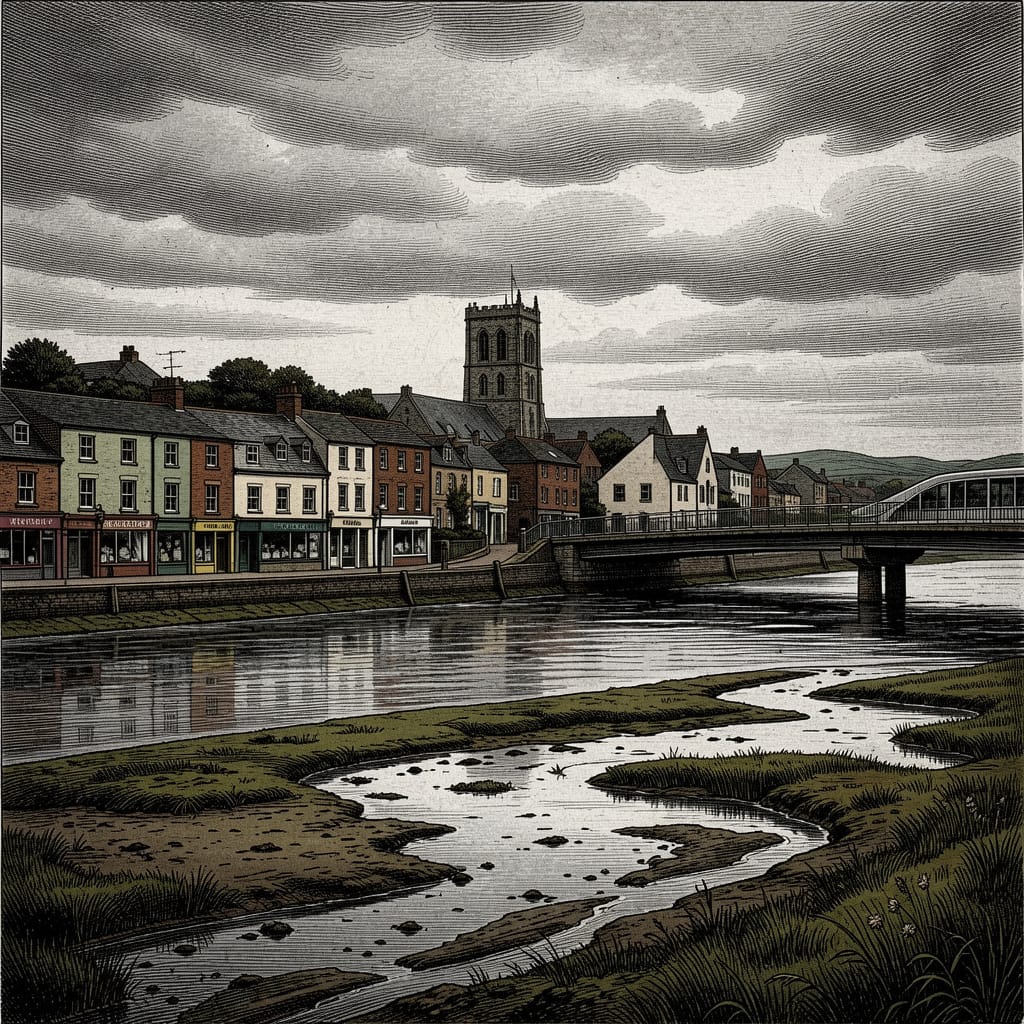
Shoreham-by-Sea

Shoreham-by-Sea, West Sussex — ancient port at the mouth of the River Adur

Location Profile
Type Coastal town and port
District Adur
County West Sussex, England
River Adur (town sits at its mouth)
Population c. 22,000
Postcode BN43
Settled Old Shoreham pre-Roman; New Shoreham founded late 11th century
Distance from Hope's End 200+ miles north
First Appearance Cambion, Chapter Seven: Not So Quiet

Shoreham-by-Sea

Ancient port at the mouth of the River Adur, West Sussex.


Overview

Shoreham-by-Sea is a coastal town and port in the Adur district of West Sussex, England, situated at the mouth of the River Adur where it meets the English Channel, midway along the ribbon of coastal development between Brighton and Worthing. With a population of around 22,000, it is the principal town of the Adur district. The South Downs rise immediately to the north; the Adur valley opens to the west; Shoreham Beach, a shingle spit, borders the town to the south.

The town is one of the oldest ports on the south coast of England, with a maritime history reaching back before the Roman period and a continuously operating commercial harbour to the present day. It comprises two historic centres: Old Shoreham, the original Saxon settlement upriver around the partly Anglo-Saxon church of St Nicolas, and New Shoreham, the Norman planned port town laid out on a grid at the river mouth at the end of the eleventh century.

Within the Book of Thoth Saga, Shoreham-by-Sea is the origin point of the Knight family before their relocation more than two hundred miles north to Hope's End, Derbyshire. It does not appear in the saga as a present-tense setting; it exists in the text entirely through documents, files, suppressed records, and the silence the Knight brothers carry about it. Robert Knight, born there, has never seen it.


Geography & Atmosphere

Shoreham occupies the flat coastal ground at the mouth of the River Adur, one of the four main rivers of Sussex, which rises in the Weald and cuts south through the South Downs to reach the sea here. The river's final approach to the Channel runs east behind a long shingle spit — Shoreham Beach — before turning south to the harbour mouth, an arrangement produced by the eastward longshore drift of shingle along this stretch of coast, which has repeatedly moved the river's outflow over the centuries. The estuary and its mudflats form a notified Site of Special Scientific Interest, important for waders and overwintering wildfowl.

The town is dominated, on its seaward side, by the working infrastructure of Shoreham Harbour: locked basins, wharves, warehousing, and the tall chimney of the former Shoreham (Brighton 'B') power station, visible for miles along the coast and out to sea. The harbour is protected from the Channel by substantial sea walls. North of the commercial port, the older town centre around the High Street and St Mary de Haura retains a quieter, small-town character of independent shops, the medieval Marlipins building, and the riverside walks along the Adur.

To the south of the river, on the shingle of Shoreham Beach, sits the town's celebrated houseboat community: several dozen permanently-moored vessels — converted Thames barges, minesweepers, landing craft, and improvised hybrids of hull and house — that form one of the more distinctive residential communities on the south coast. The South Downs rising behind the town to the north, the open estuary to the west, and the long shingle beach to the south give Shoreham a setting of unusual variety for its size.

History

Old Shoreham, the original settlement, sits a little way up the Adur from the sea and dates back to pre-Roman times; by the Domesday survey of 1086 it was an established village. Its church of St Nicolas — St Nicolas being the patron saint of sailors — is partly Anglo-Saxon in fabric, one of the older churches in Sussex, and reflects the antiquity of the upriver settlement.

New Shoreham was founded at the river mouth toward the end of the eleventh century by William de Braose, the first Lord of Bramber, who recognised the strategic value of the Adur estuary and its short crossing to Normandy. The new port town was laid out on a grid pattern that survives in essence in the present town centre, and was provided with a great cruciform church, St Mary de Haura — the name a contraction of St Mary of the Haven (or Harbour) — founded around 1096 and built in the decade following 1103. The original church was on a scale befitting the port's medieval importance, large enough to have been described as collegiate; the surviving building, Grade I listed, is the eastern half of the original, the great Norman nave having fallen into ruin by the time of the Civil War.

The medieval port of Shoreham was, for a period, one of the most important on the south coast: a centre of cross-Channel trade and a significant naval embarkation point. It was from Shoreham that the future King Charles II is traditionally held to have escaped to France in October 1651, after his defeat at the Battle of Worcester — the final leg of the journey commemorated in the long-distance footpath, Monarch's Way, that ends at the town. The port's fortunes fluctuated with the silting and shifting of the Adur's mouth over the centuries, requiring repeated re-engineering of the harbour entrance to keep the port viable.

The Marlipins, on the High Street — a twelfth-to-thirteenth-century building distinguished by the striking chequerboard pattern of limestone and flint on its façade — is one of the oldest surviving secular (non-religious) buildings in Britain. Its original function is uncertain; it was in use as an oat market by 1347, and may have served as a customs house for the port. It has housed a museum of Shoreham's maritime and local history, run by the Sussex Archaeological Society, since the 1920s.

Shoreham grew substantially in the Victorian period as a centre of shipbuilding and coastal trade, and the commercial harbour was progressively modernised through the nineteenth and twentieth centuries into the locked, sea-walled commercial port that operates today. Shoreham Fort, at the harbour mouth, is a Palmerston fort built in 1857 against the perceived threat of invasion under Napoleon III. In the early twentieth century, the shingle of Shoreham Beach became Bungalow Town, a settlement of converted railway carriages and a flourishing early British film industry — the locality was briefly known as ‘Hollywood on Sea’ — before the film studios moved away and the area was redeveloped for housing.

Shoreham Airport, on the Adur floodplain west of the town, opened in 1910 and is generally recognised as the oldest purpose-built commercial airport in the United Kingdom; its elegant Art Deco terminal building, opened in 1936, is a Grade II* listed landmark and a frequent filming location for period productions.


The Great Storm of 1987

On the night of 15–16 October 1987, the south of England was struck by the Great Storm — the most destructive extratropical cyclone to affect the country since the Great Storm of 1703. Hurricane-force winds, gusting to over 100 knots on the exposed south coast, swept inland across Sussex, Kent and the home counties. The Met Office had not forecast the storm's severity; eighteen people died across southern England in a single night, and an estimated fifteen million trees were felled.

Shoreham-by-Sea, directly on the coast in the storm's path, was among the worst-affected towns in West Sussex. The harbour and seafront sustained extensive damage; the railway line was blocked; the town was, like much of the south coast, days recovering its basic services. The storm is, by some distance, the most significant single event in the modern history of the town — and the meteorological context into which, in the Book of Thoth Saga, the loss of Shoreham Haven Hospital was folded.



Role in the Saga — Cambion spoilers Contains central plot reveals from Book One.

Shoreham-by-Sea is the origin point of the entire saga — the place the Knight family fled, and the place two of its central catastrophes occurred. It is never visited in present-tense narrative; it exists in Cambion entirely through documents and the silence the surviving Knights keep about it.

The events of October 1987. On the night of 15–16 October 1987, under cover of the Great Storm, Shoreham Haven Hospital was destroyed. Christine Knight died in childbirth on Ward 4 at 00:47 GMT; Dorothy Knight died performing the working that sealed the breach; the infant Robert survived, carried out by Toby. The full account of that night is given in the Shoreham Haven Hospital archive entry. Following their mother's final written instructions, the surviving Knight brothers left Shoreham immediately and relocated more than two hundred miles inland to Hope's End. The question logged in Helen Marsden's surveillance notes about that relocation — hiding, or containment? — is, the saga implies, answered by both.

The death of Helen Marsden. Helen Marsden — a Beowulf operative whose surveillance team had been watching the Knight household, and the mother of Daniel — had maintained three years of surveillance and come close to the truth of what Robert was. Her final report laid out the theory of a coordinated gateway: that the Seven were breeding deliberately toward a crossing. Three weeks after she filed it, on 7 March 1989, her body was found in the early hours in a disused outbuilding near the coastal path at Shoreham-by-Sea. The newspaper account — Woman Found Dead in Shoreham. Police Appeal for Witnesses — recorded a woman in her thirties, the death being treated as unexplained. The injuries, in the wider account the saga gives, indicated she had been held and tortured slowly over an extended period before death.

The collarbone photograph. A follow-up newspaper piece — printed small, beneath a garden-centre advertisement — reported that a photograph had emerged in connection with the death, described by a source as ‘disturbing in nature’. The image did not show Helen's face. It showed her left collarbone, and the mark carved into the skin beneath it: the Ars Goetia sigil of Asmodeus. The original photograph vanished from the police evidence file within forty-eight hours of her death; Declan Marsden — her widower — spent eighteen months obtaining a copy through three separate channels, and has carried it since. The Beowulf file on her death was sealed within forty-eight hours; no inquiry followed.

Asmodeus — or something acting in its name, something that signed its work — had carved its symbol into Helen's skin in a disused outbuilding in Shoreham, three weeks after Helen filed the report that named what Robert really was. Cambion

Shoreham in Robert's consciousness. Robert was born in Shoreham and has never seen it. When he searches for it — for the hospital, for his mother, for the storm — he finds local archives that skip whole years, pages pared back to weather reports and football scores as though the dead belonged to a different category; medical registries that fail him; death notices that speak only of strangers. The search term Shoreham Haven returns not silence but the active response QUERY LOGGED. IP TRACED. DO NOT PROCEED. (see the Shoreham Haven Hospital entry). What he is left with is the shape of the place without its detail — the residue carried by the men who raised him:

The men who raised him flinched at thunder because of what had happened somewhere else: somewhere southern, somewhere coastal; a place he had never seen. He had built this storm from their silence, from the way Ben's jaw locked at the first low rumble, and Toby's hand went to his wrist. Cambion, Chapter Forty-Nine

Trivia

  • The church of St Mary de Haura takes its name from a contraction of St Mary of the Haven (or harbour) — de Haura — reflecting the medieval port's identity. Founded around 1096, it was originally a great cruciform church on a scale reflecting Shoreham's importance as a Norman port; the surviving Grade I-listed building is the eastern half of the original, the great Norman nave having fallen into ruin by the Civil War.
  • The Marlipins building on the High Street, with its distinctive chequerboard limestone-and-flint façade, is one of the oldest surviving secular buildings in Britain — twelfth to thirteenth century. It was in use as an oat market by 1347 and has housed the Sussex Archaeological Society's museum of Shoreham history since the 1920s.
  • King Charles II is traditionally held to have escaped to France from Shoreham in October 1651, after his defeat at the Battle of Worcester. The long-distance footpath Monarch's Way, which traces his escape route across 625 miles of England, ends at the town.
  • Shoreham Airport, opened in 1910 on the Adur floodplain, is generally recognised as the oldest purpose-built commercial airport in the United Kingdom. Its Art Deco terminal, opened in 1936, is Grade II* listed and a frequent filming location for productions set in the 1930s and 1940s.
  • The shingle of Shoreham Beach was, in the early twentieth century, the site of Bungalow Town — a community of converted railway carriages that became a centre of the early British film industry, briefly nicknamed ‘Hollywood on Sea’, before the studios moved away and the area was redeveloped.
  • The Shoreham houseboat community on the southern bank of the Adur is one of the most distinctive residential communities on the south coast: several dozen permanently-moored vessels, including converted barges, minesweepers and landing craft, many extensively rebuilt into eccentric floating homes.
  • Shoreham lies at the mouth of the River Adur, one of the four principal rivers of Sussex. The town's entire history — Saxon, Norman, medieval, Victorian and modern — is a function of the river's strategic position and the repeated re-engineering of its shifting, silting outflow to the Channel.

Appearances

Title Role Notes
Cambion
Book One · Book of Thoth Saga
Origin Location Never visited in present-tense narrative. Present throughout as documents, files, suppressed records, and the silence the Knight brothers carry. The origin point of the Knight family; site of the October 1987 hospital events and of the death of Helen Marsden on 7 March 1989.