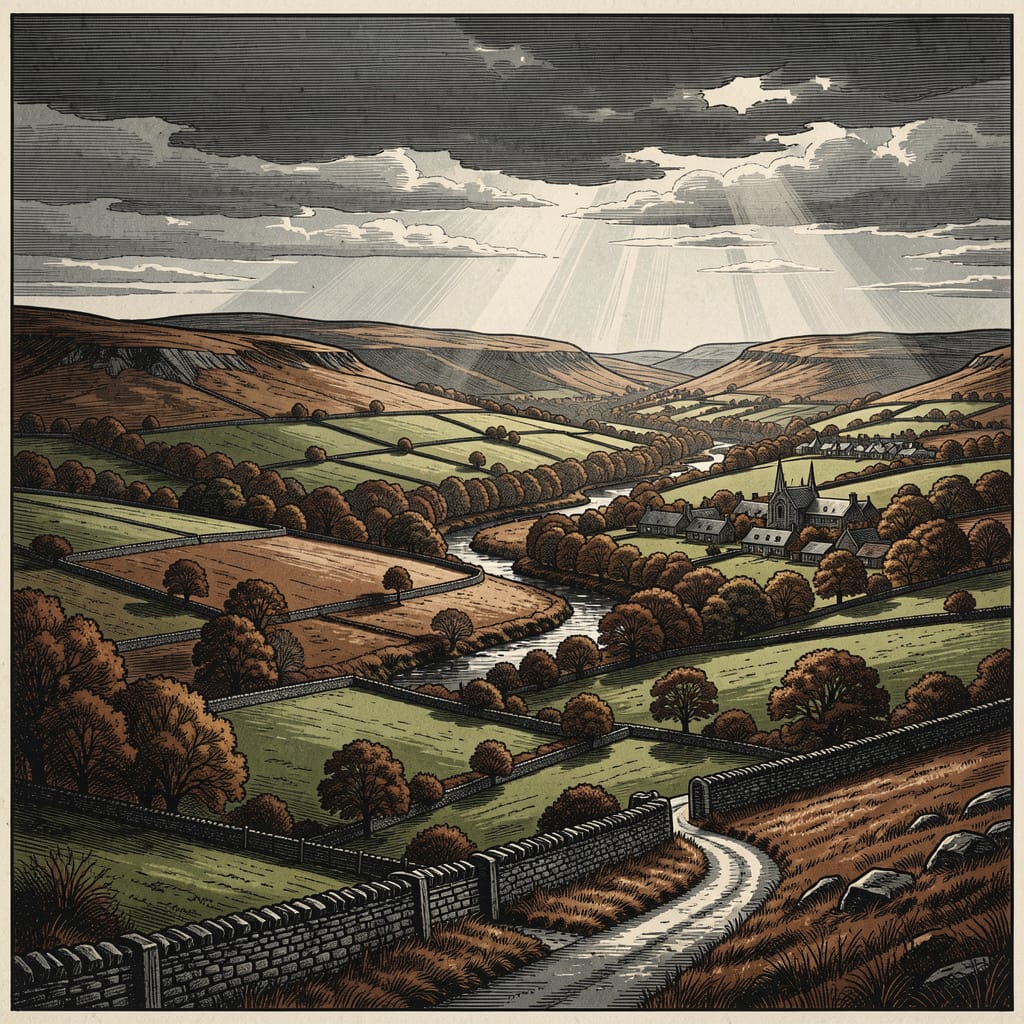
Derbyshire is the principal county setting of the entire Book of Thoth Saga, named in the very first text of the novel: a single italicised line at the head of Chapter One: Quiet — Derbyshire, 1995. No other geographical orientation is offered. The county is treated as sufficient. The fictional village of Hope's End sits within its real geography without being assigned a precise grid reference.
The Knight relocation. A Beowulf-archive note recovered by Declan Marsden records the post-1987 fact baldly: Knight brothers relocated to Hope's End, Derbyshire. 200+ miles inland from Shoreham. Why? Hiding? Or containment? The choice of Derbyshire, on the available reading, was deliberate: a county where settlements are small, weather routinely difficult, and a child of no recorded existence could grow up in a small Peak District village without drawing the attention of the agencies that had attempted to ensure he was never born. The question raised in Declan's note — hiding or containment? — recurs across the saga.
The Mammon coin pattern. In the six-week period following Robert Knight's manifestation event of November 1995, an anomalous one-pound coin surfaces at five Derbyshire and South Yorkshire towns — Derby, Matlock, Bakewell, Chesterfield and Sheffield — all within forty miles of Hope's End, in a geographical pattern that Declan identifies as inward-tightening on the village. The coins all share the same mint mark, weigh three times what a sterling pound coin should weigh, and remain warm to the touch even in December. Canon establishes that the Bakewell coin appeared before the Matlock coin; the full chronological sequence of the other three is not given in the text. Declan's account of the mechanism is precise:
Vice spreading across Derbyshire like rot through timber.
— Cambion, Chapter Thirteen.
Months later, in Chapter Eighteen: Creep, the kitchen radio relays three local news items in a single newsreader's sentence: a warehouse fire outside Chesterfield, a vicar in Matlock describing ‘mindless vandalism’ after someone has torched the church porch, and a Derby accountant ‘helping police with enquiries’ over missing funds. Three discrete acts of arson, vandalism and embezzlement — three classifications of vice — falling cleanly across three of the five Mammon-pattern towns. The text does not connect them aloud. The geography rhymes in the background.
Beowulf and Orion operational territory. The county functions as an active operational zone for the two principal covert agencies in the saga. Ben Knight's base of operation is formally recorded in Beowulf documentation as Hope's End, Derbyshire, UK. The laminated OS maps of the Dark Peak pinned above the fire in his room, edges curling, indicate his relationship with the country: he knows it as terrain, not as scenery. Orion's return to Derbyshire — confirmed during a charged exchange between Amy and Declan Marsden — signals an escalation. Field operatives are inbound. Through the late chapters, the county is increasingly the site of competing surveillance operations to which the inhabitants of its villages and towns are not party.
Cultural texture. The county is present in Cambion as much through its texture as through its events. The Derbyshire Times sits on Toby's kitchen table with the crossword half-done. A faded Derbyshire cricket pennant hangs in his room. Ben's rejoinder to Robert's complaint about the cold — It's December. In Derbyshire. What did you reckon it'd be? — carries the flat, unimpressed logic of someone who grew up in the place. The dialect word nesh, used by Ben and (separately) by Mick Hargreaves at The Rail and Reservoir, places the speakers as people of a specific country, speaking as people of that country speak. None of these details comments on the supernatural events surrounding them; they exist to confirm that the world goes on, and that the county has not, on its own account, noticed it is at the centre of anything.
The reddish soil. Among the saga's smaller and more telling details: in Chapter Forty-One, Robert, going through Ben's wardrobe, finds work boots heavy with reddish soil — the wrong colour for Derbyshire, which is limestone country with grey, brown and ochre soils. The county's own geology, recognised without being analysed, registers as an early warning that Ben has been somewhere he has not accounted for.
Daniel's map. In the closing pages, Daniel Marsden, working a wall map at international scale, draws a single line from a red pin in Sydney across the page, across the ocean, until the ink bleeds over Derbyshire: a tiny rain-drowned point in a country that has no idea what is coming. He writes on the map, beside the line: When two fires meet, they do not cancel. They feed each other. They build. The county, at that scale, is barely visible. That the entire saga has unfolded within that barely-visible point is the most economical observation the page makes about the relationship between the ordinary and the catastrophic.