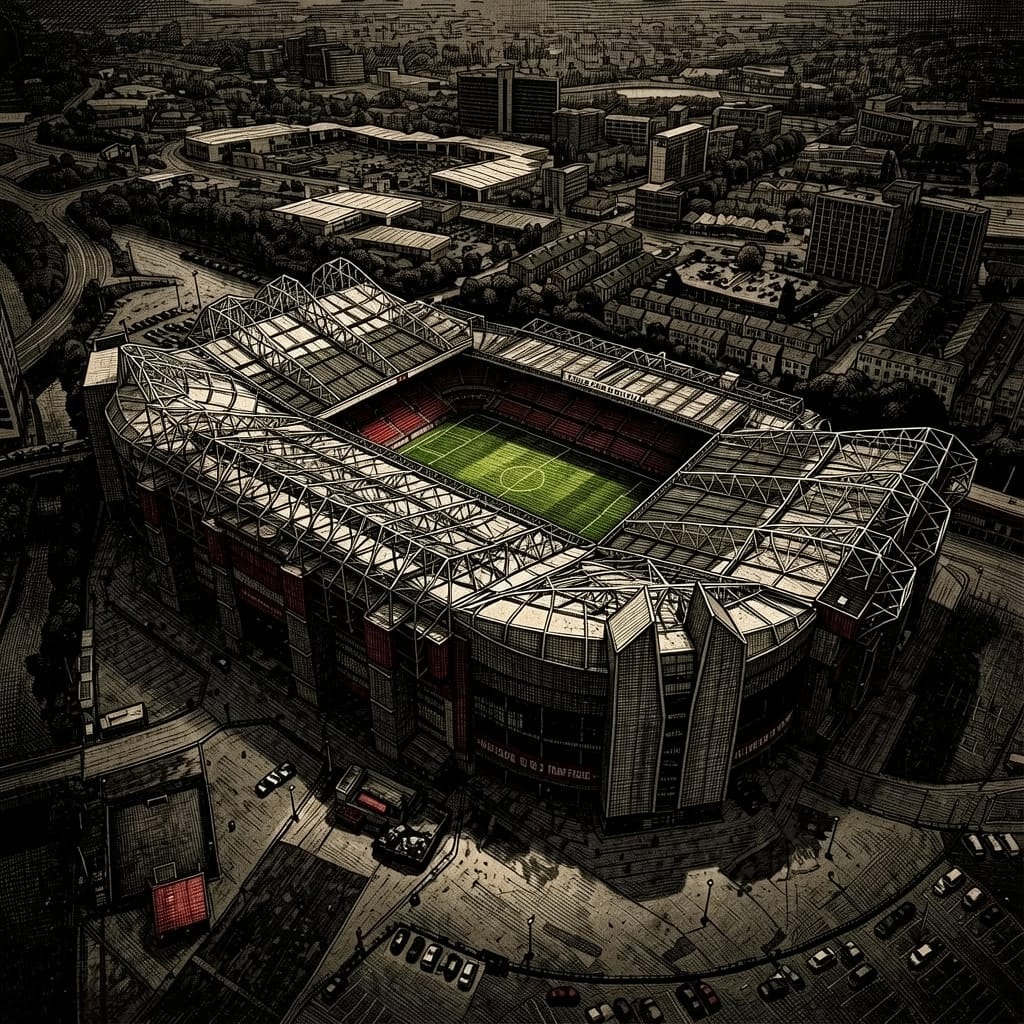
Old Trafford

Old Trafford, home of Manchester United since 1910

Location Profile
Type Football stadium
Borough Trafford, Greater Manchester
Home Club Manchester United F.C.
Opened 19 February 1910
Nickname ‘The Theatre of Dreams’
First Appearance Cambion, Chapter Eighteen: Creep

Old Trafford

Manchester United's stadium, Trafford, Greater Manchester.


Overview

Old Trafford is the home stadium of Manchester United Football Club, in the borough of Trafford, Greater Manchester, roughly three miles south-west of the city centre. Opened in 1910, it is the largest club football ground in the United Kingdom, and one of the most recognisable stadiums in the world — known to United supporters, after a phrase coined by Sir Bobby Charlton, as ‘the Theatre of Dreams’.

The stadium sits beside the Bridgewater Canal and directly alongside Lancashire County Cricket Club's ground, from which it takes its name — Old Trafford was originally the name of the district itself, long before the football ground existed.


Geography & Atmosphere

The stadium takes its name from the district around it, Trafford Park, which was the ancestral home of the de Trafford family from as early as the 1200s until the close of the nineteenth century — a deer park centred on Trafford Hall, which stood until it was destroyed in the Manchester Blitz of December 1940. The family sold the estate in 1896 to the financier Ernest Terah Hooley, who developed it into the world's first planned industrial estate: bounded by the Bridgewater Canal on one side and the newly opened Manchester Ship Canal on the other, it drew manufacturers from across the world, including Ford's first factory outside the United States in 1911. The football ground stands on the estate's eastern edge, a comparatively small and now globally famous corner of a much larger industrial site most visitors never think to look for.

On a match day the stadium dominates its surroundings completely: terraced streets and industrial units give way, without much warning, to a structure built to hold tens of thousands of people, the crowd audible streets before the ground itself comes into view. The Stretford End, the stand traditionally home to United's most vocal supporters, gives its name to the atmosphere the whole ground is known for — loud, tightly packed, and largely unconcerned with anything happening outside its own four stands for the ninety minutes a match lasts.

History

Manchester United moved to Old Trafford in 1910 after outgrowing their previous ground at Bank Street, Clayton; the new stadium, designed by the Scottish architect Archibald Leitch and funded by club chairman John Henry Davies, was built to hold some 80,000 spectators and was described on its opening day as the most impressive football ground in the world. United lost their first match there, 4–3 to Liverpool.

The stadium suffered heavy damage in two German bombing raids during the Second World War, on 22 December 1940 and 11 March 1941, the second of which destroyed most of the main stand. United played the rest of the war years, and the years immediately after, as guests at Maine Road, the home of local rivals Manchester City, before Old Trafford reopened in 1949. The players' tunnel used until 1993 is the only part of the original 1910 structure to have survived the bombing intact; it was renamed the Munich Tunnel in 2008, in memory of the 1958 Munich air disaster.


The Munich Air Disaster & the Stadium's Memory

On 6 February 1958, the aircraft carrying Manchester United's young ‘Busby Babes’ side home from a European Cup tie in Belgrade crashed on take-off after refuelling at Munich, killing twenty-three of the forty-four people on board, including eight players. Manager Matt Busby, badly injured himself, returned within a year to rebuild the team almost from nothing; a decade later, a second generation of Busby Babes — George Best, Denis Law and Bobby Charlton, one of only two survivors of the crash still playing — won the European Cup, the trophy the original side had been chasing when the plane went down.

Old Trafford has carried the memory of that day ever since. A clock on the exterior of the South Stand, the Munich Clock, has been permanently fixed at 3:04pm, the time of the crash, since it was installed; a statue of the ‘United Trinity’ — Best, Law and Charlton — stands outside the East Stand, and the club holds a remembrance service at the ground every year on the anniversary. It was Charlton, the survivor who went on to captain the side that finally won the trophy, who coined the phrase ‘the Theatre of Dreams’ that the ground is still known by. Old Trafford also houses the world's first stadium museum dedicated to a single football club, opened in 1986 and moved to its current home in the North Stand in 1998, in a ceremony attended by Pelé.


Euro '96 & the Modern Stadium

Ahead of England's hosting of the European Championship in 1996, Old Trafford's ageing North Stand was demolished and rebuilt as a three-tiered structure in time to host three group matches, a quarter-final and a semi-final — part of a broader expansion through the 1990s and 2000s that added extra tiers to three of the ground's four stands and brought the capacity close to its original 1910 figure. It was not the stadium's first taste of international tournament football: Old Trafford had already hosted matches during the 1966 World Cup, thirty years earlier. The ground has since hosted a European Cup final and remains, at a capacity of around 74,000, the largest club ground in the country.


Stands, Records & Redevelopment

The ground's four stands now carry the names Sir Alex Ferguson (North), East, Sir Bobby Charlton (South) and West — the last of these still commonly known by its older name, the Stretford End. The South Stand, the ground's original main stand, is built at a slightly different, shallower angle to the other three and holds the television gantry, the directors' and police control boxes, and the first twenty or so rows of seats around the whole stadium, which sit below street level.

Oddly, Old Trafford's record attendance was not set by Manchester United at all: 76,962 people watched an FA Cup semi-final between Wolverhampton Wanderers and Grimsby Town there on 25 March 1939, a figure no United fixture has matched since all-seater conversion in the 1990s made anything close to it impossible. The ground hosted its first full international a little earlier still, in 1926, when England lost 1–0 to Scotland in front of just under 50,000 spectators. Plans for further expansion — most often a second tier on the South Stand, which would push capacity toward 90,000 — have circulated for years alongside separate proposals for an entirely new stadium on an adjoining site, though as yet neither has been built.


Role in the Saga — Cambion spoilers Woven into the real 1996 Manchester bombing.

Old Trafford is the setting of one of Robert and Ben Knight's most quietly significant memories together, in Chapter Eighteen: Creep, set against the real background of Euro '96. Ben has promised Robert tickets to a group match at Old Trafford — Germany against Russia — scraped together from overtime he can't quite afford, and keeps his word. The night before they are due to travel, the real Manchester bombing of 15 June 1996 tears open the city centre a few miles from the ground. Ben's answer to whether the match is still on is characteristically short: “Still standing. We're going.”

They travel up anyway, past green fields that look untouched by anything, toward a city with a crater and smoke somewhere ahead of them. The crowd inside the ground is not subdued; if anything it sings itself hoarse, defiantly ordinary in the middle of an extraordinary day. At half-time, a woman in an old, dark, oddly out-of-place dress moves through the aisle and drops a coin at Robert's feet — dense, heavier than its size should allow, stamped with a date that matches no year he recognises. It is the same signature Chapter Thirteen: The Coin That Never Spent had already attached to Mammon's circulating coins — overweight, warm, marked identically wherever they surface — and the woman's line to Robert, “Careful. Money's a bad thing to lose,” plays on exactly the mechanism Declan describes elsewhere: Mammon works not by taking, but by making people reach. She watches Robert's hands rather than his face before he hands the coin back, then the crowd swallows her. The encounter is the Seven's first physical appearance anywhere in the saga, and the saga leaves it exactly where it happens: unnamed on the page, uncanny, and never directly resolved.

Germany win 3–0. Robert counts every goal and memorises the minute it went in, the same private compulsion that runs through the whole chapter — his own quiet fear that each shot on the television might somehow be his doing. Leaving the stadium afterwards, the noise of the crowd tangles with the sound of sirens still working through the wrecked city; for once, the saga notes, the noise carries Robert rather than pressing in on him.

The day recurs later in the book, in Chapter Forty-Two: What I've Done, as one of the memories Robert reaches for to hold on to who Ben actually is to him — alongside marking his height on the kitchen doorframe and spinning a football shirt across the living room in shared hatred of a rival — a man who kept a promise to a child on the one day it would have been easiest, and most forgivable, to break it.



Trivia

  • The real Russia–Germany group match at Old Trafford was played on 16 June 1996, the day immediately after the Manchester bombing — the same juxtaposition of ordinary life and recent violence that the saga places its characters inside.
  • Old Trafford's South Stand backs onto Lancashire County Cricket Club's own ground; the two venues have stood side by side for longer than either has existed in its current form.
  • The stadium's pre-war capacity, close to 80,000, was not fully recovered until the stand-by-stand expansions of the 1990s and 2000s — meaning Old Trafford spent most of the twentieth century smaller than the ground that first opened in 1910.

Appearances

Title Role Notes
Cambion
Book One · Book of Thoth Saga
Day-trip setting The primary setting of Chapter Eighteen: Creep; recalled again in Chapter Forty-Two: What I've Done.