The dating of Edale Cross is uncertain and variously argued. Faint traces of Saxon-style knotwork on the face of the shaft have been read by some commentators as suggesting a pre-Conquest origin — possibly as early as the eighth century — while the chamfered edges of the shaft suggest a Norman or post-Conquest re-cutting of an earlier piece. Other accounts associate its origin with the Cistercian house of Basingwerk Abbey in north Wales, to which Henry II granted lands in the central Peak in 1157; the cross may have been raised by the Basingwerk monks to mark the southern boundary of their estate. A third tradition, recorded by the Reverend J. C. Cox at the start of the twentieth century, holds that the cross marked the meeting-point of the three wards of the Royal Forest of the Peak: Longdendale in the north, Hopedale (or Ashop and Edale) in the east, and Campana — the open country, the ‘Champion country’ — in the south. The cross's alternative name, Champion Cross, descends from this last reading.
The cross is known to have fallen at some point in the post-medieval period and to have been re-erected in 1810 by a group of local farmers led by Thomas Gee. The initials carved into its surfaces — JG, WD, GH, JH, JS, with the date 1810 — are those of John Gee, William Drinkwater, George and Joseph Hadfield, and John Shirt, the farmers who re-set it; an additional inscription IG 1610 on the east arm probably refers to John Gell, a seventeenth-century surveyor of the Peak Forest, whose road survey mark this is generally taken to be. (Thomas Gee's decision to add his own initials and the 1810 re-erection date to the medieval monument was, at the time, a matter of some local criticism.)
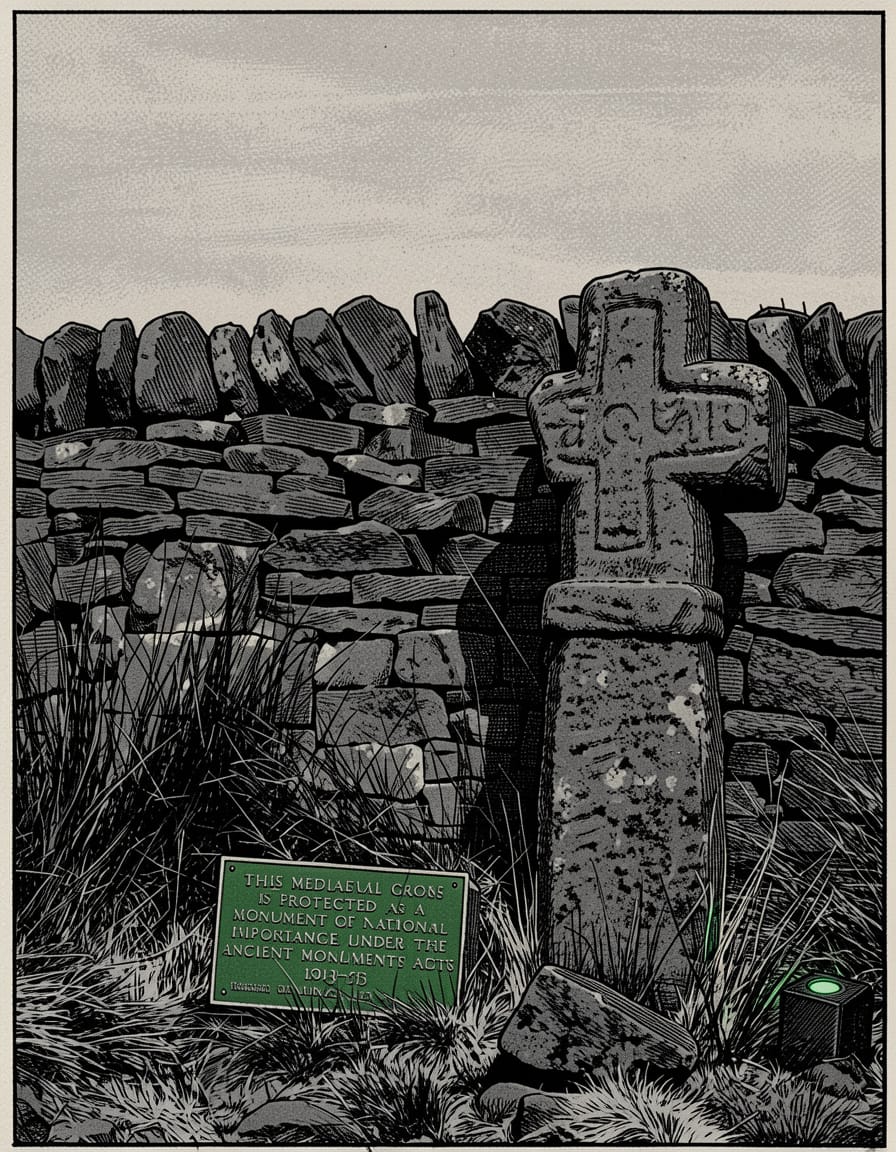
The cross was scheduled for protection as an ancient monument in 1934. It has subsequently been re-erected once again, after leaning in the saturated peat, and the dry-stone enclosure now around its base was constructed by the National Trust during that work. The cross continues to stand on what is generally accepted to be its original site.
The cross is a single piece of coarse-dressed gritstone, standing 1.6 metres high, 0.49 metres wide across the arms and 0.29 metres wide at the base. The shaft is of rectangular section, with chamfered edges, surmounted by an integral equal-armed cross head above a band-like collar. The cross head is, in proportion, slightly large for the present length of the shaft, suggesting that the shaft has at some point been broken or shortened from a greater original length and that it may originally have been set into a now-lost socle stone.
The face of the shaft preserves faint traces of what appear to be Saxon-style knotwork; the chamfered edges, by contrast, are characteristic of post-Conquest dressing. The plain rear face carries the principal inscriptions: the initials and date 1810 from the re-erection, the earlier IG 1610 on the east arm of the cross head, and the additional sets of initials cut into the shaft. The left arm of the cross head, as one stands in front of it, is broken; the damage is not recent.