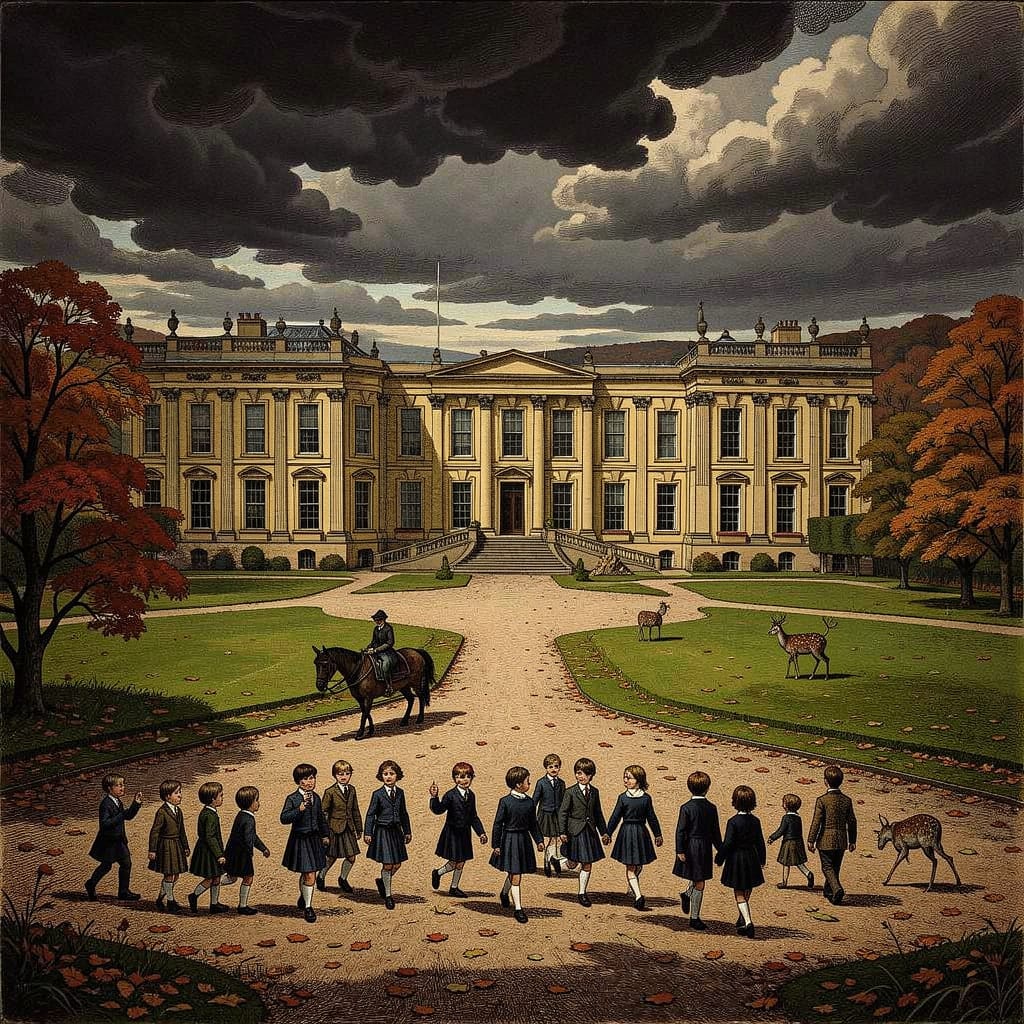
The first house at Chatsworth was begun in 1552 by Sir William Cavendish (d. 1557) and his second wife Bess of Hardwick, the formidable Tudor heiress who, by the end of her life, would be among the wealthiest and most influential women in Elizabethan England. Bess's first house, an Elizabethan courtyard mansion, took several decades to complete and outlived its first owner by more than half a century. Bess subsequently married, as her fourth husband, George Talbot, sixth Earl of Shrewsbury, who, in his official capacity as guardian to the captive Mary, Queen of Scots, brought her to Chatsworth at intervals between 1569 and 1584. The east-end suite in which Mary was lodged is still known as the Queen of Scots Apartments, and is open to the public on payment of a separate admission charge. By 1608, when Bess died, her son William had inherited the estate; in 1618, his son was created first Earl of Devonshire by James I.
The Elizabethan house was rebuilt — piecemeal, then comprehensively — by William Cavendish, fourth Earl and (from 1694) first Duke of Devonshire, whose Whig politics had made him a co-author of the Glorious Revolution of 1688. The first Duke commissioned William Talman to begin the south front of the present house in 1687 in the new Baroque manner, retained the Elizabethan courtyard plan but replaced the structure on every other side over the following twenty years, and laid out a formal garden anchored by the Cascade — a man-made waterfall of twenty-four steps designed by the French engineer Grillet and completed in 1703. The State Apartments on the south range were built in expectation of a state visit from William III and Mary II that, in the event, never took place.
The Georgian Chatsworth was the work principally of the fourth Duke (1720–1764), who reversed the approach to the house from east to west, employed Lancelot ‘Capability’ Brown to remodel the surrounding park in the naturalistic English landscape style, and engaged James Paine to build a new bridge over the river (1762), a water mill, and an impressive ornate stable block on the slope above the house. As part of the same scheme, the houses of the village of Edensor visible from the new west front were demolished. (The full rebuilding of Edensor in its present picturesque form was a separate, later project of the sixth Duke.)
The Victorian period at Chatsworth is dominated by the sixth Duke, William Cavendish (1790–1858), known as the ‘Bachelor Duke’, and the man who in 1826 appointed as his head gardener at the age of twenty-three an able young plantsman named Joseph Paxton. The thirty-year partnership that followed transformed the gardens of Chatsworth and, in the process, helped transform Victorian horticulture more broadly. Paxton built the Rockery on the model of Alpine scenery; the colossal Great Conservatory of 1837 (since demolished, but the prototype for his subsequent Crystal Palace at the 1851 Great Exhibition); the Emperor Fountain (1843–44); and, between 1838 and the early 1840s, the new estate village of Edensor, in a deliberate variety of architectural styles, on the far side of the road through the park. He also engaged Sir Jeffry Wyatville to add the long North Wing to the house (1820s–1830s).
The twentieth century brought near-disaster. The tenth Duke died in 1950 with death duties at eighty per cent of the value of the entire estate; Hardwick Hall, a long list of rare books, and a great deal of art were surrendered to the Treasury in lieu. The eleventh Duke and his wife Deborah (one of the Mitford sisters) negotiated the survival of Chatsworth in trust through the second half of the century, restoring the house and gardens, opening them progressively to the public, and establishing the Chatsworth House Trust in 1981 to safeguard the building and the collection in perpetuity. The estate today is held by the Trustees of the Chatsworth Settlement, a family trust established in 1946.
The present house is on a substantial scale: a four-square Baroque palace built around an Elizabethan courtyard, with twenty-five rooms open to the public, including the Painted Hall (decorated by Louis Laguerre and Antonio Verrio in the 1690s), the Great Stairs, the Long Gallery (now the Library), the State Apartments, the Sculpture Gallery and the Chapel. The interiors are at once ducal and lived-in: the family still occupies the private apartments, and the public route circles around them rather than through them.
The Devonshire Collection is among the largest and oldest privately-held art collections in Britain. It includes paintings by Rembrandt, Veronese, Reynolds, Sargent and Lucian Freud; significant holdings of Old Master drawings; Renaissance and Neo-classical sculpture; an important library of incunabula and bound manuscripts; mineralogical and natural-history collections; furniture; tapestries; and a remarkable archive of family papers. Only a portion is on display at any given time. The collection's catalogue runs to many volumes.
Capability Brown's landscape, laid out in the 1750s and 1760s for the fourth Duke, replaced the formal Baroque garden of the first Duke with sweeping lawns, careful tree plantations, the Salisbury Lawn, and a managed naturalism that has remained the underlying logic of the Chatsworth park ever since. The course of the River Derwent was straightened in the same period; bridges and a stable block were built to designs by James Paine; the parts of Edensor village visible from the new west front were taken down. The work is one of Brown's most complete surviving commissions.
The Emperor Fountain, in the Canal Pond on the south lawn, was Paxton's response to the announcement, in 1843, that Tsar Nicholas I of Russia intended to visit Chatsworth the following summer. The sixth Duke resolved that Chatsworth should fire a fountain to a height the Tsar had never seen, and Paxton drove the work through in six months — including the digging of an eight-acre reservoir on the moors three hundred and fifty feet above the house, to provide the gravity-fed pressure on which the jet depended. The reservoir was completed; the fountain rose, on record, to two hundred and ninety-six feet (about ninety metres), the tallest fountain in the world. The Tsar did not visit. He died in 1855 without ever seeing it. The fountain has been firing into the Derwent valley, generally on partial pressure, ever since. The same gravity-fed water system was used to generate Chatsworth's electricity from 1893 to 1936; a modern turbine, installed in 1988, now supplies about a third of the electricity the house consumes.
The estate village of Edensor, separated from the house by the road through the park, is one of the most striking small villages in England: thirty-three dwellings rebuilt by Paxton between 1838 and the early 1840s in a deliberate medley of styles, from Tudor through Italianate to alpine, around a triangular green near the medieval parish church of St Peter's. Most of the present houses are occupied by Chatsworth staff, retired estate workers and pensioners. St Peter's itself, rebuilt by Sir George Gilbert Scott in the 1860s on the site of an earlier Saxon church, contains a notable monument to the elder sons of Bess of Hardwick and is the burial place of the sixth, seventh, eighth, ninth, tenth and eleventh Dukes, in simple individual headstones in the family plot overlooking the churchyard.