Ancient Mesopotamia & Egypt
In Mesopotamian myth the cosmos opens by being split into three: a heaven of the gods above, the human world between, and a comfortless underworld below to which all the dead alike descend, never to come back. Heaven here is the gods' preserve and not a human prospect — mortals were made to serve, not to ascend. The lesson is put bluntly to the hero of the Epic of Gilgamesh, whose search for unending life ends in the answer that the gods, in fashioning humanity, kept life to themselves and dealt out death as man's portion.
The Egyptian sky had no single shape: it could be the goddess Nut bent above the earth, or the celestial cow on which the sun withdrew. Nor did the blessed dead have one destination — the lush Field of Reeds, the sun-god's barque, and the stars that never set were all on offer. What did change was who might hope for any of it. In the early Pyramid Texts such an afterlife was a royal privilege; the later Coffin Texts and Book of the Dead opened it to everyone, each soul now merged with Osiris and made to answer for itself as its heart was weighed.
Judaism, Christianity & Islam
The older strata of Judaism kept Heaven and earth strictly apart — the heavens were God's, the earth was given to humankind — and looked for no celestial afterlife, the dead passing instead into Sheol. That the Hebrew šāmayim is grammatically plural has been taken to imply a tiered structure, God reigning above the firmament. A heavenly reward for the just is a comparatively late development, taking shape in the wake of the Babylonian Exile and the loss of the First Temple in 586 BCE, and amplified by Persian and Greek thought; it surfaced in several competing forms — bodily resurrection, the soul's immortality, or elevation into the company of the angels or the stars.
For Christianity the old separation is overcome in the person of Christ, whose incarnation, death, resurrection and ascension reconcile the two realms; the soul dying in grace passes into the direct sight of God, a beatitude the Book of Revelation renders as ceaseless worship within the jewelled heavenly Jerusalem. Islam calls the reward Jannah, the Garden, set beneath a sky God formed into seven firmaments. Its joys are described in concrete abundance, but the highest is nearness to God Himself, and the saved are ranked by exactly that nearness — a logic underlined by the tradition of Muhammad's own ascent through the seven heavens to the throne.
Hinduism & Buddhism
The Vedas populate Heaven with sky-gods — Indra, Surya, Agni, Varuna, and Yama, who was first to die and so first to cross over. With the Upanishads the whole picture is relativised: existence is now a turning wheel, samsara, on which death only returns one to birth, the motion fuelled by desire and steered by karma. On this view a heavenly rebirth (svarga) is real but temporary — the gods themselves are not exempt from dying — and the genuine aim lies past every heaven, in moksha, the soul's release from the cycle into brahman, the unbounded spirit.
Buddhism places its heaven-realms among six possible destinations for rebirth, the most fortunate being existence as a god — yet even this is transient, bound like every other state to impermanence. The goal of practice is therefore not Heaven but nirvana, the end of becoming itself. The tradition does, however, hold open a heaven-like prospect: certain beings of boundless compassion, Amitabha Buddha foremost among them, are said to have devoted their merit to founding Pure Lands, realms into which the faithful may be born and find every condition favourable to awakening.
Other Heavens
A single tradition will commonly entertain several heavens together. The classical world kept Olympus, the Elysian Fields and the Isles of the Blessed side by side; the Norse imagined Valhalla, where each day's feast-boar is slaughtered and made whole again by night. China's ‘way of Heaven’ appears in three guises — the Mandate of Heaven that crowns or unseats a ruler, the Daoist attunement to nature, and the Eight Immortals who ascend by alchemical and bodily discipline. Later Western culture remade Heaven again in the image of progress and the family hearth: the luminous, self-improving spheres of nineteenth-century Spiritualism, and sentimental works such as The Gates Ajar (1868), in which Heaven is above all a reunion of kin.
In Art and Literature
The doctrine has its detractors, who read it as consoling illusion or as a distraction from the world's actual demands, and its defenders, who answer that it furnishes life with purpose and prompts genuine sacrifice. Whichever case one takes, the imagery is inseparable from the Western canon — present in the verse of Dante, Spenser, Milton, Donne and Blake, in the panels of Fra Angelico, Botticelli and Jan van Eyck, and in the great journey-narratives from the Divine Comedy to the Chinese Journey to the West and Bunyan's Pilgrim's Progress. What a given age makes of Heaven turns out to be one of the surest measures of what it holds most precious.
The Aethereal Realm — Heaven in Aethereal Stories
In-universe lore for the Aethereal Stories universe.
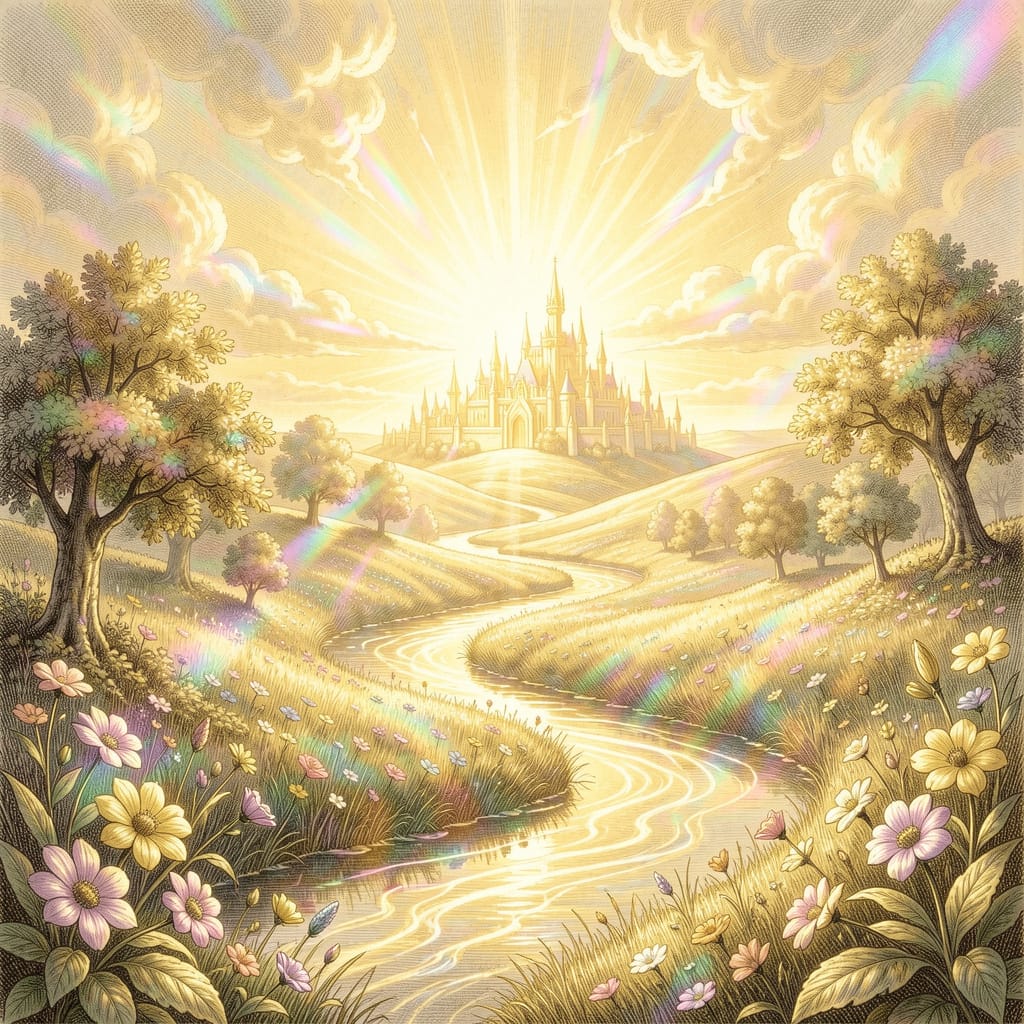
Within the Aethereal Stories universe, Heaven — the Aethereal Realm, also called Paradise — is the first thing that was built in all of creation. When Yehwah and Asherah, the creator avatars of the light, punctured out of a Light Dimension into the dark, the light that poured through the wound behind them became the raw material of everything that exists. They raised Heaven at the site of that breach, and the universe was constructed outward from it. The puncture never closed: Heaven remains the one place in creation still joined directly to the source, and from it the realm is connected to all nine realms of the universe — the common centre to which the whole of creation is bound.
The Founding & the Garden of Eden
In-universe lore for the Aethereal Stories universe.
Yehwah and Asherah are the only two beings able to cross between the light and the dark, and the crossing was an act of force — a puncture through the barrier of their own dimension into a dark one. At the centre of the realm they raised lies the Garden of Eden, set at the puncture itself, where the light still pours through without end, reached only by the world-axis that runs through the heart of creation. To one traveller that axis appears as a river, to another a road; across the realms it is remembered as a great tree rooted at the centre of everything.
To hold what they had made, Yehwah forged six archangels — the first beings of Heaven: Michael who binds, Lucifer the Morning Star, Gabriel who carries the word, Raphael who heals and casts down, Leonardo, and Uriel the light of the divine. They were made of the light and made to fight for it, and the war they were forged for came quickly.
The Celestial Hierarchy & the Grigori
In-universe lore for the Aethereal Stories universe.
Heaven's beings are ordered by their nearness to the light. Nearest the source stand the burning Seraphim, wrapped in six wings before a light they cannot look upon directly; the Cherubim, the fullness of knowledge, set to keep the threshold of Eden; and the Thrones. Below them the governing choirs — Dominions, Virtues, Powers — and nearest the mortal world, the Principalities, Archangels, and Angels. Above them all stand the six archangels Yehwah made.
Every order shares one law: an angel holds creative power only. An angel can make, but an angel cannot destroy — destruction was never given. Apart from the choirs stand the Grigori, the Watchers, those who do not sleep: angels who fell by descending to humanity and giving it what was never meant to be given — the working of metal into weapons, the casting of charms, the reading of the stars, the arts of war and vanity. The higher orders were sent to bind them for it.
The Fall
In-universe lore for the Aethereal Stories universe.
The defining wound in Heaven's history is its own civil war. Lucifer — one of the six, the Morning Star — led a rebellion against Heaven, and a third of its angels followed him. They were defeated and exiled: banished from the realm of light, their divinity stripped from them, and with it much of their power. Their ability to adopt physical form was taken too, leaving them trapped in the semi-physical realm between Heaven and the physical universe.
There the exiles built a kingdom of their own — the realm that became known as Hell. What the fallen lost was their place and their standing, not their nature: they kept their creative power, the same making-power every angel holds, though corrupted and turned from what it was made for. Heaven was never the same number again; a third of its host now stands outside it, and the Seven trace their origin to this event — the original measured not against evil, but against the height of his fall.
Heaven in the Book of Thoth Saga — Cambion spoilers
Contains plot reveals from Book One.
In the modern era of the Book of Thoth Saga, Heaven is not a place the living walk into. It surfaces in the record once, by name, in a classified Beowulf intelligence summary: A joint BEOWULF–HEAVEN action resulted in the destruction of the active host, fragmented COUNCIL-7 command, and secured both human-linked assets.
The document names Heaven and explains nothing. The dash in BEOWULF–HEAVEN is the tell — not a subordination but an equivalence, a human intelligence organisation and the realm of light set side by side as partners in a single action. Whatever it was, it was enough to fragment Council-7 command and force the Seven back from overt surface operations for decades. The thread between the realm and the operation is Amy — in Beowulf records since at least 1910, active in the 1918 event.
Trivia
- The recurring image of seven Heavens appears independently across Jewish, Islamic, and Gnostic cosmology — and the Aethereal Realm's seven ascending levels follow the same pattern.
- The world-axis at the centre of the realm — seen as river, road, or tree — is the real-world axis mundi, the cosmic pillar or world tree that binds Heaven, earth, and underworld in traditions from Norse Yggdrasil to the Mesopotamian temple-mountain.
- The law that an angel may create but never destroy is the line against which the Fall is measured: the fallen keep the making-power, and it is its corruption — not its loss — that defines what they become.
Appears In
| Title |
Role |
Notes |
The First War
Aethereal Chronicles · Vol. I |
Central Setting |
The puncture, the creation of Heaven and the Garden of Eden, the making of the archangels, and the war that established the nine realms. |
Cambion
Book One · Book of Thoth Saga |
Named Authority |
Named once in the Beowulf Entity-02 summary as the second party in the joint action that fragmented Council-7 command in the 191█–191█ period. |