


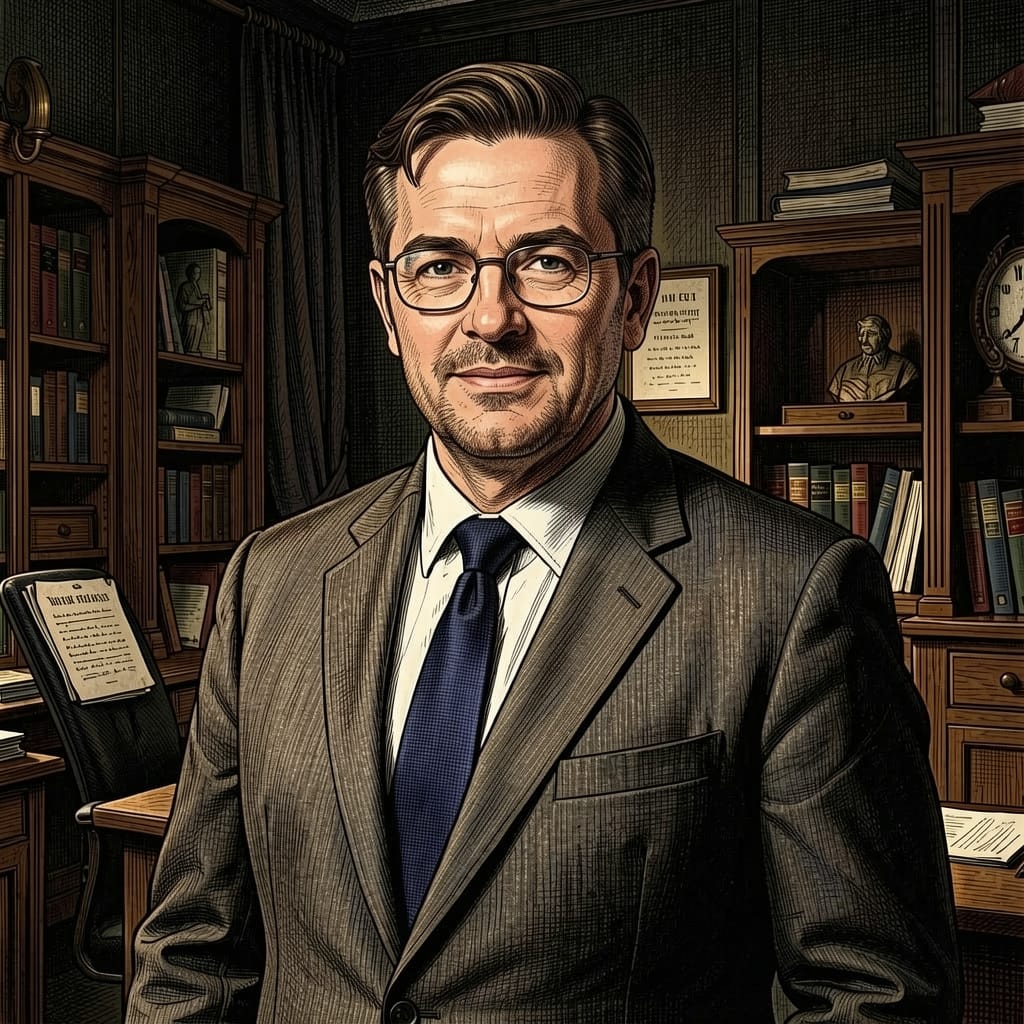
Patrick Hennessey

Patrick Hennessey — council, Hope’s End

Character Profile
Stories Book of Thoth Saga (Vol. I)
Species Human
Status Active
Occupation Council worker, Hope’s End
Affiliation Hope’s End resident; one of Declan Marsden’s village contacts
First Referenced Cambion, Chapter Seventeen: The Mask

Patrick Hennessey

“Mr Hennessey at the council.”


Overview

Patrick Hennessey works at the council in the wider Hope’s End administrative district and is one of the local contacts Declan Marsden maintains in the village. He is referenced in Cambion only once, in Daniel Marsden’s interior reflection in Chapter Seventeen: The Mask. He does not appear in any scene. He has no spoken lines.

Daniel’s thought, walking home from Stepping Stones with Toby: His dad did talk to people. He talked to Mr Hennessey at the council, to the man who ran the post office, and to Mr Alderton, the new headteacher. The line is the only window the manuscript opens onto Hennessey at all. He is one of three named contacts through whom Declan keeps the village mapped. The three contacts together cover the institutional spread of Hope’s End: civic, retail, educational. Hennessey is the civic leg.

Of the three, Hennessey’s value to Declan is, on the available reading, the most operationally consequential. The council’s reach in a rural Peak District district covers planning records, environmental notices, electoral rolls, housing registers, parish-level paperwork, and the kind of slow administrative file that records what happens to a village over years. Declan’s contact with him is, presumably, friendly. The man at the council does not need to know what the man asking the questions does for a living. The questions are unremarkable. The answers are filed.

Beyond the Scene

Patrick Hennessey is the kind of council figure every Peak District village relies on without quite knowing him. He is somewhere in his early fifties, has worked the same council office for twenty-odd years, and has the institutional memory that comes with watching three rounds of local-government reorganisation pass through the same building without disturbing his desk. He lives in Hope’s End with his wife, who teaches piano in the front room two evenings a week. Their two grown children visit at Christmas. The house is clean, the garden is small, the garage holds a car he services himself on Sunday mornings. He is, by general village agreement, a decent man. Nobody has ever had cause to revise the assessment.

The work covers planning applications for the half-dozen surrounding villages, environmental reports on footpaths and drains, agricultural notices for the upland farms, the electoral roll, parish-level paperwork, and the file of every utility incident the district records each winter — substation faults, blown transformers, electrical failures, the kind of routine paperwork that piles up between October and March in any rural area on the Peak grid. He processes it. He files it. He does not, as a rule, ask why.

The Castleton substation incidents flagged the previous winter were on his desk first. The grid-failure paperwork relating to 13 Haversage Road in Chapter Forty-Six: The Fuse — the one Declan has dated for yesterday and built around two pre-existing flagged incidents at Castleton — passed across his desk in due course as a routine matter. He approved it. There was, by every formal indicator, no reason not to. The substation had a history. The history was on file. He cross-referenced. The dates lined up. The paperwork went through. He went home that evening and ate his tea and did not give the matter a second thought, because the matter, on the face of it, was not the kind of matter that warranted one.

What he does not know is that the paperwork was constructed for him by Declan Marsden three days before it reached him, with the cooperation of the substation maintenance log and the wider operational reach of Beowulf. Hennessey has been used. He has not been told. The use was clean enough that he will never need to be told. He will retire from the council in due course with the satisfaction of a man who has spent forty years processing the small administrative truth of his district, and a small piece of that truth, on a particular set of forms in early 2000, will quietly never have been true at all.


Trivia

  • Patrick Hennessey is one of three named local contacts in Declan’s Hope’s End network surfaced in Cambion: Hennessey at the council, the man who ran the post office, and James Alderton at the school. The three contacts cover the institutional spread of the village — civic, retail, educational. Declan’s relationship with each is friendly enough not to register as anything else, and frequent enough to keep the intelligence current.
  • Of Declan’s three village contacts, Hennessey’s reach is the most consequential. The council in a rural district sits at the intersection of every formal record that matters — housing, planning, environment, electoral, utility. Where Alderton can tell Declan who has been talking to which teacher and which families have been worrying which staff, Hennessey’s desk is where the grid-failure paperwork passes through.
  • Hennessey is, on the available evidence, the institutional channel through which the cover-up of the manifestation event in Chapter Forty-Six: The Fuse was processed. Declan’s instruction over the phone — I need a narrative. Electrical fault. The Castleton substation has already had two flagged incidents this winter. Use those. Put together a report and date it for yesterday — describes a piece of paperwork that has to land somewhere. Hennessey’s desk is the somewhere. He approved it as a routine matter. He has not been told what the routine matter actually was.
  • That Declan’s village network turns out to include the man who controls the council’s utility-incident paperwork is one of the small architectural beauties of Cambion’s long-game design. Declan did not befriend Hennessey because he expected a manifestation. He befriended Hennessey because, in the village he had been embedded in for a decade, the council was the kind of relationship a careful resident kept current. The relationship turned out to be load-bearing later. Declan’s village relationships generally do.

Appearances

Title Role Notes
Cambion
Book One · Book of Thoth Saga
Referenced; Local Contact Named once, in Daniel Marsden’s interior reflection in Chapter Seventeen: The Mask. Not directly present in any scene. No spoken lines. Identified as one of the three local contacts through whom Declan keeps his intelligence on Hope’s End current.