


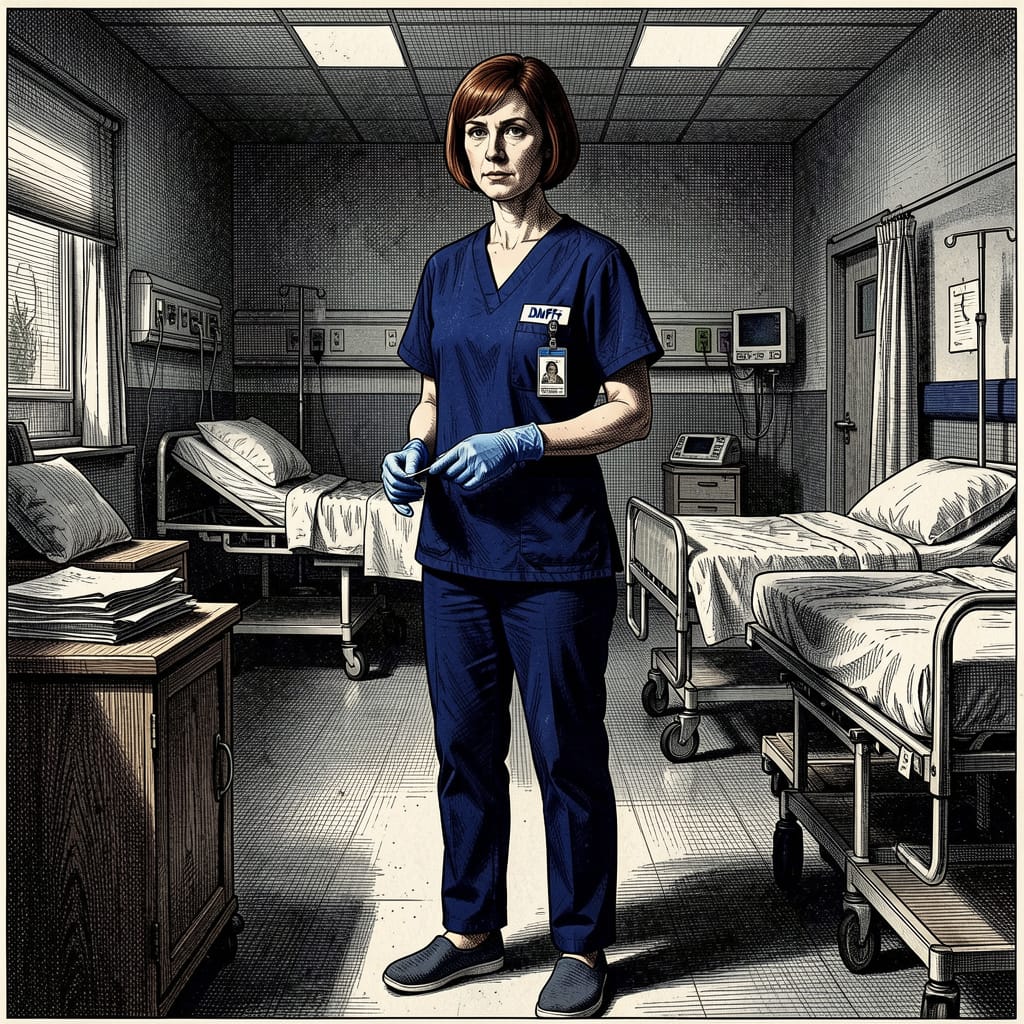
Nurse Duffy attended Robert Knight through the run of his coma at the regional hospital. Tall, spare, her hair cropped close, she moved through the ward in crepe-soled shoes that turned her into something the manuscript describes as a phantom. She measured life in percentages of pulse-ox. She came and went on the schedule of the chart and on no other schedule that the room could read.
In Chapter Forty-Nine: Life on Mars, at 14:20, the door sighs and she steps in. She sets her clipboard at the foot of the bed, scans the monitors, gives a small nod — approval or confirmation, barely moving her features. Her gloved hands work with practised method: pulse, pupils, capillary refill, two fingers pressing to Robert’s neck. She speaks once, firm and even: Can you hear me, Robert? Speech calibrated for the narrow space between life and absence. Her gaze flicks to the monitor. The lines hold steady. She waits. Movement does not come.
Her pen pauses mid-box, then finishes the mark. She straightens the sheets. She brushes a fleck of dried mucus from the corner of his mouth. She collects her chart and eases the door shut. The latch clicks softly. The whole sequence is the work of a woman whose competence has been folded into a bedside manner so quiet it almost passes for absence. The fleck-brush is the giveaway. It is not a clinical action. It is the act of a person who has decided, on her own time and without instruction, that an unconscious child should not be left with anything on his face.