


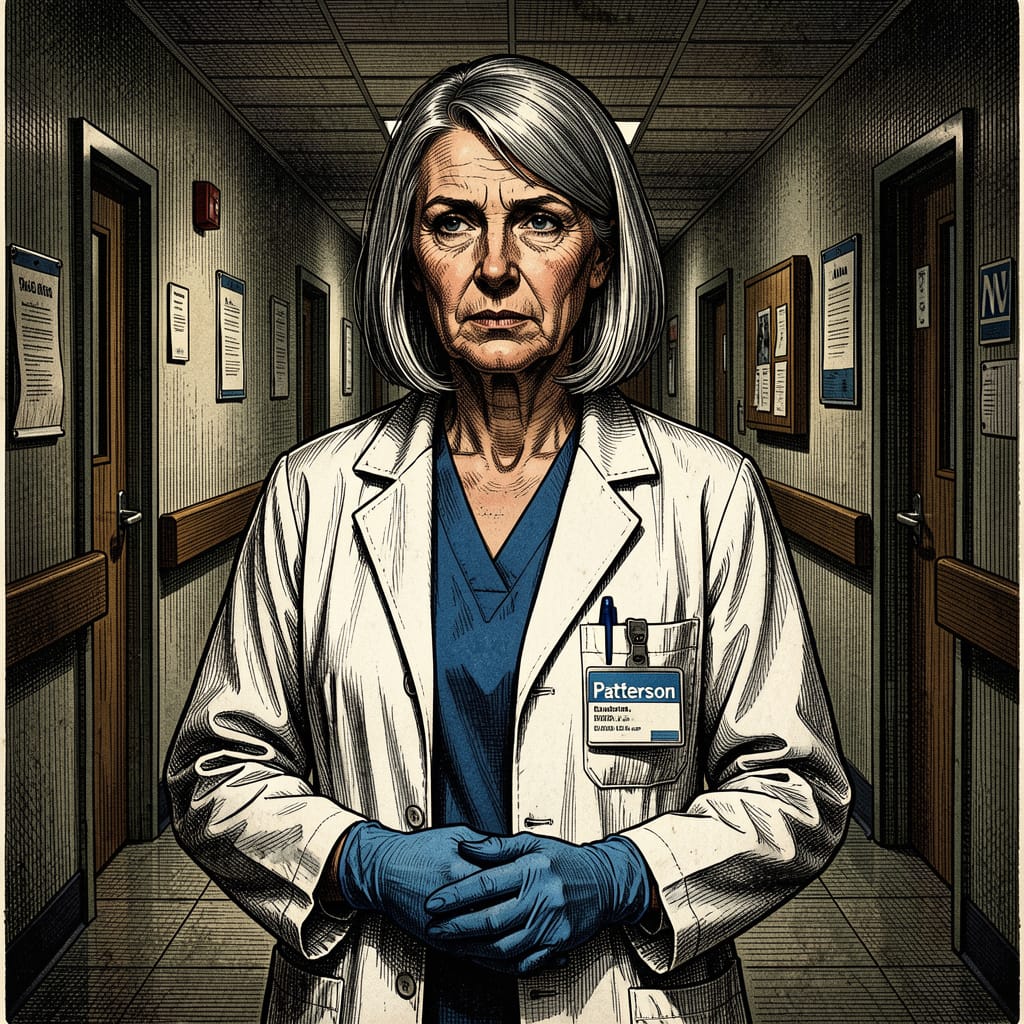
Dr Patterson

Dr Patterson — attending physician

Character Profile
Stories Book of Thoth Saga (Vol. I)
Species Human
Status Active
Occupation Hospital Doctor
Patient on File Robert Knight
First Appearance Cambion, Chapter Forty-Seven: How to Save a Life

Dr Patterson

“There is no neurological cause we can find. Which leaves us with a functional explanation.”


Overview

Dr Patterson is the attending physician who took responsibility for Robert Knight following his collapse. Hair the colour of iron filings, posture cutting a straight line through the cluttered corridor, voice clipped but not unkind, calm in the particular way of doctors who have learned to deliver bad news without rehearsing it. She arrives at the bedside in Chapter Forty-Seven: How to Save a Life, runs every available test, and returns with a verdict that is medically accurate and entirely wrong about what has actually happened.

Her workup is thorough: penlight to the pupils — no reaction — tongue depressor against the gumline, pulse, monitor, EEG, MRI, lumbar puncture, full blood panel. The results give her nothing. No neurological cause. No infection. Nothing scanning could find. Ben’s line, delivered to the room before she returns, is You can’t scan for what this is; he is not addressing her, but he might as well be. When Patterson does come back at six o’clock with her hair flattened and shadows settled deep beneath her eyes, she lifts Robert’s hand and lets it drop. Dead weight. She straightens. She says what she has to say. There is no neurological cause we can find. Which leaves us with a functional explanation. Stress-induced. I have seen it in adolescents before — the mind does this, sometimes, when it cannot process what has happened to it. It is not malingering. Nor is it necessarily permanent.

The diagnosis is the best one available to her. It is also wrong. It rests on a model of what minds and bodies can and cannot do that has no provision for what is in fact happening to Robert. Patterson is not at fault for this. The model is the model. She is delivering, with care, the closest thing the model has to an answer. It could be weeks. It could be longer. She does not say it could be never. She does not say it because she does not believe it. The Knights, she registers without naming the registration, do not look as if they are hearing it for the first time.

Beyond the Scene

Dr Patterson works the kind of hours that have stopped feeling like hours and started feeling like the structure of her life. She qualified in the early 1970s, did her training in a teaching hospital in Sheffield in years when being a woman in medicine still drew comment, and has spent the bulk of her career in the regional system rather than the consultancy track. She is somewhere in her late fifties. The grey came in early and she has not, on the available evidence, ever considered doing anything about it. She lives alone. Her social life fits around her shifts and is, in consequence, less of a social life than she once expected to have. She has made her peace with most of this.

What she is professionally good at, after thirty years of practice, is the controlled delivery of medical bad news to families who are not ready for it, which is most of them. The skill is partly temperamental and partly trained. She has the iron-filing hair and the straight-line posture and the voice tuned to bad news because the alternative, in her job, is to be a worse doctor. She has watched two generations of colleagues fold under the weight of cases where the model breaks and the patient stays broken — and she has decided, without quite framing it as a decision, that her own response will be to keep delivering what the model has and let the rest stand outside the room. The rest stands outside the room often enough that she has stopped noticing it has its own weight.

She has thought about Robert Knight more than she has thought about most of her cases since. The boy’s presentation was a textbook of nothing. Tests clean, pupils unresponsive, body simply absent in a way she could not file under any of the categories thirty years had taught her to recognise. The two uncles were calmly out of their depth in a way that did not quite read as out of their depth. She had attended thousands of families who were rehearsing the wrong grief. The Knights, she came to feel, were rehearsing the right grief and not telling her what it was. She would, on the rare occasions she returned to the case file in her own time, like to know what she had been not told. She has not pursued it. It is not in her remit to pursue.

What she does retain, professionally, is the boy’s file: open, partial, with the diagnosis still functional, stress-induced at the top of it. She has not closed it. She would not, on the available evidence, know how to.


Trivia

  • The diagnostic battery Dr Patterson ran on Robert — EEG, MRI, lumbar puncture, full blood panel — is the standard exhaustion of the medical model. The model exhausts itself and produces a clean negative. The diagnosis that follows, functional, stress-induced, is the place medicine puts patients whose bodies do not behave according to scans. It is medicine’s way of admitting it has no further questions while continuing to look like medicine.
  • Patterson’s second visit to the bedside, at six o’clock, is the moment Ben stops keeping his composure visible to the room. The hour is doctor’s hour: the part of the day when the night-shift consults arrive and the verdicts get delivered. Patterson’s entrance carries that institutional weight. The Knights have been waiting all afternoon for it. She does not enjoy being the bearer.
  • The line It could be weeks. It could be longer is the closest Dr Patterson comes to admitting that the prognosis exceeds what she knows. The longer she does not say is indefinitely. The word she does not say at all is the one that would acknowledge the case is structurally outside her competence: permanently. She will not say it because she does not, looking at the boy, believe it. She is correct not to believe it. She is correct for none of the reasons she would be able to give.

Appearances

Title Role Notes
Cambion
Book One · Book of Thoth Saga
Minor; Medical Authority Appears at Robert Knight’s bedside in Chapter Forty-Seven: How to Save a Life. Conducts the initial neurological examination and orders the diagnostic workup; returns at six o’clock to deliver the functional, stress-induced diagnosis to Ben and Toby. The diagnosis exhausts the medical model without accounting for what has actually happened.