History
Stockport's market itself predates its industries by centuries: a castle stood by 1173 on the site now known as Castle Yard, and the market that grew up in its shadow received its formal charter in 1260, on the same ground the Market Place occupies today. The current Covered Market Hall, an open-sided cast-iron and glass structure nicknamed the ‘glass umbrella’ when it opened in 1861, came close to demolition at the start of the 1980s under a council redevelopment scheme; some thirty thousand residents signed a petition against it, the plan was dropped, and the hall reopened after restoration in 1985.
Stockport's economy in the sixteenth century turned on hemp cultivation and rope-making; by the seventeenth it had become a centre of the hatting trade, and remained one of the country's principal hat-making towns for the better part of three centuries. The eighteenth century brought one of Britain's first mechanised silk factories, and the nineteenth the cotton boom that transformed most of the towns along the Goyt and the Mersey; Friedrich Engels, visiting in the 1840s, called Stockport one of the dingiest, smokiest holes in the industrial north. The hatting and cotton trades declined together through the twentieth century, and the town has since diversified into services, retail and, more recently, a smaller cultural and hospitality quarter around the old Underbanks streets.
The Viaduct & the Buried Town
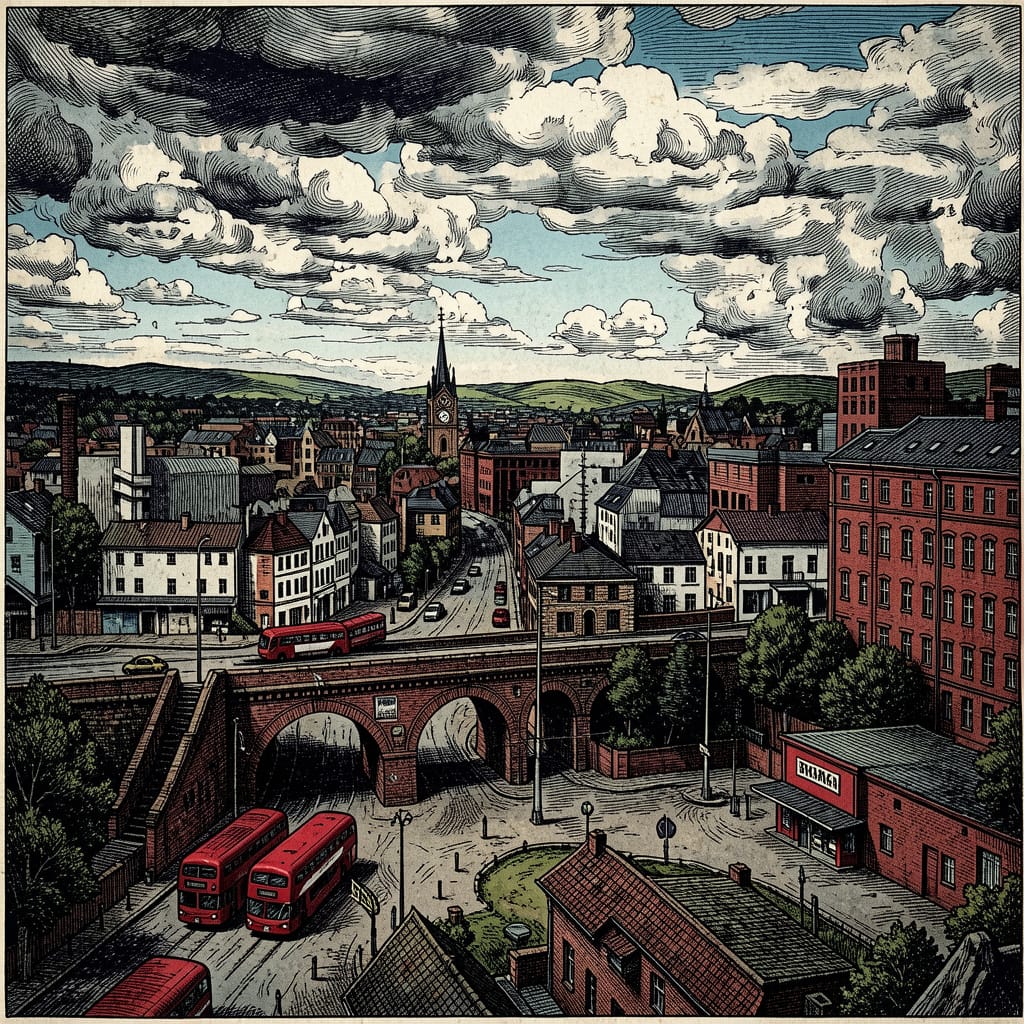
Stockport Viaduct, completed in 1840 to carry the Manchester and Birmingham Railway across the valley, still dominates every westward view of the town centre: 111 feet high, twenty-seven brick arches, and among the largest brick structures in Britain. It was built partly by navvies who sheltered, between shifts, in a set of natural caves at Brinksway on the riverbank — caves that would themselves be expanded a century later into something far larger.
From September 1938, the council cut nearly a mile of tunnels into the sandstone beneath the town centre as public air-raid shelters, in four separate systems; the first opened on 28 October 1939, almost a year before Stockport was actually bombed, on 11 October 1940. The smallest could hold 2,000 people and the largest 3,850; by 1940–41 the whole network had been expanded to accommodate 6,500. One section, nicknamed the ‘Chestergate Hotel’ for its relative comfort, had bunks, lighting and even flushing toilets. The shelters were sealed in 1948 and reopened to the public as a museum in 1996.
The town's buried geography continues into the present day: the Merseyway shopping centre, built in 1965–70, sits directly over the river the town is named for, and the Mersey itself still flows for roughly four hundred metres beneath its floor. Few visitors realise they are walking above running water.
The Hatting Trade & Robinsons Brewery
By 1884 Stockport's hatters were exporting more than six million hats a year, and the trade remained the town's defining industry until the last hat works closed in 1997. Stockport County Football Club is still nicknamed ‘The Hatters’ in its memory, and the Hat Works, housed in a former Victorian mill, is the only museum in the country dedicated to the trade.
Almost as old is Robinsons Brewery, one of Britain's oldest independent family breweries. William Robinson bought the Unicorn Inn on Lower Hillgate from Samuel Hole on 29 September 1838; his son George brewed the first Robinsons ale there in 1849, and his grandson Frederic expanded the business through the 1860s to 1880s into an estate of exclusive tied pubs that has since grown to some 250 across the North West and Wales. Still run by the same family six generations on, the brewery's best-known beers — Unicorn, first brewed in 1896, and Old Tom, in 1899 — remain in production; brewing itself moved from Lower Hillgate to a new plant at Bredbury in 2025, after 187 years on the original site.
Stockport County & Fred Perry
Stockport County traces its history to 1883, when it was founded as Heaton Norris Rovers before adopting its present name in 1890. It has played at Edgeley Park, originally built for a rugby league club in 1891, since 1902, and carries the nickname ‘The Hatters’ from the same trade that gave the town its identity. The club holds an English Football League record it is unlikely ever to lose: a 13–0 win over Halifax Town in 1934. A 1946 cup tie against Doncaster Rovers, tied at 2–2 after normal time and unable to be settled by penalties under the rules of the day, went to extra time without a winning goal and was eventually decided, after 203 minutes of football, by the toss of a coin.
Stockport's most celebrated sporting export, though, played a different game entirely. Fred Perry, born in the Portwood district of the town in 1909, won three consecutive Wimbledon singles titles in 1934, 1935 and 1936, and remained the last British man to win the tournament until Andy Murray, seventy-seven years later. A blue plaque marks his birthplace, and a public footpath through the town, the Fred Perry Way, still carries his name.
Role in the Saga — Cambion spoilers
Covers a formative early scene between Robert and Daniel.
Stockport is never visited in the saga's present-tense narrative; it surfaces only as a memory, in Chapter Thirty: Half the World Away, when a flash of lightning against his bedroom window sends Robert back to something that happened “two days ago” — a reconciliation with Daniel Marsden at what the text calls, simply, the Stockport Arcade: not a documented real venue, but the book's own name for an ordinary amusement arcade in the town.
The two boys had not spoken properly in three months, since an earlier falling-out; Daniel offers a new arcade game as a wordless olive branch — an easy way to be boys again — and leads Robert to a Street Fighter II cabinet. The moment Robert's hand closes on the joystick, a high-pitched whine starts at the base of his skull and the arcade slides out of focus. When he pulls back on the stick to block a move, the plastic snaps — not from force, but from a sudden electrical discharge that warps the screen, blows the marquee light, and sends the machine into fault, vomiting its entire coin store across the carpet in a bright, uncontrolled cascade.
An attendant starts toward them; Daniel grabs Robert's arm and they run. Outside, he settles on the cover story before Robert can even try to explain: “Surge. Dodgy wiring. I saw static jump, that's all… If Ben hears about this, or Toby… just forget it happened, yeah?” When Robert tries to admit the truth — “I didn't mean to” — Daniel's answer closes the subject for good: “I know. Because you didn't do anything.”
The memory returns to Robert in his bedroom two days later, triggered by nothing more than a lightning flash on the window glass, and the recollection of the arcade's violence bleeds directly into the present: the storm outside, the gold spreading through his own reflected eyes, and the crash of a chair as he startles at his own desk. The Stockport scene is the saga's first clear demonstration that Daniel will actively cover for Robert rather than report him — a private complicity that predates, and quietly shapes, everything Daniel investigates about him later in the book.
Trivia
- The Brinksway caves that sheltered the Viaduct's navvies in the 1830s were expanded a century later into part of the WWII shelter network — the same sandstone doing the same job twice, a hundred years apart.
- The name Merseyway is taken from a 1930s road that itself ran above the river before the shopping centre was built over it in 1970.
- Robinsons' collaboration beer, Trooper, is brewed with Iron Maiden frontman Bruce Dickinson — a small, incongruous footnote for a brewery whose flagship ale, Unicorn, has been in continuous production since 1896.
- The last of Stockport's hat factories closed in 1997 — the same year in which, elsewhere in the saga's timeline, the ‘three weekends, three trips’ excursions to Blackpool, Alton Towers and Twycross Zoo take place, though the two events are otherwise unconnected.
Appearances