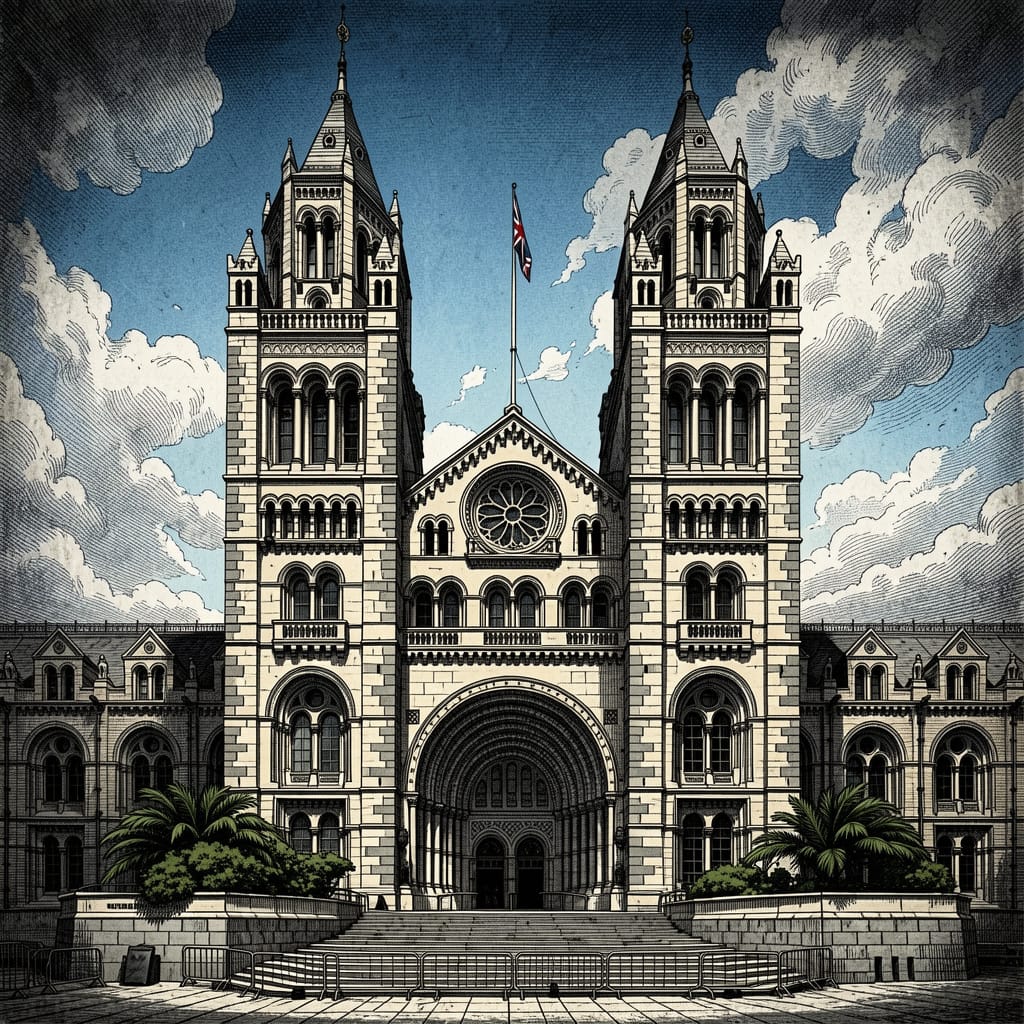
Natural History Museum

The Natural History Museum, South Kensington, London

Location Profile
Type Natural history museum
Location South Kensington, London
Opened 1881
Architect Alfred Waterhouse
Founder Sir Richard Owen
First Appearance Cambion, Chapter Thirty-Five: Where Wild Roses Grow

Natural History Museum

Natural history museum in South Kensington, London.


Overview

The Natural History Museum in South Kensington houses one of the world's great collections of life and earth sciences specimens, from dinosaur skeletons to a mineral collection numbering in the tens of thousands. Its founder, the anatomist Sir Richard Owen, conceived of it as a ‘cathedral to nature’ — a building grand enough to match the wonder of what it held, and, unusually for its era, free to enter for anyone who walked through the door.

The building itself, designed by the architect Alfred Waterhouse and opened in 1881, is as much a part of the museum's reputation as anything inside it: a vast, cathedral-like Romanesque Revival structure in warm terracotta, its facades carved from top to bottom with sculpted animals and plants.


Geography & Atmosphere

The museum sits on Cromwell Road in South Kensington, part of the cluster of major museums — alongside the Victoria and Albert Museum and the Science Museum — built on land bought with the profits of the Great Exhibition of 1851. Its entrance hall, Hintze Hall, was deliberately designed to overwhelm on arrival: a soaring nave-like space beneath an ornately painted botanical ceiling, arched galleries running off in every direction, the whole effect closer to walking into a cathedral than a museum.

Owen dictated the building's exterior ornamentation with the same precision as its collections: the east wing's stonework depicts extinct creatures — dinosaurs, ichthyosaurs, ancient plants — while the west wing carries living species, so that the building itself tells the story of deep time before a visitor has stepped inside it.

History

The museum exists because the British Museum's natural history collections — swollen by specimens brought back from across the British Empire, including material gathered by Charles Darwin himself — had outgrown their space in Bloomsbury by the mid-nineteenth century. Owen, the museum's first superintendent, insisted the new building be free to all visitors, a genuinely radical position at a time when most museums charged an entrance fee and catered mainly to the wealthy. The museum opened its doors on the current South Kensington site in 1881.


Dippy & the Geological Collections

For over a century, the museum's most famous resident was ‘Dippy’, a cast of a Diplodocus carnegii skeleton gifted by the American industrialist Andrew Carnegie in 1905 — the first Diplodocus skeleton ever put on public display anywhere in the world. Dippy dominated the central hall from the 1970s until 2017, when the skeleton was retired to a touring exhibition and replaced by the skeleton of a blue whale, nicknamed ‘Hope’; throughout the 1990s, then, it was still Dippy's long neck and tail that greeted every visitor walking in from Cromwell Road. A statue of Charles Darwin looks down over the same hall from a staircase landing, a fixture of Hintze Hall since long before Dippy or Hope occupied the floor beneath it.

The Mammal Hall, meanwhile, has held its own giant since 1938: a life-sized model of a blue whale, some 28 metres long, built from a wooden frame, wire mesh and plaster and weighing six or seven tonnes once finished. It has hung there, essentially unchanged, for the better part of ninety years, and long predates ‘Hope’ the whale skeleton by nearly eighty years; workmen who built it are said to have used a maintenance trapdoor in its belly as a secret smoking spot, and persistent museum rumour holds that a telephone directory and a handful of coins were sealed inside before the trapdoor was closed for good.

In 1985 the museum absorbed the neighbouring Geological Museum, run by the British Geological Survey, along with its collection of more than 30,000 minerals — the origin of the museum's mineral and earth-sciences galleries as they exist today. It is this collection, tucked away from the dinosaur halls that draw the largest crowds, that the saga's own ‘rocks room’ refers to: rank upon rank of glass cases holding stone and crystal, considerably quieter than Hintze Hall, and considerably easier to feel alone in even at the busiest times of year.


Role in the Saga — Cambion spoilers Covers a major manifestation and the training that precedes it.

The museum trip in Chapter Thirty-Five: Where Wild Roses Grow is the reward at the end of a fortnight's desperate work. After a manifestation bad enough to leave Robert feverish and unable to stand, Toby and Ben decide against isolating him further and instead spend fourteen days deliberately exposing him to controlled noise and contact — a detuned radio turned to static while he reads aloud, page by page, until the words stop swimming; hallway drills in which Ben shoulder-barges him on purpose until he can absorb the shock without cracking a photo frame's glass. The training culminates in a test with his late grandmother's bone china teacup — “If you can keep that safe, maybe you can keep yourself safe on a train” — which Robert passes, hands steady, not a drop spilled. On the strength of that one quiet moment, his uncles agree to the trip he has wanted for weeks, ever since a Natural History Museum leaflet went up on the kitchen noticeboard: a day in London, “big, loud, ugly, full of dead things behind glass.”

It goes wrong in the mineral galleries. Standing alone in front of a single stone in the ‘rocks room’, Robert feels the noise of the room spike, too bright and too loud all at once; a display stand tips, three glass rods sliding free and clattering to the floor, in full view of a woman standing nearby. That night, using a walkie-talkie link to Daniel Marsden, Robert confesses what happened, insisting his eyes went gold and that “something wanted to come out”; Daniel, unconvinced but wary of the unsecured line, shuts the conversation down with the family's established code phrase before Robert can say more.

What Robert never learns is what his uncles do afterwards: the witness's dropped wallet leads them, that same night, to her home in Luton, where they take considerably more drastic steps to ensure her silence. The museum incident becomes, in Declan Marsden's later phrasing, the thing that finally gives him leverage he did not have before — “not after what Robert did at the museum” — tightening a blackmail arrangement with Ben that reshapes much of the rest of the book.


Trivia

  • Dippy's cast is not, and has never been, a real fossil — it is a plaster-of-Paris replica, commissioned specifically as a gift, and its enormous popularity helped inspire replica casts of the same skeleton to be sent to museums around the world.
  • Owen's insistence on free admission for the Natural History Museum was, in its day, a genuinely contested position; many contemporaries believed a museum of this scale and cost should charge visitors to help offset its upkeep.
  • The museum's exterior carvings are arranged by design rather than accident: extinct creatures on the east wing, living ones on the west, so that the building itself narrates the history of life before a single gallery is entered.

Appearances

Title Role Notes
Cambion
Book One · Book of Thoth Saga
Manifestation setting The setting of the manifestation in Chapter Thirty-Five: Where Wild Roses Grow, the direct cause of the events at Luton that same night.