History
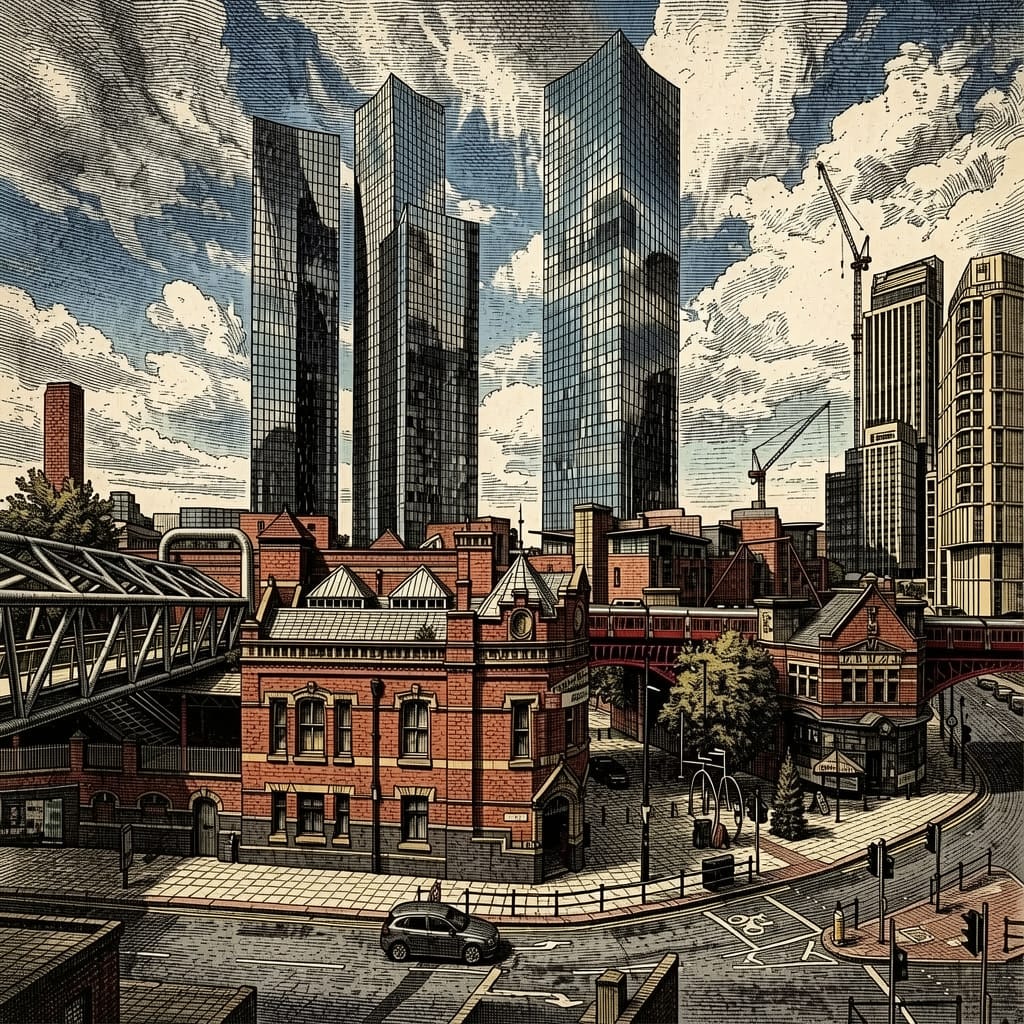
A Roman fort named Mamucium was established around AD 79 on a defensible bluff above the Irwell, in what is now the Castlefield area, garrisoning auxiliary troops guarding the road network of the north-west; a reconstructed section of its walls and gateway still stands, a Scheduled Ancient Monument in the middle of the modern city. After the Romans withdrew, the site persisted as the Anglo-Saxon settlement of Mameceaster, and by the thirteenth century had grown into a modest manorial market town, granted its first town charter in 1301. Chetham's Library, founded in 1653, is the oldest public library in the English-speaking world, and still operates from its original building today.
Cottonopolis & the Ship Canal
Manchester's transformation began with the Bridgewater Canal, opened in 1761 to move coal cheaply into the town and generally credited with launching the entire canal age in Britain. Richard Arkwright opened one of the first steam-powered cotton mills in the country here in 1781, and over the following decades the town's access to coal, its canal and later rail links to the port of Liverpool, and a booming supply of cheap labour turned it into the world centre of cotton processing — a reputation that earned it the nickname ‘Cottonopolis’. City status followed in 1853, official recognition of a place that had, by then, been the most industrially significant town on earth for the best part of a century.
Manchester's appetite for direct trade outgrew even Liverpool's port eventually: the Manchester Ship Canal, opened in 1894, ran 36 miles from the city to the Mersey estuary, allowing ocean-going ships to dock in Manchester itself and making it, briefly, one of the busiest inland ports in the country.
Peterloo & Radical Manchester
Manchester's industrial growth ran alongside a long radical political tradition. On 16 August 1819, a peaceful rally of some 60,000 people demanding parliamentary reform at St Peter's Field was broken up by a cavalry charge that killed at least fifteen people and injured several hundred more — the Peterloo Massacre, still one of the defining atrocities in the history of British democracy. The city went on to become a centre of the Chartist movement through the 1830s and 1840s, home to the Anti-Corn Law League founded in 1838, and host, later in the century, to the first Trades Union Congress.
The Christmas Blitz
As an inland port and major centre of war production — the nearby Trafford Park industrial estate, in the shadow of the football ground of the same name, was among the most important manufacturing sites in the country — Manchester was a deliberate Luftwaffe target throughout the Second World War. The worst of it came on two consecutive nights, 22–24 December 1940, remembered locally as the Christmas Blitz: nearly 450 bombers dropped almost 500 tonnes of explosives and close to 2,000 incendiaries, killing an estimated 684 people, injuring over 2,000 more, and leaving some 8,000 homes uninhabitable. Manchester Cathedral was struck by a parachute mine, the Free Trade Hall was badly damaged, and both main railway stations and the bus station were put out of action, cutting the city off from itself in the days immediately following.
A City of Firsts
Manchester's habit of being first at things did not end with cotton and canals. Emmeline Pankhurst, born in the city's Moss Side district in 1858, founded the Women's Social and Political Union — the organisation that gave the world the word ‘suffragette’ — at her home on Nelson Street in 1903; the house survives today as the Pankhurst Centre. In 1917, at the University of Manchester, the physicist Ernest Rutherford became the first person to split the atom, a discovery that eventually made possible both nuclear power and radiotherapy; almost a century later, in 2010, two more University of Manchester physicists, Andre Geim and Konstantin Novoselov, won the Nobel Prize for isolating graphene, the world's thinnest known material.
Even football's modern structure has a Manchester origin: the world's first professional football league was founded at a meeting in the city's Royal Hotel in 1888, laying the groundwork for the same sport that now brings tens of thousands of people to Old Trafford every fortnight.
A Musical City
Manchester's modern musical reputation is often traced to a single evening: the Sex Pistols' gig at the Lesser Free Trade Hall on 4 June 1976, played to a small crowd that reportedly included future members of Joy Division, the Smiths and Simply Red, along with the broadcaster Tony Wilson. Wilson went on to found Factory Records, whose roster — Joy Division, New Order, the Happy Mondays — and whose nightclub, the Haçienda, open from 1982 to 1997, became the twin engines of the late-1980s scene that came to be known as ‘Madchester’: a distinctive fusion of indie guitar music and the acid house sound arriving from elsewhere, embodied above all by the Stone Roses.
The Britpop era that followed produced Manchester's biggest musical export yet: Oasis, formed in the Burnage area of the city by brothers Noel and Liam Gallagher, whose 1994 debut album became the fastest-selling in British history at the time. The Haçienda itself closed in 1997 and has since been converted into flats, though a plaque and a pair of the club's original bollards still mark the site on Whitworth Street West.
The 1996 Bombing
On 15 June 1996, the Provisional IRA detonated a lorry bomb outside the Arndale shopping centre in the heart of the city, having given a telephoned warning some ninety minutes beforehand that allowed police to clear the immediate area. At an estimated 1,500 kilograms, it remains the largest bomb detonated in Britain since the Second World War; the blast injured 212 people but killed no one, largely thanks to that warning and the evacuation it triggered. The explosion devastated the city centre, causing damage estimated at around £700 million and destroying or badly damaging a wide swathe of Victorian and modern buildings alike — among them, a nearby postbox that survived the blast almost entirely intact, later adopted as an informal symbol of the city's resilience.
Rather than simply rebuild what had been lost, the city used the bombing as the catalyst for a decade-long regeneration of its entire centre, reshaping streets, retail space and public squares on a scale that peacetime redevelopment alone would never have justified. The bomb went off partway through Euro '96, which England was hosting at the time, with roughly two weeks of the tournament still to play; a scheduled fixture at Old Trafford went ahead the very next day regardless, and that specific, compressed timeframe — bombing one night, football the next — forms the real-world backdrop to one of the saga's own most significant scenes.
Role in the Saga — Cambion spoilers
Covers several scattered background references.
Manchester never becomes a scene in its own right in Cambion — with one major exception, at Old Trafford, which has its own page — and instead recurs throughout as the professional, institutional city sitting just off the edge of the story's much smaller stage. Mick Hargreaves identifies a static relay near Edale Cross positioned to bounce a signal to the city — listening, not talking — and Declan Marsden reflects that somewhere in Manchester, handlers from opposing organisations are quietly comparing notes across the same case.
The city surfaces again in the paper trails both Declan and, later, Daniel Marsden assemble on the recurring pattern of ‘Ignition’ incidents tied to the Seven: a 1918 newspaper clipping headlined BANKER'S SUICIDE SHOCKS CITY (Manchester, 1918), and a separate, more clinical incident record for Manchester, Ardwick Green, noting multiple fatalities and houses marked with crosses. Neither is explained on the page; both take their place among a wider set of historical incidents the saga uses to suggest the same pattern recurring, quietly, for centuries.
Later, when Robert searches the word Beowulf from the library in Chapel-en-le-Frith, one of the ordinary, unhelpful results the search briefly returns, before the page resolves into the saga's central warning, is a mundane security firm based in Manchester — the ordinary noise the real answer is hiding inside. The city is also simply where journeys pass through: the train that carries Robert, Toby and Ben toward Blackpool changes here, a few minutes of tinny announcements and hissing doors between one destination and the next.
Trivia
- The University of Manchester built Baby in 1948, the world's first stored-program computer — a direct ancestor, however distant, of the search engines and databases the saga's characters spend so much of the book quietly afraid of.
- The John Rylands Library on Deansgate, a neo-Gothic memorial built by Enriqueta Rylands for her late husband and opened in 1900, looks from the outside more like a cathedral than a library — and was, fittingly, one of the first buildings in the city to be lit by electricity.
- Manchester's modern tram network, the Metrolink, opened in 1992 — the first British city to bring trams back after the old Victorian and Edwardian networks had been ripped out across the country in the mid-twentieth century.
Appearances