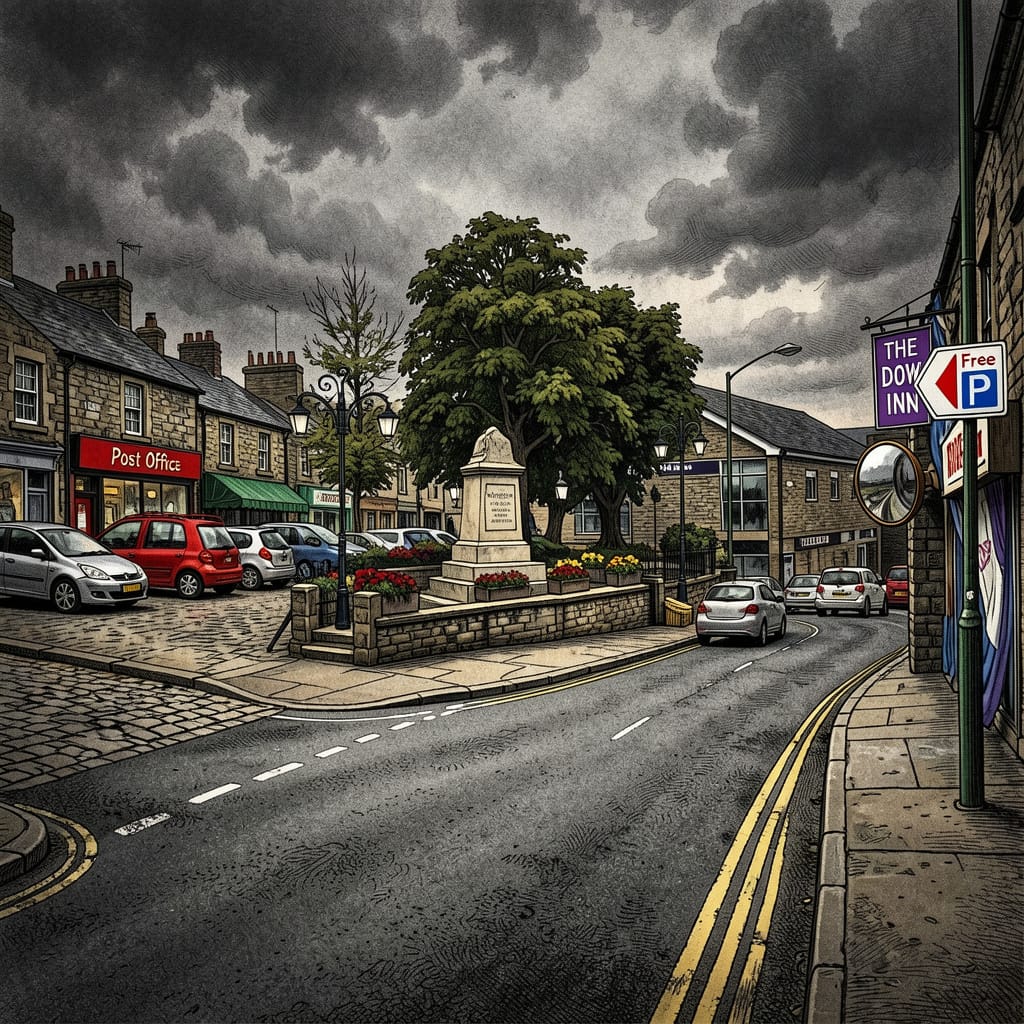
Chapel-en-le-Frith is one of the towns Toby takes Robert to for the “educational outings” that make up his home schooling — ordinary enough that Daniel Marsden, wanting somewhere he won't risk running into them, avoids it and takes three buses to Marple instead.
It is to the Chapel-en-le-Frith library, in Chapter Forty-Three: Torn, that Robert comes alone, some days after learning what he brought down on Shoreham Haven Hospital. The library is one long room above the market square, three computers along the far wall, a section of local history nobody ever quite adds to, warm with the stifling heat of wall-mounted heaters working too hard. Through the window the market square goes on beneath him — the post office, the Co-op, a handwritten sign about biosecurity on the butcher's door, a farmer's Land Rover parked on the double yellows — entirely unaware of what he is trying to find out.
The dial-up connects with its usual racket. He reads restrained newspaper accounts of the Great Storm of October 1987 — his own birthday, the night the south of England was battered and soaked. The hospital itself proves harder: Shoreham General in one record, ‘St Bernard's’ in another, no name that belongs anywhere, no obituary or death notice for Christine Knight. A search for Beowulf resolves, after nearly two minutes, to a blank white page reading only This query has been logged. Outside, the news is full of foot-and-mouth — fields ringed with KEEP OUT signs, pyres working through the nights beyond the village — and Robert thinks that whatever Beowulf is, it keeps itself clean the same way: by burning, by sealing off, by making sure nothing crosses a perimeter that isn't meant to be crossed.
He tries Shoreham Haven directly. The machine freezes, whines, and answers:
QUERY LOGGED. IP TRACED. DO NOT PROCEED.
— on-screen response to a search, Cambion, Chapter Forty-Three.
He switches tack, searching for hybrid supernatural beings, and finds a scanned academic abstract, its author redacted, describing entities that belong to no taxonomy — violations of natural order, the paper says, “often referred to in archaic texts as ‘abominations’ due to their boundary-crossing nature.” It is the first time the word has reached him from outside his own head. Later that session, an aerial photograph resolves on the screen: a broad building, a white corridor running its spine, numbered doors, and at the far end not darkness but absence. He tries to print it; the printer produces only static, then, for one frame, the same corridor viewed head-on. That night, the image returns to the small television in his bedroom — the same white corridor, and a woman in a white coat walking towards the camera with his mother's jaw and someone else's eyes, smiling directly at him before the screen dies to static and then black.
The library scene is the hinge between what Robert has felt and what he can name. He leaves Chapel-en-le-Frith with a word he did not have before he arrived, and does not tell anyone what he saw on the screen that night.
The word does not stay confined to that afternoon. Later still, in Chapter Fifty: Yesterday, Robert finds a notebook of his own from this period, titled What I Know For Certain, and does not remember writing it. Inside, copied out by hand, are the same fragments this library gave him — QUERY LOGGED. IP TRACED. DO NOT PROCEED — and, written once, large: abomination, followed by the definition transcribed in full, and beneath it, in smaller writing: not what it is. what they call it. Whatever drove the hand that filled those pages is, by then, simply gone; Robert closes the notebook, unread past that point, and drops it in the bin along with the rest of the stack. The word he first met above the market square outlives the urgency that found it.